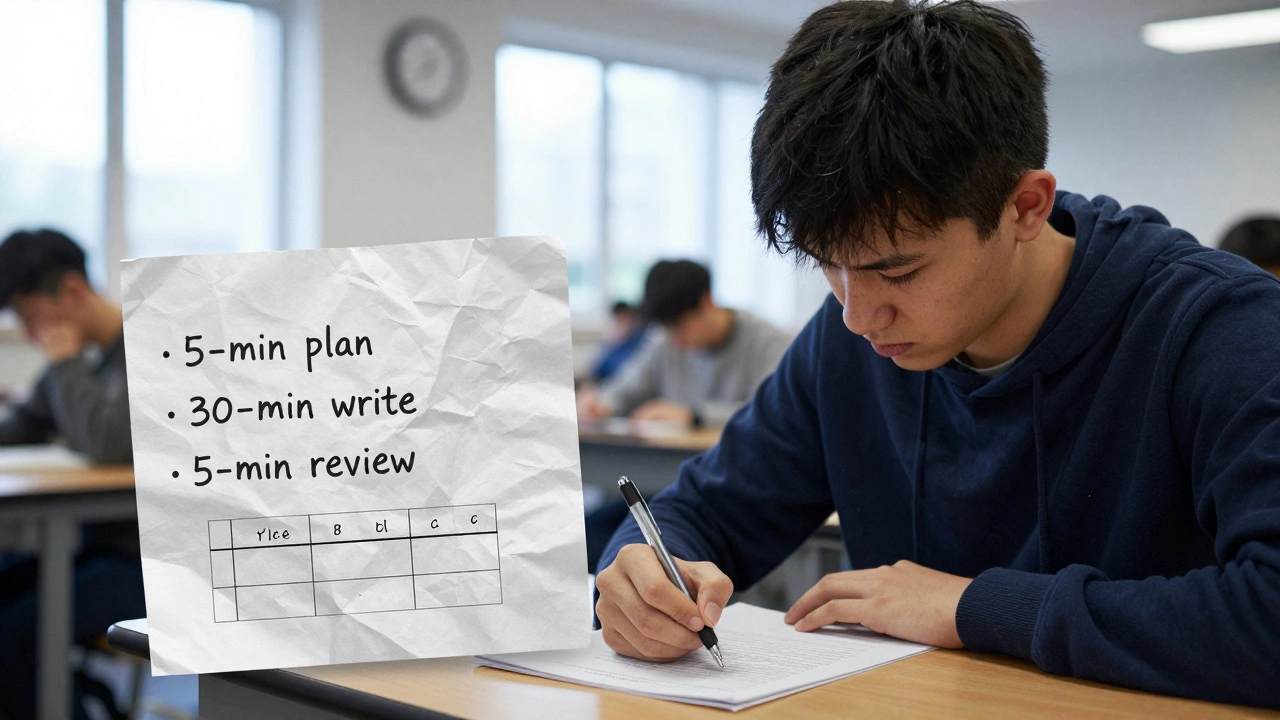
Think about the last time you had to write an essay in under an hour. Your heart was pounding. Your pen was moving faster than your thoughts. And somewhere in the back of your mind, you were counting down the minutes until the bell rang. If that sounds familiar, you’re not alone. Every year, tens of thousands of UK students sit for GCSEs, A-levels, and university entrance exams where writing under pressure isn’t optional-it’s the rule.
Here’s the truth no one tells you: the best writers aren’t the ones who write the most beautiful sentences. They’re the ones who know how to think fast, organize quickly, and stick to a plan-even when their hands are shaking. This isn’t about being a genius. It’s about having a system.
Why Timed Essays Feel Impossible
Most students panic during timed essays because they treat them like free-writing exercises. They start with a blank page and hope inspiration strikes. It rarely does. Instead, your brain gets stuck in a loop: What do I write? Is this good enough? Do I have time to fix this?
Research from the University of Cambridge’s Assessment Research Group found that students who used a structured 5-step method during exams scored 27% higher on average than those who wrote spontaneously. Why? Because structure reduces cognitive load. When you know exactly what to do next, your brain stops panicking and starts writing.
Let’s break down what actually happens in your head during a 45-minute essay. You’re juggling:
- Understanding the question
- Recalling evidence
- Organizing ideas
- Writing clearly
- Managing time
That’s five tasks at once. No wonder you feel overwhelmed. The fix? Turn those five tasks into a sequence. One after the other. No multitasking. No guessing.
The 5-Minute Planning Rule
Stop writing immediately after reading the question. Seriously. Put your pen down. Take five minutes. Use them like gold.
Here’s what to do in those five minutes:
- Underline the command word. Is it ‘evaluate’, ‘discuss’, ‘analyse’, or ‘compare’? Each one demands a different approach. ‘Evaluate’ means weigh pros and cons. ‘Analyse’ means break it into parts. If you miss this, your whole essay goes off-track.
- Write the question in your own words. Rewrite it at the top of your page. This forces you to understand it, not just read it.
- Brainstorm 3-5 key points. Don’t write full sentences. Just keywords: ‘Industrial Revolution’, ‘child labour’, ‘factory laws’. You’re not writing an essay-you’re planting seeds.
- Order your points by strength. Put your strongest argument first. Your weakest in the middle. Save your second-strongest for last. This creates momentum.
- Assign time per paragraph. If you have 40 minutes left and 3 body paragraphs, give each 10 minutes. Leave 5 minutes for intro and conclusion, 5 minutes to review.
This isn’t just advice. It’s a habit. Students who do this every time they practice-whether for homework or mock exams-see a dramatic drop in anxiety and a rise in clarity. The five minutes feel like a luxury. They’re actually your lifeline.
How to Write a Strong Introduction (Without Wasting Time)
Most students write their introduction first. That’s backwards. You don’t know what you’re arguing until you’ve sketched your points. So skip the polished intro.
Instead, use this formula:
1 sentence = Answer the question. Don’t be vague. If the question is ‘To what extent was the Treaty of Versailles responsible for WWII?’, your answer should be: ‘The Treaty of Versailles was a major factor in causing WWII because it humiliated Germany, crippled its economy, and fueled nationalist resentment.’
1 sentence = Roadmap. ‘This essay will examine the economic impact, political consequences, and social unrest that followed.’
That’s it. Two sentences. No fluff. No quotes. No fancy vocabulary. Just clarity. Save the elegance for later. Right now, you need direction.
Body Paragraphs: The One-Point Rule
Every paragraph must make one point. One. Not two. Not three.
Use this simple structure for every body paragraph:
- Topic sentence: State the point. ‘One major consequence of the Treaty was the collapse of Germany’s economy.’
- Evidence: Give one specific fact or quote. ‘Hyperinflation in 1923 saw the mark lose 99% of its value, making basic goods unaffordable.’
- Analysis: Explain why it matters. ‘This didn’t just hurt families-it destroyed trust in the Weimar government, making radical alternatives like the Nazis seem like the only solution.’
- Link: Connect to the next point. ‘This economic chaos also fueled political instability, which led to…’
That’s 4 sentences. Takes 8-10 minutes. You don’t need more. Don’t try to cram in five examples. One strong one with deep analysis beats three shallow ones every time.
Time Management: The 10-30-5 Rule
Here’s how to split your time in a 45-minute essay:
- 5 minutes: Planning (as above)
- 30 minutes: Writing (3 paragraphs at 10 minutes each)
- 5 minutes: Review and polish
- 5 minutes: Buffer (if you finish early, use it here)
That’s it. No more. No less.
Why not write longer? Because when you run out of time, you don’t get points for half-finished ideas. You get points for complete, clear arguments. Even if you only write two strong paragraphs with perfect structure, you’ll score higher than someone who wrote four messy ones.

What to Do When You Blank Out
It happens. You’re halfway through, and suddenly-nothing. Your mind goes blank. Your pen stops. Your breath gets shallow.
Don’t panic. Do this:
- Stop writing.
- Close your eyes for 5 seconds.
- Take one slow breath in. Count to three. Breathe out. Count to five.
- Look back at your plan. What was your next point?
- Write the topic sentence. Even if it’s rough. Just get it down.
That’s it. You’re not trying to be brilliant. You’re trying to stay on track. The rest will follow.
Practice Like You’re Taking the Exam
Most students practice essays by writing them at home-no timer, no pressure, no rules. That’s not practice. That’s rehearsal.
Real practice means simulating the exam:
- Set a timer for the exact time you’ll have.
- Use the same paper and pen.
- Don’t look up facts. Write from memory.
- Afterward, grade yourself using the official mark scheme.
Do this once a week for four weeks before your exam. You’ll notice three things:
- You’ll stop panicking.
- You’ll finish on time.
- You’ll start enjoying the process.
Why? Because you’ve trained your brain to handle the pressure. You’ve turned chaos into routine.
Final Tip: Don’t Chase Perfection
The biggest mistake students make is trying to write perfect essays. They rewrite sentences. They delete paragraphs. They waste time polishing words that won’t change the grade.
Examiners aren’t looking for literary genius. They’re looking for:
- Clear understanding of the question
- Relevant evidence
- Logical structure
- Time management
They don’t care if your sentence is beautiful. They care if it makes sense. If it answers the question. If it shows you know the topic.
Write clearly. Write fully. Write on time. That’s enough.
What if I don’t have time to plan?
Planning isn’t optional-it’s the difference between passing and failing. Even if you only have 2 minutes, write down your answer to the question, list two key points, and note the order. That’s enough to keep you on track. Skipping planning leads to rambling, repetition, and lost marks.
Can I use bullet points in my essay?
No. Exams require full, connected prose. Bullet points are not accepted in UK exam essays. Use full sentences with clear transitions. If you need to organize your thoughts, use bullet points only in your planning stage-never in the final answer.
How many paragraphs should I write?
Aim for 4-5 paragraphs: introduction, 3 body paragraphs, and a conclusion. If the question is complex (like ‘Evaluate’), you can do 5 paragraphs. But never write more than 5 unless you have extra time. More paragraphs don’t mean more marks-clarity does.
Should I memorise quotes for exams?
Memorising quotes is risky. If you misremember them, you lose credibility. Instead, focus on understanding key ideas and being able to explain them in your own words. You’ll score higher by accurately analysing a concept than by forcing in a half-remembered quote.
What if I finish early?
Use the extra time to check: Did I answer the question? Are my paragraphs focused? Is my spelling and grammar clear? Read your essay aloud in your head. If a sentence sounds awkward, fix it. Don’t rewrite-it’s too late for major changes. Just polish.