
Choosing between a vocational degree and an academic degree in the UK isn’t about picking the "better" option-it’s about picking the one that matches your goals, your way of learning, and the life you want to build. Too many students feel pressured to go to university because it’s what everyone expects. But the truth is, thousands of people in the UK are thriving without a traditional bachelor’s degree-and they’re not outliers. They’re the new normal.
What’s the real difference?
An academic degree-like a BA in History or a BSc in Physics-is built around theory, research, and critical thinking. You’ll spend time reading books, writing essays, debating ideas, and sitting exams. These programs are designed to prepare you for further study or roles that demand deep analytical skills.
A vocational degree-think HNDs, Foundation Degrees, or T Levels-is built around doing. You learn by doing real tasks in real settings. A vocational course in nursing doesn’t just teach you anatomy-it has you shadowing nurses in hospitals. A construction management T Level gets you on site with builders, using the same tools and software as professionals.
The difference isn’t just in the classroom. It’s in the outcome. Academic degrees open doors to postgraduate study and research-heavy careers. Vocational degrees open doors to jobs-right after graduation.
Who picks what-and why?
Let’s look at two real paths.
Emma, 18, from Manchester, got A-levels in Biology and Chemistry. She wanted to be a doctor. She went to university, studied Biomedical Science, and is now in her third year. She’ll need a master’s and years of training before she can practice. Her path is long, but it’s the only one that leads to her goal.
Jamal, also 18, from Birmingham, didn’t like sitting in lectures. He loved fixing things. He chose a Level 4 HND in Electrical Engineering at a local college. He spent half his time in labs, half on placements with local firms. By age 20, he was working full-time as a maintenance engineer with a starting salary of £32,000. No debt. No waiting.
Emma’s path is academic. Jamal’s is vocational. Neither is wrong. One isn’t "easier" than the other. They’re just different tools for different jobs.
Cost matters-big time
UK university tuition fees for home students are £9,250 per year. Add living costs, and a three-year degree can easily cost £40,000-£50,000. Most students graduate with £45,000-£50,000 in debt. Repayments start when you earn over £25,000, and they’re 9% of everything above that. The debt doesn’t disappear-it just fades after 30 years.
Vocational courses? They’re cheaper. A Level 4 HND costs around £6,000-£8,000 total. T Levels are government-funded and often free for 16-19-year-olds. Many include paid work placements. You graduate with skills, experience, and little to no debt.
That’s not a small thing. A 22-year-old with £50,000 in debt can’t afford to take a low-paying job in the arts or social work. A 20-year-old with £5,000 in debt can.
Employment rates don’t lie
In 2024, the UK government reported that 92% of T Level graduates were in work, further study, or training within six months. For university graduates, the figure was 81%.
Why the gap? Because vocational courses are built with employers. Colleges don’t just guess what skills are needed-they ask companies directly. The construction industry needed more electricians with BIM software skills? Colleges added it to the curriculum. The NHS needed more healthcare assistants trained in digital records? That’s now part of the Level 3 Health course.
Academic degrees? They’re still valuable-but the job market doesn’t always wait for you to graduate. A philosophy graduate might spend months applying for entry-level roles that don’t require a degree at all.

What jobs actually need each type?
Here’s a simple breakdown:
- Need an academic degree? Doctor, lawyer, architect, university professor, research scientist, chartered accountant, psychologist.
- Need a vocational degree? Electrician, plumber, nurse, paramedic, dental hygienist, IT support technician, civil engineering technician, early years educator, web developer (via coding bootcamps or T Levels).
Some roles accept both. For example, you can become a teacher with a BA in Education-or with a Level 5 Diploma in Education and Training. The end result is the same: you’re qualified to teach. But the path? Totally different.
Can you switch later?
Yes. And many people do.
James did a Level 3 Business Administration course at 17. He worked in admin for two years. Then he used his experience and qualifications to get into university for a Business Management degree. He graduated at 22 with work experience already on his CV.
Lisa got a BA in English Literature. After three years, she realized she didn’t want to write for publishers. She took a part-time Level 4 course in Digital Marketing while working. Now she runs her own social media agency.
The UK system lets you move between paths. Vocational doesn’t mean you’re stuck. Academic doesn’t mean you’re locked in. You can start one way and pivot later.
What if you’re unsure?
Start with a foundation. Many colleges offer Level 3 courses that give you a taste of both worlds. A Level 3 Extended Diploma in Engineering? You’ll touch robotics, CAD design, and theory. A Level 3 Applied Science course? You’ll do lab work and write research briefs.
These are perfect for people who aren’t sure yet. They’re cheaper than university. You can apply for student finance. And if you decide to go to university later, many Level 3 diplomas give you UCAS points equivalent to A-levels.
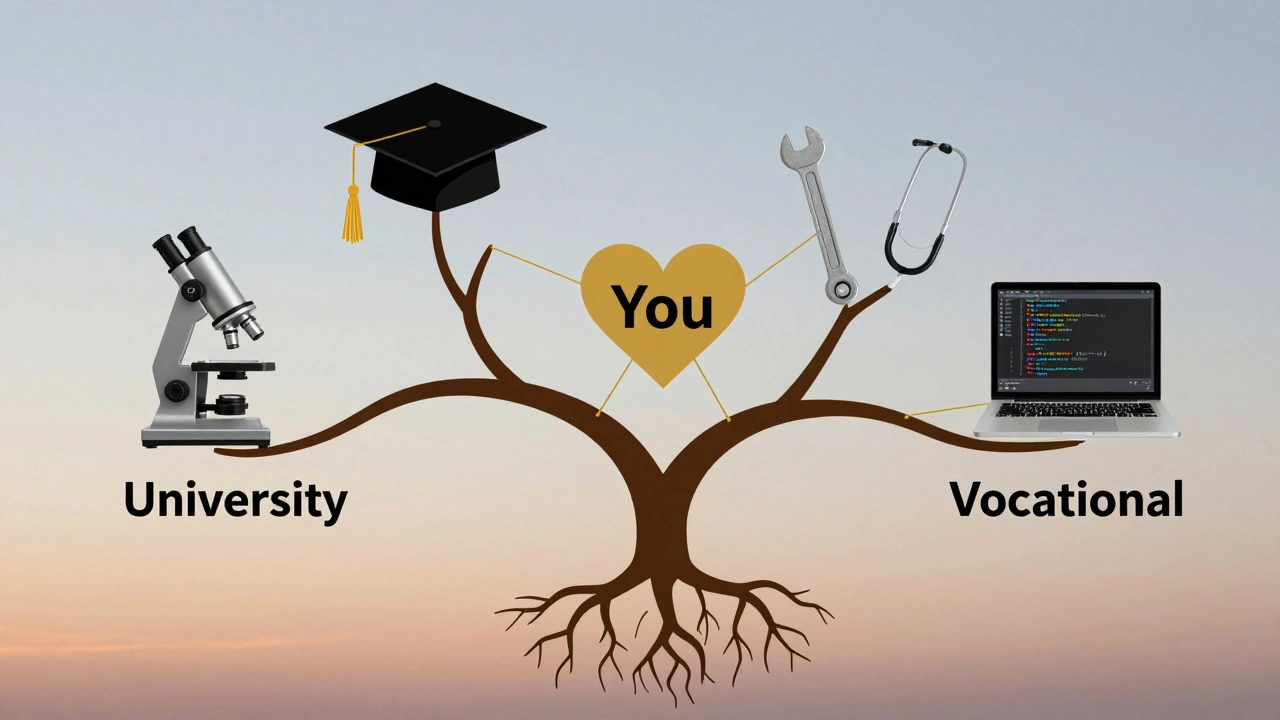
What’s changing in 2026?
The UK government is pushing vocational education harder than ever. T Levels are now available in 25 subjects-from agriculture to digital production. More employers are offering apprenticeships that lead directly to degrees.
Companies like Siemens, Jaguar Land Rover, and NHS Trusts now run degree apprenticeships. You work four days a week, study one day, and earn a full bachelor’s or master’s degree-without paying tuition. Your employer covers it. You get a salary. You graduate with a degree and a job.
This isn’t the future. It’s happening now.
So-what’s right for you?
Ask yourself these questions:
- Do I want to learn by doing, or by thinking and writing?
- Do I have a specific job in mind that requires a degree, or could I get there with a certificate and experience?
- Can I afford £50,000 in debt, or would I rather start earning sooner?
- Am I okay with starting in a technical role and building up, or do I need the prestige of a university name?
- Do I see myself in a lab, a classroom, or on a construction site?
If you answered "doing" and "earning" and "no debt," vocational is probably your fit.
If you answered "thinking," "research," and "I want to be a doctor or professor," then university makes sense.
There’s no shame in either choice. The UK used to treat vocational paths as second-tier. That’s changing. Employers now value skills over paper. And the best path is the one that gets you where you want to go-without breaking you in the process.
Can I go to university after a vocational degree?
Yes. Many UK universities accept HNDs, Foundation Degrees, and T Levels for entry into the second or third year of a bachelor’s program. Some even offer "top-up" degrees that let you finish your BA or BSc in just one extra year. Your vocational course doesn’t lock you out-it can actually give you a head start.
Are vocational degrees respected by employers?
Absolutely. In fields like healthcare, engineering, IT, and skilled trades, employers prefer vocational qualifications because they know graduates are ready to work. A 2024 survey by the Confederation of British Industry found that 78% of hiring managers rated vocational graduates as "more job-ready" than traditional degree holders. Skills matter more than the label on the diploma.
Do vocational degrees cost less than university?
Yes, significantly. A three-year university degree can cost over £40,000 including living expenses. A Level 4 HND typically costs under £8,000 total. T Levels are free for 16-19-year-olds. Many vocational courses include paid work placements, so you earn while you learn. No debt, no stress.
Can I get a good salary with a vocational degree?
Definitely. Electricians in the UK earn an average of £40,000-£50,000. Senior IT support technicians make £35,000-£45,000. Paramedics start at £28,000 and can rise to £40,000. Many vocational careers offer faster pay growth than academic ones because you’re working full-time from day one.
What if I change my mind later?
You’re not stuck. The UK education system is designed for flexibility. Many people start with a vocational course, gain experience, then return to university. Others begin with a degree, realize they’d rather be hands-on, and switch to a Level 4 or 5 qualification. Your path isn’t set in stone-it’s a journey.
Final thought: Your future isn’t a single path
The old idea that university is the only respectable route is fading. In 2026, success isn’t measured by whether you went to Oxford or Cambridge. It’s measured by whether you’re doing work you care about, earning what you need, and not drowning in debt.
There’s no one-size-fits-all. The best choice is the one that fits you-not your parents, not your teachers, not Instagram influencers. Look at your skills. Look at your budget. Look at the jobs you actually want. Then choose.
The UK has two strong roads. Pick the one that leads where you want to go.