
Why AI in UK Academic Writing Is No Longer Optional
Every week, a new university in the UK updates its rules on AI use. Some ban it outright. Others say it’s fine-if you cite it. A few even encourage it for drafting. The confusion is real. If you’re a student in Manchester, Edinburgh, or Cardiff, you’re not alone in wondering: Can I use ChatGPT to write my essay? The answer isn’t simple. It depends on your department, your tutor, and whether you’re honest about how you used it.
Here’s the hard truth: using AI without disclosure is now considered academic misconduct in nearly all UK universities. It’s not just about cheating. It’s about trust. When you hand in work that looks like yours but was written by a machine, you’re not just breaking rules-you’re undermining your own learning. And the tools to catch this are getting better every month.
What UK Universities Actually Say About AI
There’s no single national rule. Each university sets its own policy. But most follow a similar pattern. The University of Edinburgh, for example, allows AI for brainstorming and editing-but not for generating core content. The University of Manchester requires students to declare any AI use in a footnote. Oxford’s policy is stricter: any AI-generated text counts as unauthorised assistance unless explicitly permitted by the module leader.
These aren’t vague guidelines. They’re enforced. In 2025, the UK Higher Education Policy Institute reported that over 1,200 students were formally investigated for AI misuse across 47 universities. More than 300 received penalties ranging from grade deductions to suspension. The most common violation? Submitting AI-written essays without disclosure.
Some departments are more flexible. In creative writing or digital media courses, AI is sometimes used as a co-authoring tool. But even there, transparency is mandatory. If your professor says, “Use AI to help structure your argument,” then do it-but tell them how. If they say nothing, assume it’s not allowed.
The Biggest Pitfalls Students Don’t See Coming
Most students think the risk is getting caught. The real danger is what happens before you even submit.
First, AI doesn’t understand context. It can’t tell if your tutor expects a Marxist critique or a neoliberal analysis. It just spits out generic phrases that sound academic. Your essay might pass a plagiarism checker-but it’ll sound flat, robotic, and completely disconnected from your course readings. Tutors notice. They’ve read thousands of essays. They know what real thinking sounds like.
Second, AI hallucinates. It makes up citations. It invents studies. In one case at the University of Glasgow, a student used AI to generate references for a history paper. The AI cited a 2022 journal article that didn’t exist. The student didn’t check. The tutor did. Result? A failed assignment and a formal warning.
Third, you’re training your brain to outsource thinking. If you rely on AI to write your arguments, you won’t learn how to build them yourself. By the time you get to your final year or a postgraduate program, you’ll be stuck. No AI can help you think critically under pressure. Only practice can.
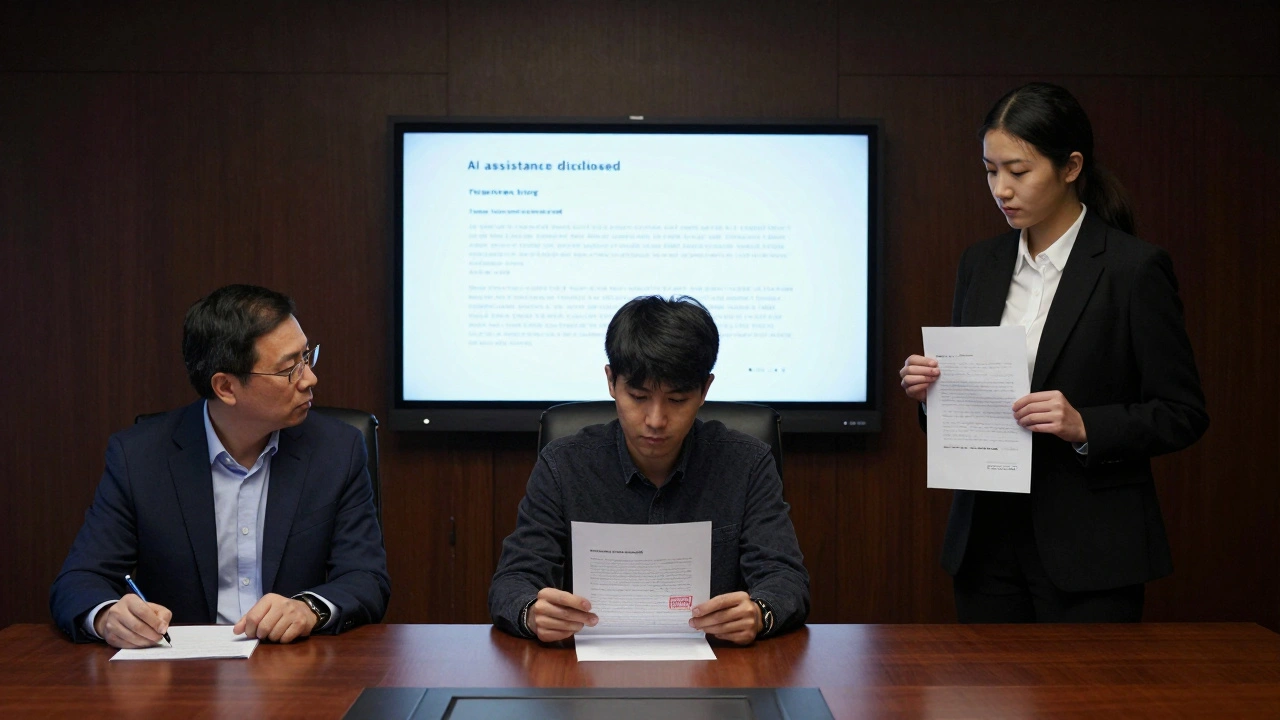
How to Use AI Ethically-Step by Step
You don’t have to give up AI. You just have to use it right. Here’s how:
- Use AI to clarify ideas, not create them. If you’re stuck on how to phrase a thesis, ask AI for three possible versions. Pick the one that matches your voice and rewrite it yourself.
- Use AI to find sources, not cite them. Ask: “What are key papers on climate policy in the UK since 2020?” Then go to Google Scholar or your library database. Find the real articles. Read them. Cite them yourself.
- Never copy AI text. Even if you tweak a sentence, if the structure and phrasing came from AI, it’s still AI-generated. Paraphrase from memory after reading.
- Always declare your use. Add a short note at the end: “I used AI to brainstorm structure and refine grammar. All arguments and citations are my own.”
- Check your university’s policy. Go to your department’s website. Search for “AI use policy.” If you can’t find it, email your module coordinator. Get it in writing.
AI Detection Tools Are Everywhere-And They’re Accurate
Turnitin, Originality.ai, and GPTZero are now standard in UK universities. They don’t just scan for copied text. They analyze writing patterns: sentence length variation, vocabulary richness, punctuation habits. AI-generated text has a signature. It’s too smooth. Too consistent. Too perfect.
One 2025 study by the University of Leeds tested 1,800 student essays. AI detection tools flagged 92% of submissions where AI was used without disclosure. The false positive rate? Just 3%. That means if the tool says it’s AI-written, it’s almost certainly true.
And it’s not just software. Tutors are trained to spot AI writing now. They look for sudden shifts in tone, odd word choices, or arguments that sound impressive but lack depth. If your essay reads like a Wikipedia summary with fancy words, you’re in trouble.

What Happens If You Get Caught?
Consequences vary. For a first-time, minor offense-like submitting a paragraph rewritten from AI without credit-you might get a warning and a chance to resubmit with a reflection statement. For repeated use or large-scale copying, you could face a failing grade, academic probation, or even expulsion.
Universities don’t just punish. They educate. Many now require students caught using AI unethically to attend a mandatory workshop on academic integrity. These aren’t optional. They’re logged in your file.
And here’s the thing: this stays on your record. If you apply for graduate school, internships, or jobs after graduation, some institutions ask about academic misconduct. A mark for AI cheating can follow you longer than you think.
Real Examples: What Works and What Doesn’t
Here’s what a student did right:
- Wrote a draft by hand on her laptop.
- Used AI to suggest three ways to improve her conclusion.
- Chose one, rewrote it in her own words, and added a footnote: “AI suggestion used for conclusion structure.”
- Got an A.
Here’s what a student did wrong:
- Asked AI to write a 2,000-word essay on Brexit’s impact on NHS funding.
- Changed a few words.
- Didn’t cite the AI.
- Got flagged by Turnitin.
- Had to appear before the academic misconduct panel.
- Lost 40% of their grade.
Final Rule: If You’re Not Sure, Don’t Use It
AI isn’t the enemy. But using it without understanding the rules is dangerous. The goal of university isn’t to produce perfectly written essays. It’s to help you think, argue, and communicate clearly. If you let AI do that for you, you’re not learning-you’re just typing.
Ask yourself: If I couldn’t use AI, would I still be able to write this? If the answer is no, you’re not using it ethically. You’re using it as a crutch.
Be smart. Be honest. Use AI as a tool-not a writer. Your future self will thank you.
Can I use ChatGPT to help me write my university essay in the UK?
Yes-but only if your university allows it and you disclose how you used it. Most UK universities permit AI for brainstorming, editing, or checking grammar, but not for writing core content. Always check your department’s policy and declare AI use in your submission.
What happens if I get caught using AI without disclosure?
Consequences vary by institution but can include a formal warning, grade reduction, failing the assignment, or academic probation. In serious or repeated cases, expulsion is possible. Many universities also require mandatory ethics training for students caught misusing AI.
Do AI detection tools really work?
Yes. Tools like Turnitin and Originality.ai analyze writing patterns, not just copied text. In 2025, studies showed they correctly identify AI-generated content over 90% of the time when used properly. Tutors are also trained to spot the telltale signs: unnatural fluency, lack of depth, or inconsistent tone.
Can AI make up fake references?
Absolutely. AI often invents sources, authors, or journal names that don’t exist. Students who copy these into their work get caught when tutors check the references. Always verify every citation in your university’s library database. Never trust AI-generated references.
Is it okay to use AI for proofreading?
Yes, as long as you’re still the author. Using AI to fix grammar, spelling, or sentence flow is generally acceptable. But don’t let it rewrite your ideas. If the argument sounds like it came from a machine, it probably did. Always review changes critically and keep your own voice.