
Imagine enrolling in a BSc Computer Science is a three-year undergraduate program covering algorithms, systems, and software engineering. at two different UK universities. At one, you spend your second year building a full-stack web application with real clients. At the other, you are deep in theoretical proofs and operating system kernels. Both degrees lead to the same job title, yet the daily reality of your studies feels like two different careers. This is the hidden landscape of UK university syllabus variation that most applicants miss until they are already sitting in lecture halls.
The core issue is not about which university is "better," but how course content comparison is the process of analyzing differences in academic modules, assessment methods, and learning outcomes between institutions. changes your skills, your portfolio, and your starting point in the job market. In the UK, while national frameworks set broad standards, individual universities retain significant autonomy over their specific curricula. Understanding these nuances is critical for making an informed choice that aligns with your career goals and learning style.
The Structural Framework: Degrees vs. Modules
To understand where differences emerge, you first need to grasp how UK degrees are built. Unlike the US system, which often relies on credit hours and general education requirements, the UK system is modular. A standard undergraduate degree consists of distinct units called modules are self-contained units of study with specific learning outcomes and assessments.. Each module has a defined number of credits (usually 20 or 30 per semester) and contributes to your final classification.
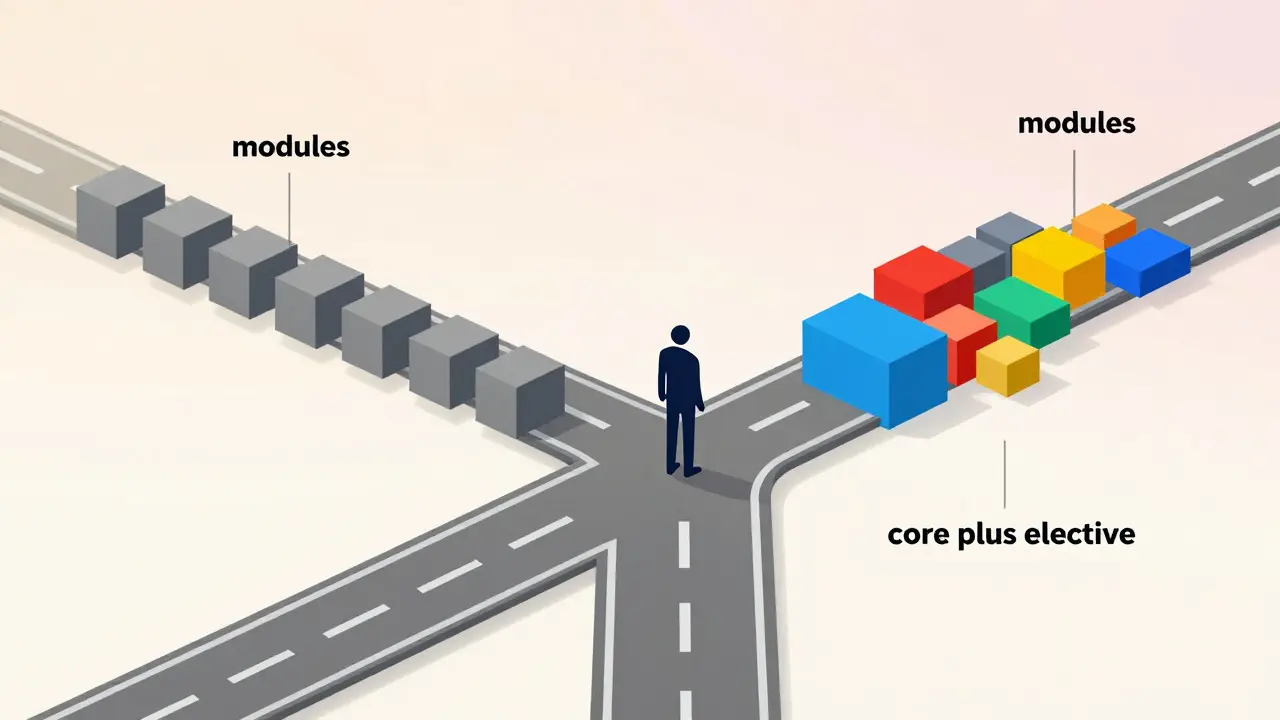
However, the way these modules are arranged varies wildly. Some universities follow a rigid, linear path where every student takes the exact same sequence of classes. Others offer a "core plus elective" model, allowing students to customize up to 40-50% of their degree from the second year onward. For example, a Business student at a specialized business school might take advanced data analytics in Year 2, while a student at a comprehensive university might take psychology or marketing communications instead. This structural flexibility means that even within the same subject area, the depth and breadth of knowledge can differ significantly.
Subject-Specific Divergences: Case Studies
Let’s look at concrete examples across popular disciplines to see how degree structure is the organizational framework defining the progression, duration, and components of an academic qualification. impacts what you actually learn.
Computer Science: Theory vs. Practice
In Computer Science, the divide is often between mathematical rigor and applied engineering. Universities with strong mathematics departments, such as those in the Russell Group, tend to emphasize discrete math, formal logic, and algorithm analysis in the early years. You might spend weeks proving the correctness of sorting algorithms before writing a line of code. Conversely, universities focused on industry partnerships may prioritize programming languages, database management, and cloud computing tools earlier in the curriculum. By the end of Year 1, one student might be comfortable with Python and SQL, while another is grappling with lambda calculus. Both are valid paths, but they prepare you for different entry-level roles-one for research-heavy positions, the other for rapid-development startups.
Psychology: Qualitative vs. Quantitative Focus
Psychology programs vary greatly in their balance between qualitative research (interviews, case studies) and quantitative methods (statistics, experimental design). Some universities require a heavy statistics load in Year 1, forcing students to master SPSS or R early on. Others allow students to delay advanced stats until Year 2, focusing initially on cognitive theories and social behavior. If you plan to pursue clinical psychology or neuropsychology, a curriculum with robust early statistical training is advantageous. If you are aiming for human resources or user experience design, a program emphasizing behavioral theory and qualitative interviewing techniques might serve you better.
Business and Management: Specialization Timing
For Business degrees, the key difference lies in when specialization begins. Some universities keep the first two years generic, covering marketing, finance, operations, and strategy equally. Only in the final year do students choose a major track. Other institutions allow specialization from the start of Year 2, letting you focus exclusively on International Business or Entrepreneurship. The latter approach allows for deeper expertise and more relevant internship opportunities during the placement year, while the former provides a broader overview that is useful if you are undecided about your specific career path.
Assessment Methods: How You Are Graded
Syllabus differences extend beyond topics to how you are assessed. This is a crucial factor for students who have specific strengths or weaknesses. Some universities rely heavily on written examinations, requiring you to demonstrate knowledge under time pressure. Others use continuous assessment, combining essays, portfolios, group projects, and presentations throughout the year.
| University Type | Primary Assessment Method | Typical Weighting | Impact on Student Skills |
|---|---|---|---|
| Research-Intensive | Written Exams & Academic Essays | 60-80% Exams | Deep theoretical understanding, analytical writing |
| Industry-Focused | Projects & Portfolios | 50-70% Practical | Application of knowledge, teamwork, client communication |
| Blended Model | Mixed Methods | 50% Exams / 50% Continuous | Balanced theoretical and practical competence |
If you struggle with exams but excel in collaborative work, choosing a university with a high proportion of project-based assessment can make a significant difference to your final degree classification. Always check the assessment breakdown for each module in the course handbook, as this information is often buried in PDFs rather than highlighted on marketing pages.

Hidden Curriculum: Resources and Support
Another layer of UK higher education is the post-secondary academic system in the United Kingdom, comprising universities and colleges offering degrees. is the "hidden curriculum"-the support structures and resources that surround the formal teaching. Does the university provide dedicated coding labs for CS students? Do psychology students have access to eye-tracking equipment or EEG machines? These resources shape the quality of your practical experience.
Additionally, consider the ratio of staff to students. A smaller class size often means more personalized feedback, which is invaluable for complex subjects like law or philosophy. Larger universities may offer more diverse electives but can feel impersonal. Check if the university offers mandatory small-group tutorials alongside large lectures, as this format encourages active participation and deeper engagement with the material.
How to Compare Syllabi Effectively
So, how do you cut through the marketing fluff to find the real differences? Start by downloading the detailed module lists for the last two academic years. Don’t just read the titles; look at the description of learning outcomes. Ask yourself: Does this module teach me a tool I want to use? Does it require a type of assessment I am comfortable with?
- Identify Core vs. Elective Modules: Determine how much freedom you have to tailor your degree. A high percentage of electives offers flexibility but requires careful planning to ensure coherence.
- Check Prerequisites: Some courses assume prior knowledge that others build from scratch. Ensure the starting level matches your current ability.
- Review Placement Year Options: If the course includes a sandwich year, investigate which companies typically host interns. This indicates the industry connections and practical relevance of the curriculum.
- Contact Current Students: Join online forums or social media groups for the specific course. Ask them about the workload distribution and whether the syllabus felt balanced.
Finally, visit open days and ask specific questions. Instead of asking "Is the course good?", ask "What does a typical week look like in the second year?" or "How are group projects structured?" These answers reveal the operational reality of the module selection is the process by which students choose specific units of study to fulfill degree requirements. process.
Do all UK universities teach the same core content for a given degree?
No. While professional bodies like the Law Society or the Institute of Engineering and Technology set minimum standards for accreditation, universities have wide discretion. For non-professional degrees, there is no single national syllabus. The core content varies based on the faculty's research interests and industry partnerships.
Which is better: a specialized university or a comprehensive one?
It depends on your goals. Specialized universities (e.g., LSE for economics, UAL for arts) often offer deeper, more focused curricula with stronger industry links in that specific field. Comprehensive universities offer broader elective options and a wider range of extracurricular activities, which is beneficial if you want a multidisciplinary background.
Can I change my major if the syllabus doesn't suit me?
Usually, yes, but only within the first few months of the first year. Most universities allow switching between related courses if you meet the entry requirements for the new course. However, switching to a completely different discipline (e.g., from History to Medicine) is rare and often requires reapplying for a new place.
How important are placement years in comparing syllabi?
Very important. A placement year breaks the academic cycle and provides practical experience. When comparing courses, check if the placement is guaranteed or competitive. Also, look at the types of employers involved. A course with placements in top-tier firms may offer a different career trajectory than one with placements in local SMEs.
Where can I find detailed syllabus information online?
Visit the specific department page on the university website. Look for links labeled "Course Handbook," "Module Descriptions," or "Academic Regulations." These documents list every module, its credits, and its assessment method. Avoid relying solely on the main course overview page, which is often summarized for marketing purposes.