
You’ve spent months applying to universities, gathering transcripts, and perfecting your personal statement. You finally get that acceptance letter from a top UK university. But there is one final hurdle that trips up thousands of applicants every year: the proof of funds requirement for the Student Route visa. If you cannot prove you have enough money to support yourself, your visa application will be rejected, no matter how brilliant your academic record is.
The UK Home Office is strict about this. They want to ensure you won’t become a burden on the state while studying. For 2026, the rules are specific, the deadlines are tight, and the penalties for getting it wrong are severe. This guide breaks down exactly how much cash you need, where it must come from, and how to present it correctly to avoid rejection.
How Much Money Do You Actually Need?
The amount you need to show isn't a random guess. It is calculated based on two main factors: your tuition fees and your living costs. The living cost requirement depends entirely on where your university is located in the UK.
London vs. Outside London: The cost of living in London is significantly higher than in other parts of the UK. Therefore, the Home Office sets different monthly thresholds for these areas.
- If your course is in London: You must show £1,334 per month for up to 9 months.
- If your course is outside London: You must show £1,023 per month for up to 9 months.
The Calculation Formula: Total Required = Tuition Fees + (Monthly Living Cost × 9 Months).
For example, if you are studying in Manchester (outside London) and your tuition fee is £15,000, you need to show:
£15,000 (Tuition) + (£1,023 × 9) = £24,207.
You must have this full amount available in your account. You cannot split the difference or promise to send more later. The entire sum must be visible at the time of application.
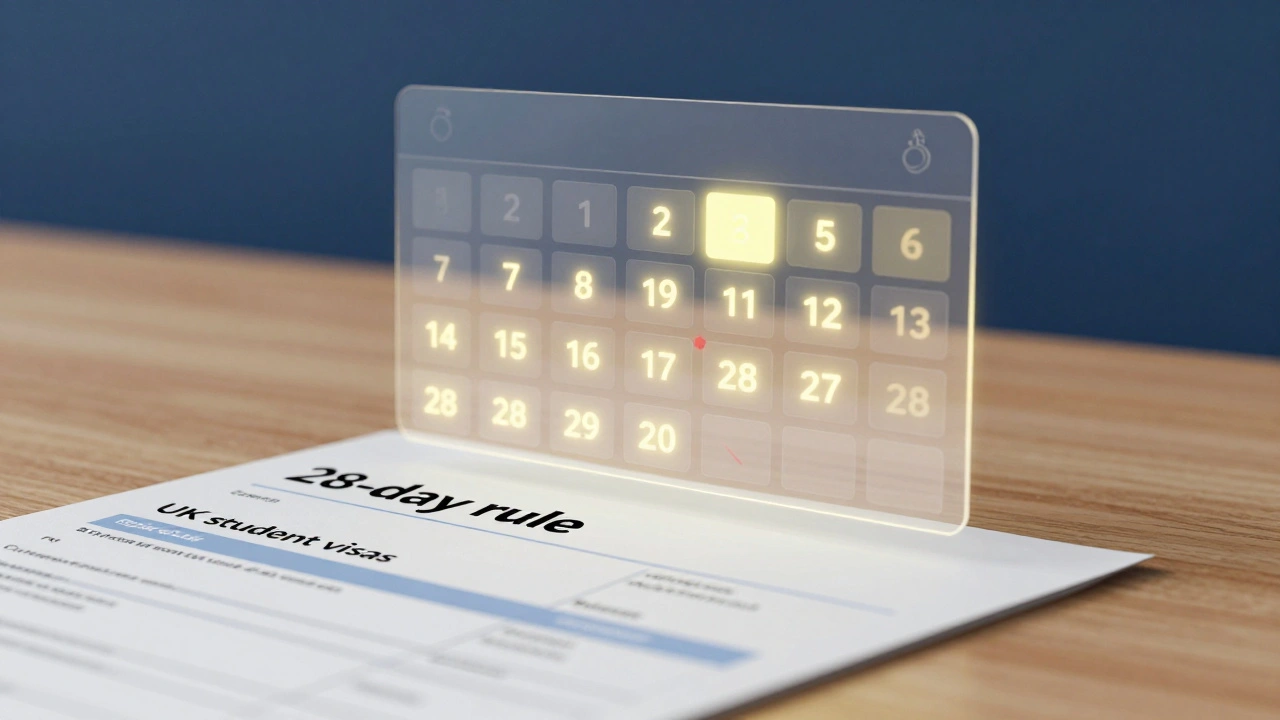
The 28-Day Rule: Timing Is Everything
This is the most common reason for visa refusals. It’s not just about having the money; it’s about having it for the right amount of time. The Home Office calls this the "28-day rule."
Your bank balance must stay above the required total for a continuous period of 28 days. Here is how it works:
- Start Date: The day your balance first hits the required amount.
- End Date: Exactly 28 days later.
- Balance Check: At no point during these 28 days can the balance drop below the required total.
If you deposit a large sum on January 1st, but withdraw £100 on January 15th, causing the balance to dip below the threshold, the clock resets. You would need to wait until the balance is restored and then start another 28-day count.
Deadline for Evidence: The date you submit your visa application must fall within 31 days of the end of your 28-day period. If your 28-day period ends on February 1st, you must apply by March 3rd. If you apply on March 4th, your evidence is considered expired.
Acceptable Sources of Funds
Not all money is treated equally. The Home Office accepts specific sources of funds, each with its own documentation requirements.
| Source Type | Description | Key Requirement |
|---|---|---|
| Personal Savings | Cash in your own name or your parent/guardian's name. | Must meet the 28-day rule. Bank statements must be original or certified copies. |
| Sponsorship | Funds provided by a government, scholarship body, or recognized institution. | Requires an official letter confirming the award covers tuition and/or living costs. |
| Loans | Education loans from approved banks or financial institutions. | Loan agreement must clearly state the amount and disbursement schedule. |
| Tuition Fee Deposit | d>Money already paid to your university.You only need to prove the remaining balance for living costs and unpaid tuition. |
A Note on Parental Funds: If you use your parents' savings, you must provide additional documents proving their relationship to you. This usually means a birth certificate or a notarized letter of sponsorship. The bank statements must be in their name, and they must sign a declaration agreeing to sponsor your studies.
Documentation Checklist: What to Submit
When you upload your documents to the visa portal, clarity is key. Immigration officers review thousands of applications. If they have to guess what a document is, they might reject it. Follow this checklist to ensure your submission is clean and complete.
- Bank Statements: Must cover the full 28-day period. Include every transaction. Do not redact lines. Use English translations if the original statement is in another language.
- Bank Letter: A recent letter from the bank confirming your identity, account number, and balance. Some banks include this information directly on the statement; check if this is sufficient.
- Proof of Relationship: If using parental funds, include a birth certificate showing both your name and your parents' names. If names don't match exactly, provide a legal affidavit.
- Sponsorship Letter: If sponsored, include the official award letter detailing the amount and duration of funding.
- Tuition Fee Receipt: If you’ve already paid part of your tuition, include the receipt to reduce the amount you need to show in cash.
Digital vs. Paper: Most banks now offer digital statements. Ensure these are downloaded as PDFs and contain all necessary security features (watermarks, bank logos, contact details). Printed screenshots are often rejected because they lack verifiable metadata.
Common Pitfalls That Lead to Rejection
Even with enough money, your application can fail due to technical errors. Avoid these common mistakes:
- Using Multiple Accounts Incorrectly: You can combine balances from multiple accounts, but each account must individually satisfy the 28-day rule. You cannot move money between accounts to make them look compliant.
- Expired Documents: Bank statements older than 31 days from your application date are invalid. Always request new statements close to your submission date.
- Unclear Transactions: Large deposits without explanation can raise flags. If you received a lump sum, provide a source document (e.g., sale of property, inheritance) to explain the inflow.
- Ignoring Currency Conversion: The Home Office uses exchange rates published by the Office for National Statistics (ONS). Do not rely on Google or your bank’s rate. Use the ONS rate for the last working day before your 28-day period started.
The "Frozen" Account Myth: You do not need to freeze your account. You can spend money freely as long as the balance never drops below the required threshold. However, many students choose to stop using the card linked to the account to avoid accidental dips.
Special Cases: Scholarships and Government Funding
If you receive a scholarship from a recognized body (like Chevening, Commonwealth, or Fulbright), the rules are slightly different. These awards are often trusted automatically, meaning you may not need to show the full 28-day history for the covered amounts.
However, you still need to prove any additional funds you bring personally. For instance, if your scholarship covers tuition but not living costs, you must show the living cost amount in your bank account following the standard 28-day rule.
Always check your scholarship award letter. It should explicitly state whether it covers tuition, living costs, or both. If it’s ambiguous, contact your university’s international office for clarification before applying.
Next Steps After Submission
Once you submit your application, you’ll receive a reference number. Keep this safe. You may be asked for biometrics (fingerprints and photo) at a local visa center. Processing times vary by country, so apply as early as possible-ideally 3 months before your course starts.
If your visa is granted, you’ll receive a BRP (Biometric Residence Permit) collection notice upon arrival in the UK. Remember, your visa is tied to your specific course and university. Changing institutions later requires a new visa application and potentially new proof of funds.
Can I use my parents' bank account for proof of funds?
Yes, you can use your parents' or legal guardian's bank account. However, you must provide additional documentation to prove the relationship, such as a birth certificate or a notarized letter of sponsorship. The bank statements must be in their name, and they must agree to sponsor your studies.
What happens if my bank balance drops below the required amount during the 28-day period?
If your balance drops below the required total at any point during the 28-day period, the clock resets. You must wait until the balance is restored to the required level and then start a new 28-day count. Consistency is key.
Do I need to show funds for the entire duration of my degree?
No. You only need to show funds for the first 9 months of your stay, plus the tuition fees for the first year (or the full course if it's less than 9 months). You do not need to prove you can afford years 2 and 3 at the time of your initial visa application.
Can I combine money from multiple bank accounts?
Yes, you can combine balances from multiple accounts. However, each individual account must independently satisfy the 28-day rule. You cannot transfer money between accounts to make them compliant; each account must have held its portion of the required funds for the full 28 days.
Which exchange rate should I use for currency conversion?
You must use the exchange rate published by the Office for National Statistics (ONS) for the last working day before your 28-day period began. Do not use rates from Google, your bank, or private converters, as the Home Office strictly adheres to ONS data.