You’ve written the draft. You’ve hit submit in your head a dozen times already. But here’s the thing about UK essays: they live or die in the editing phase. Most students spend 80% of their time writing and only 20% editing. That ratio is backwards. If you want a First Class degree, you need to treat editing as a distinct, rigorous process, not just a quick spell-check before bed.
The UK academic system has specific quirks. It’s not just about grammar; it’s about critical distance, formal tone, and precise citation styles like Harvard or OSCOLA. A generic American-style edit won’t cut it. You need a targeted approach that checks for British spelling conventions, structural logic, and strict adherence to university-specific guidelines.
Key Takeaways
- Structure first: Never fix sentences until your argument flows logically from introduction to conclusion.
- Style matters: Remove contractions, slang, and emotive language to maintain academic objectivity.
- Referencing is non-negotiable: Every claim needs a source, and every source must appear in the bibliography.
- British English rules: Watch out for -ise vs -ize endings and specific punctuation norms (single quotes).
- Read aloud: Your ears catch awkward phrasing and run-on sentences better than your eyes.
Structural Integrity: Does Your Argument Hold Water?
Before you even look at a comma, check the skeleton of your essay. Is it built to last? Many students write a great paragraph but lose the thread between paragraphs. This is where your essay structure fails.
Start with the Introduction. Does it clearly state your thesis? In UK academia, markers hate ambiguity. They want to know exactly what you are arguing and how you plan to prove it. If your introduction wanders around the topic without landing on a clear position, rewrite it. Then, move to the Body Paragraphs. Each one should have a single main idea, supported by evidence, and linked back to the thesis. Use the PEEL method (Point, Evidence, Explanation, Link) as a mental check. If a paragraph doesn’t link back to the question, cut it or merge it.
Check your transitions. Do you use signposting words like "However," "Conversely," or "Furthermore" effectively? These aren’t just filler; they guide the marker through your logic. If you jump from discussing economic factors to social impacts without a bridge, the reader stumbles. Finally, look at the Conclusion. Does it introduce new arguments? It shouldn’t. It should synthesize what you’ve already said and answer the "So what?" question. Why does your analysis matter?
Academic Style: Killing the Informal Tone
This is where most international students and even native speakers trip up. UK academic writing demands a formal, objective tone. It’s not about sounding smart; it’s about sounding professional and detached.
First, hunt down contractions. "Don't," "can't," and "it's" belong in emails, not essays. Write them out: "do not," "cannot," "it is." Next, scan for colloquialisms. Words like "stuff," "things," "a lot," or "huge" are too vague. Replace "a lot of people think" with "many scholars argue." Replace "big problem" with "significant challenge." Precision shows respect for the subject matter.
Watch out for emotive language. Avoid words like "shocking," "terrible," or "wonderful." Instead of saying "This policy was disastrous," say "The policy resulted in significant economic decline." Let the data speak, not your adjectives. Also, check your voice. While active voice is generally preferred for clarity, passive voice is acceptable in scientific or historical contexts where the actor is less important than the action. Just be consistent. Don’t switch mid-sentence unless necessary.
A common pitfall is overusing first-person pronouns. Unless your module explicitly allows it, avoid "I believe" or "In my opinion." State your argument directly. "It can be argued that..." or "The evidence suggests..." sounds more authoritative and aligns with traditional UK expectations.
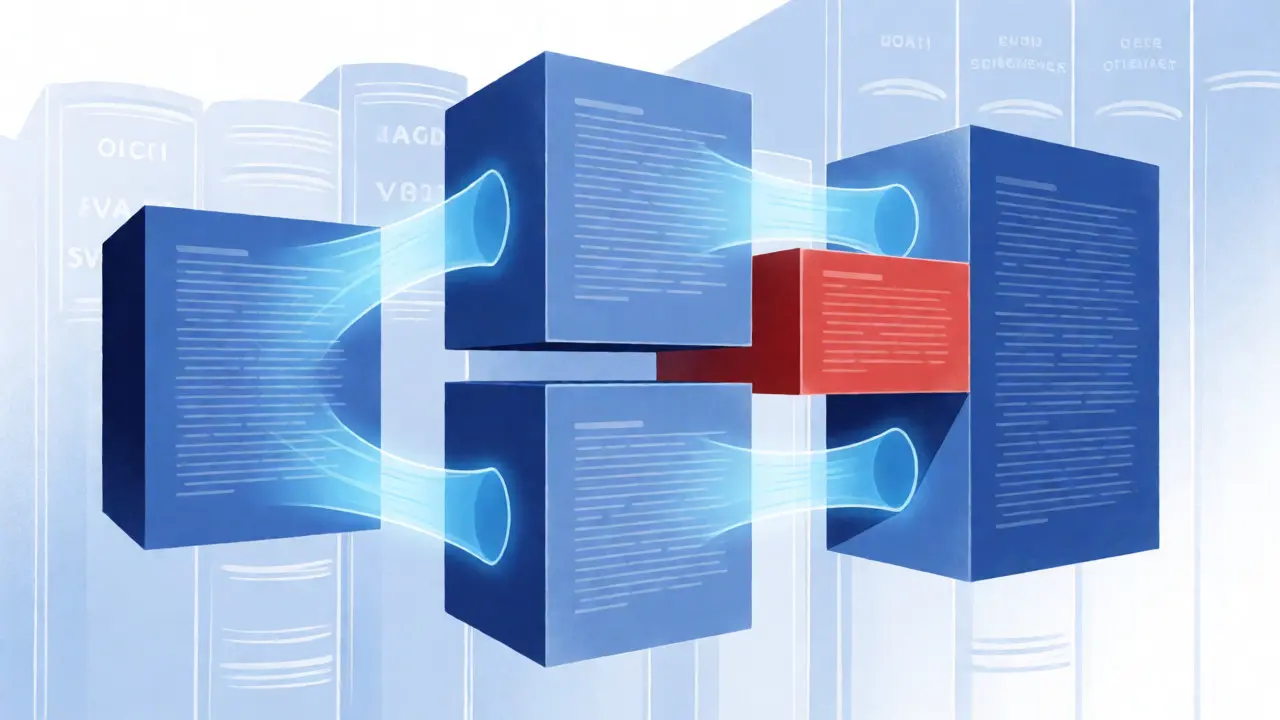
Referencing Rigor: The Make-or-Break Section
If your referencing is wrong, you might get marked down heavily, or worse, flagged for plagiarism. UK universities typically use Harvard (author-date), APA, or OSCOLA (for law). Check your handbook immediately. Do not guess.
Here is a quick comparison of common styles to help you spot discrepancies:
| Feature | Harvard | APA (7th Ed) | OSCOLA |
|---|---|---|---|
| In-text Citation | (Smith, 2023) | (Smith, 2023) | Superscript number1 |
| Bibliography Order | Alphabetical by surname | Alphabetical by surname | By order of appearance |
| Footnotes | Rarely used for citations | Not used for citations | Mandatory for all sources |
| Punctuation | Varies by university | Strict APA rules | Specific legal formatting |
Once you know your style, do a cross-check. Go through your text and find every citation. Does each one appear in the reference list? Now go the other way. Does every entry in the reference list appear in the text? Orphan references are a red flag. They suggest you copied a list without reading the sources.
Pay attention to details. Are page numbers included for direct quotes? Did you italicize book titles? Did you capitalize article titles correctly? These small errors accumulate and signal carelessness to the marker. Use a reference manager like Zotero or Mendeley if you haven’t already, but never trust it blindly. Always double-check against your university’s official guide.
British English Nuances: Spelling and Punctuation
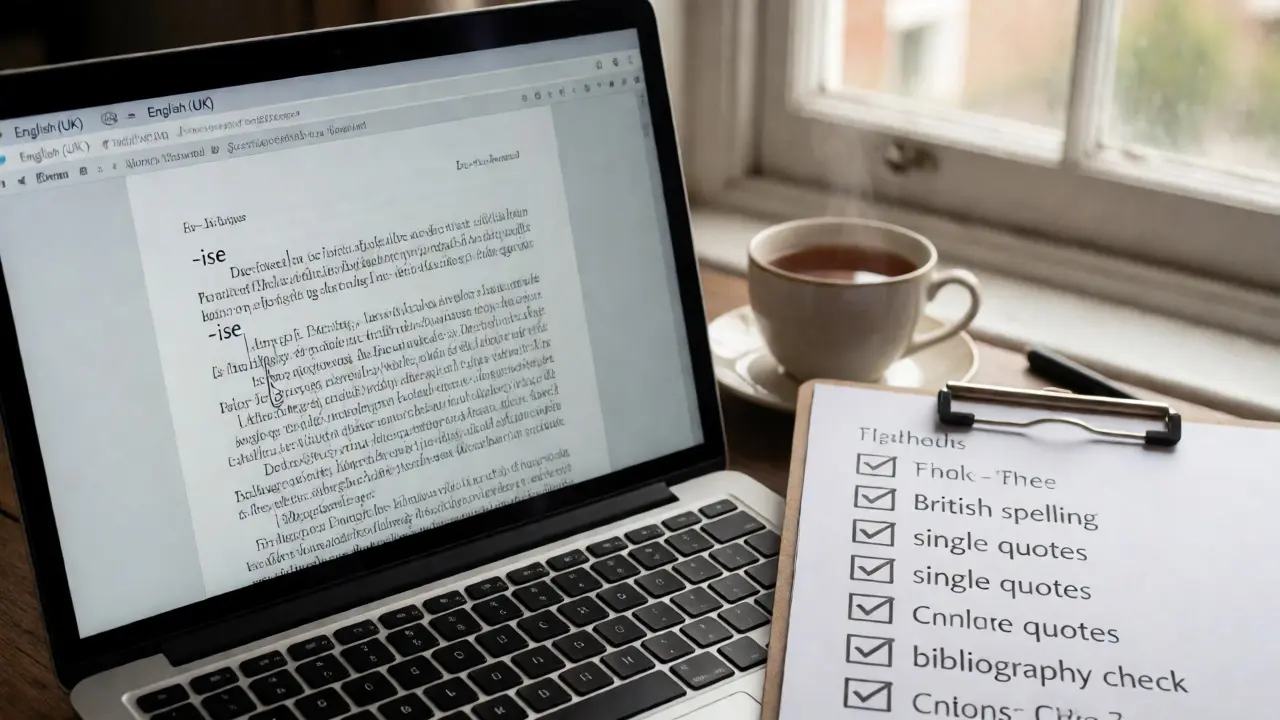
If you’re using an American spell-checker, it will fight you. Set your document language to "English (United Kingdom)." Here are the big ones to watch:
- -ise vs -ize: While Oxford spelling accepts -ize, most UK universities prefer -ise (e.g., "organise," "recognise"). Stick to one and be consistent.
- -our vs -or: Colour, honour, labour. Not color, honor, labor.
- -re vs -er: Centre, theatre, metre. Not center, theater, meter.
- Double consonants: Travelled, cancelled, modelling. Americans drop the second 'l' often; Brits keep it.
Punctuation differs too. In the US, commas and periods go inside quotation marks regardless of logic. In the UK, punctuation goes outside unless it’s part of the quoted material itself. For example: He called it a "failure", then left. Note the comma after the quote. Also, use single quotation marks for primary quotes and double for quotes within quotes, though some styles vary. Check your department’s preference.
The Proofreading Protocol: Catching What Eyes Miss
After fixing style and structure, you need a final sweep for typos. Your brain auto-corrects errors when you read silently because it knows what you meant to say. To break this pattern, try these techniques:
- Read Aloud: Seriously, talk to yourself. If you stumble over a sentence, it’s awkward. Rewrite it.
- Change the Font: Copy your text into a different font or size. It tricks your brain into seeing it as new content.
- Reverse Reading: Read your paper from the last sentence to the first. This isolates each sentence, making grammar errors pop out.
- Search for Common Culprits: Ctrl+F for "their/there/they're," "its/it's," and "affect/effect." These homophones slip through unnoticed.
Don’t rely solely on Grammarly or Microsoft Editor. They often miss context-specific errors or suggest American idioms. Human review is still king. If possible, swap papers with a friend. Ask them specifically to check for clarity, not just typos. Can they understand your argument without asking questions? If yes, you’re good.
Final Pre-Submission Checklist
Before you upload that file, run through this rapid-fire list. It takes five minutes but saves hours of regret.
- [ ] Word count is within ±10% of the limit.
- [ ] File name follows university format (e.g., StudentID_ModuleCode_Assignment.pdf).
- [ ] Page numbers are present and correct.
- [ ] Title page includes all required info (Name, ID, Module, Date).
- [ ] Margins are standard (usually 2.5cm or 1 inch).
- [ ] Line spacing is correct (usually 1.5 or double).
- [ ] No track changes or comments remain visible.
- [ ] PDF conversion looks clean (check images and tables didn’t shift).
How much weight does referencing carry in UK grading?
It varies by institution and subject, but poor referencing can cap your grade significantly. Some markers deduct marks for every error, while others apply a blanket penalty if the style is inconsistent. More importantly, incorrect referencing can trigger plagiarism checks, leading to serious academic misconduct investigations. Treat it as foundational, not optional.
Should I use the first person in UK essays?
Traditionally, no. Most humanities and social science essays expect third-person objective voice. However, reflective assignments or personal statements often require first-person. Always check your assignment brief. If unsure, ask your tutor. When in doubt, stick to impersonal constructions like "This essay argues..." rather than "I argue..."
Is it okay to use bullet points in a UK essay?
Generally, no. UK academic essays favor continuous prose. Bullet points are seen as informal and lacking in analytical depth. Use them only if explicitly permitted or in very specific technical reports. Otherwise, convert lists into flowing sentences with transition words.
What is the best tool for checking British English?
Microsoft Word’s built-in spell checker set to "English (UK)" is reliable for basics. For style, tools like Grammarly allow you to set regional dialects, but they may still push American norms. ProWritingAid offers detailed style reports. Ultimately, manual proofreading remains the gold standard for nuance.
How many drafts should I edit?
There’s no magic number, but two full editing passes are recommended. The first pass focuses on macro issues: structure, argument flow, and evidence. The second pass focuses on micro issues: grammar, style, and referencing. Trying to do both at once is inefficient and leads to missed errors.