
You’ve spent years studying. You’ve pulled all-nighters, survived endless essays, and finally earned that degree certificate. But here is the hard truth: a piece of paper alone does not guarantee you a job in Engineering, Law, or Business. In these three specific fields, your university’s reputation matters less than one thing: accreditation.
If you are choosing a university in the United Kingdom, ignoring accreditation is like buying a car without checking if it has an engine. It might look nice, but it won’t get you where you need to go. For regulated professions, accreditation is the gatekeeper. Without it, you cannot practice, you cannot qualify, and your degree might be worthless in the eyes of employers.
The Hidden Gatekeeper: What Accreditation Actually Does
Let’s cut through the jargon. Accreditation is an official stamp of approval from a professional body. It confirms that a course meets the specific technical standards required by the industry. It is not just about quality; it is about compliance.
In the UK, universities must meet general standards set by OfS (Office for Students) to operate. However, this baseline is not enough for specialized careers. If you want to become a chartered engineer, a solicitor, or a qualified accountant, you need a degree accredited by the relevant professional body. This process ensures that your curriculum covers the critical skills, ethics, and technical knowledge that employers demand.
Think of it this way: OfS checks if the university is a legitimate institution. Professional bodies check if the specific degree teaches you how to do the job. Missing this distinction can cost you thousands of pounds in additional training or years of delayed career progression.
Engineering: The Chartered Route
Engineering is perhaps the most strictly regulated field regarding accreditation. If you study Mechanical Engineering, Civil Engineering, or Electrical Engineering, you are likely aiming for Chartered Engineer (CEng) status. This is the gold standard in the industry.
To achieve CEng status, your undergraduate degree must be accredited by Engineers Ireland (for Irish degrees) or, more commonly for UK students, by one of the licensed professional institutions recognized by Engineering Council UK. The main bodies include:
- Institution of Mechanical Engineers (IMechE)
- Institution of Civil Engineers (ICE)
- Institution of Engineering and Technology (IET)
- Institution of Structural Engineers (IStructE)
Here is why this matters: If your BEng or MEng degree is fully accredited, you automatically satisfy the academic requirements for CEng. You only need to complete your Initial Professional Development (IPD) after graduation. If your degree is not accredited, you will have to take additional exams or even a postgraduate master’s degree to prove you have the necessary knowledge. This adds time, money, and stress to your career start.
Always check the course page. Look for phrases like "Accredited by IMechE on behalf of Engineering Council UK." If you don’t see it, ask the admissions team directly. Do not assume.
Law: The SQE Revolution
The landscape for Law Degrees in the UK changed dramatically with the introduction of the Solicitors Qualifying Examination (SQE). Previously, you needed a qualifying law degree (QLD) accredited by the Solicitors Regulation Authority (SRA). That system is gone.
Today, any bachelor’s degree can technically lead to becoming a solicitor, provided you pass the SQE. However, accreditation still matters, but in a different way. The SRA now accredits SQE Preparation Courses. While your LLB doesn’t need to be "accredited" in the old sense, you need a degree that provides the foundational knowledge to pass the SQE.
This creates a trap for unsuspecting students. Some universities offer "law-related" degrees that are not LLBs. These might cover legal theory but lack the practical black-letter law needed for the SQE. If you choose a non-LLB route, you may need to take conversion courses later.
For barristers, the path remains stricter. You still need a qualifying law degree or a conversion course approved by the Bar Standards Board (BSB). The BSB maintains a list of approved undergraduate and conversion courses. If your university is not on this list, you cannot proceed to the Bar Training Course. Always verify with the BSB website before enrolling.
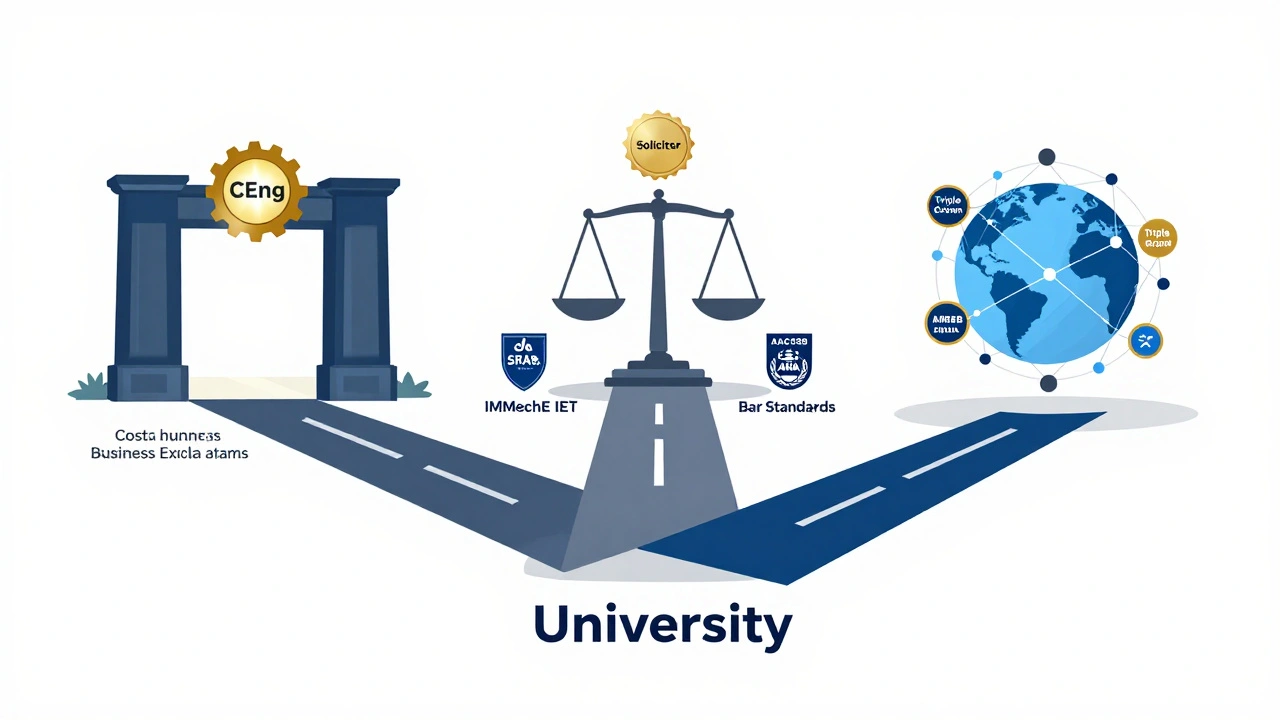
Business: The Triple Crown
Business schools are different. There is no single regulatory body that licenses you to practice "business." Instead, accreditation acts as a signal of quality and global recognition. For MBA programs and undergraduate business degrees, look for the so-called "Triple Crown" accreditations:
- AACSB (Association to Advance Collegiate Schools of Business)
- AMBA (Association of MBAs)
- EQUIS (European Quality Improvement System)
Fewer than 1% of business schools worldwide hold all three. In the UK, top institutions like London Business School, Warwick Business School, and Imperial College Business School hold these marks. But many mid-tier universities also hold AACSB or AMBA accreditation.
Why should you care? Employers use these accreditations as a filter. A degree from an AACSB-accredited school signals that the faculty are research-active, the curriculum is current, and the alumni network is strong. It also matters for international mobility. If you plan to work abroad, an EQUIS or AACSB credential is recognized globally, whereas a non-accredited degree might raise eyebrows.
Additionally, for accounting and finance roles, look for exemptions. Bodies like ACCA (Association of Chartered Certified Accountants) and CIMA (Chartered Institute of Management Accountants) grant exam exemptions based on accredited degrees. An accredited BSc in Accounting might save you six exams. That is a massive head start in your career.
| Field | Primary Body | Consequence of No Accreditation | Key Benefit |
|---|---|---|---|
| Engineering | Engineering Council UK / IMechE / IET | Cannot become Chartered Engineer without extra exams/Masters | Direct route to CEng status |
| Law | SRA / Bar Standards Board | May need conversion course; ineligible for Bar Training | Eligibility for SQE/Bar Pathways |
| Business | AACSB / AMBA / EQUIS | Lower employer recognition; fewer professional exemptions | Global recognition; ACCA/CIMA exemptions |
How to Verify Accreditation Before You Apply
Universities are marketing machines. They will highlight rankings, campus facilities, and student satisfaction scores. They rarely put accreditation front and center unless it is a selling point. You have to dig.
First, go to the professional body’s website, not the university’s. For engineering, visit the Engineering Council UK register. For law, check the SRA approved list. For business, search the AACSB member directory. These lists are authoritative and updated regularly.
Second, read the fine print. Sometimes a university offers multiple versions of a degree. One might be accredited, while another variant (e.g., "Business Studies" vs. "BSc Management") is not. Ensure the specific module code and title you are applying for matches the accredited program.
Third, ask about "grandfathering." If you start a degree that is currently unaccredited but the university is in the process of gaining accreditation, will you benefit? Usually, no. Accreditation applies to cohorts starting after the approval date. Do not bet on future changes.
The Cost of Ignoring Accreditation
Let’s talk numbers. A typical UK undergraduate degree costs around £9,250 per year. Over three years, that is £27,750. If you graduate with a non-accredited engineering degree, you might need to take a Master’s degree to bridge the gap. That adds another £10,000-£20,000 in tuition and two years of lost earnings.
In law, failing to secure a qualifying degree means paying for a Common Professional Examination (CPE) or Graduate Diploma in Law (GDL). These courses cost between £6,000 and £12,000 and require full-time study for a year. You could have avoided this entirely by choosing an accredited LLB.
In business, the cost is softer but real. Graduates from non-accredited schools often face higher barriers to entry at top firms. They miss out on exclusive recruitment pipelines and professional exemptions. The ROI (Return on Investment) of your degree drops significantly.
Final Checklist for Prospective Students
Before you submit your UCAS application or direct enrollment form, run this checklist:
- Identify your target profession: Are you aiming for CEng, Solicitor, Barrister, or CPA?
- Find the governing body: Who regulates this profession in the UK?
- Check the official register: Is the specific degree title listed?
- Verify the cohort year: Does the accreditation apply to students starting in 2026?
- Ask for written confirmation: Email the department and keep a record of their response.
Accreditation is not a badge of honor; it is a license to practice. In Engineering, Law, and Business, it is the difference between a hobby and a career. Don’t let a lack of due diligence derail your professional future. Check the stamps, not just the slogans.
Is a Russell Group degree automatically accredited?
No. Being part of the Russell Group indicates research intensity and prestige, but it does not guarantee professional accreditation. You must still check with the specific professional body (e.g., IMechE, SRA) for each individual course.
Can I get accredited after graduating?
Generally, no. Accreditation applies to the curriculum during your studies. If you graduate with a non-accredited degree, you usually need to take additional qualifications (like a Master’s or conversion course) to meet the standards, rather than simply getting retroactive accreditation.
What is the difference between CEng and IEng?
CEng (Chartered Engineer) typically requires an MEng degree or a BEng plus a Master’s. IEng (Incorporated Engineer) is often accessible with a BEng or HND. Both are accredited statuses, but CEng is the higher tier for complex design and innovation roles.
Does AACSB accreditation matter for undergraduate degrees?
Yes. While AACSB is famous for MBAs, it accredits entire business schools. An undergraduate degree from an AACSB-accredited school benefits from the same rigorous faculty standards and curriculum reviews, which enhances employability and global recognition.
How do I find out if my law degree is SQE compatible?
The SQE tests functional legal knowledge. Any LLB that covers the 14 core subjects defined by the SRA is compatible. Check the university syllabus against the SRA SQE specification. If your degree lacks key areas like Contract Law or Tort Law, you may need supplemental preparation.