
If you're applying to medicine or dentistry in the UK, you know the pressure. UCAT and BMAT aren't the only options-but most students don't realize that. Some universities don't require either. Others use different tests, interviews, or even portfolio reviews. If you're stressed about preparing for UCAT or BMAT, or you're not sure you'll perform well, there are other paths. You just need to know where to look.
Not All UK Medical Schools Require UCAT or BMAT
It’s a common myth that every medical school in the UK demands UCAT or BMAT. That’s not true. As of 2026, at least six UK medical schools don’t use either test for undergraduate medicine entry. These include Cardiff University, the University of Central Lancashire (UCLan), and the University of Buckingham. Instead, they rely on academic grades, personal statements, and interviews.
Cardiff, for example, uses a holistic approach. They look at your predicted A-level grades (minimum AAA, including Chemistry and Biology), your personal statement, and your performance in a multiple mini-interview (MMI). No UCAT. No BMAT. Just solid academics and clear motivation.
Similarly, UCLan evaluates applicants based on GCSEs, A-levels, work experience, and a situational judgment test they design themselves. It’s not a national exam like UCAT-it’s a shorter, school-specific assessment focused on ethics and communication.
What About Dentistry? Same Rules Apply
Dentistry programs follow the same pattern. While King’s College London and Manchester require UCAT, others like the University of Central Lancashire and the University of Sunderland don’t. Sunderland’s dentistry program uses a combination of academic performance, a personal statement, and a short online interview. They even accept applicants with non-traditional backgrounds if they’ve completed relevant work experience in healthcare settings.
Some schools, like the University of East Anglia, use a modified version of the BMAT called the “Dentistry Admissions Profile.” It’s shorter, less math-heavy, and focuses more on problem-solving in clinical scenarios. You won’t find this test listed on the official BMAT website-it’s internal to UEA.
International Students Have More Options Too
If you’re applying from outside the UK, UCAT and BMAT can feel like foreign hurdles. But several schools accept alternative qualifications. The University of Buckingham, for instance, accepts the SAT with a minimum score of 1350, along with two APs in Chemistry and Biology. The University of Central Lancashire accepts the International Baccalaureate (IB) with a minimum of 36 points, including HL Chemistry and Biology.
Some schools even allow you to substitute UCAT/BMAT with the MCAT if you’ve already taken it for US applications. This is rare, but it happens. The University of Buckingham and the University of Central Lancashire have both accepted MCAT scores in the past for international applicants with strong academic records.
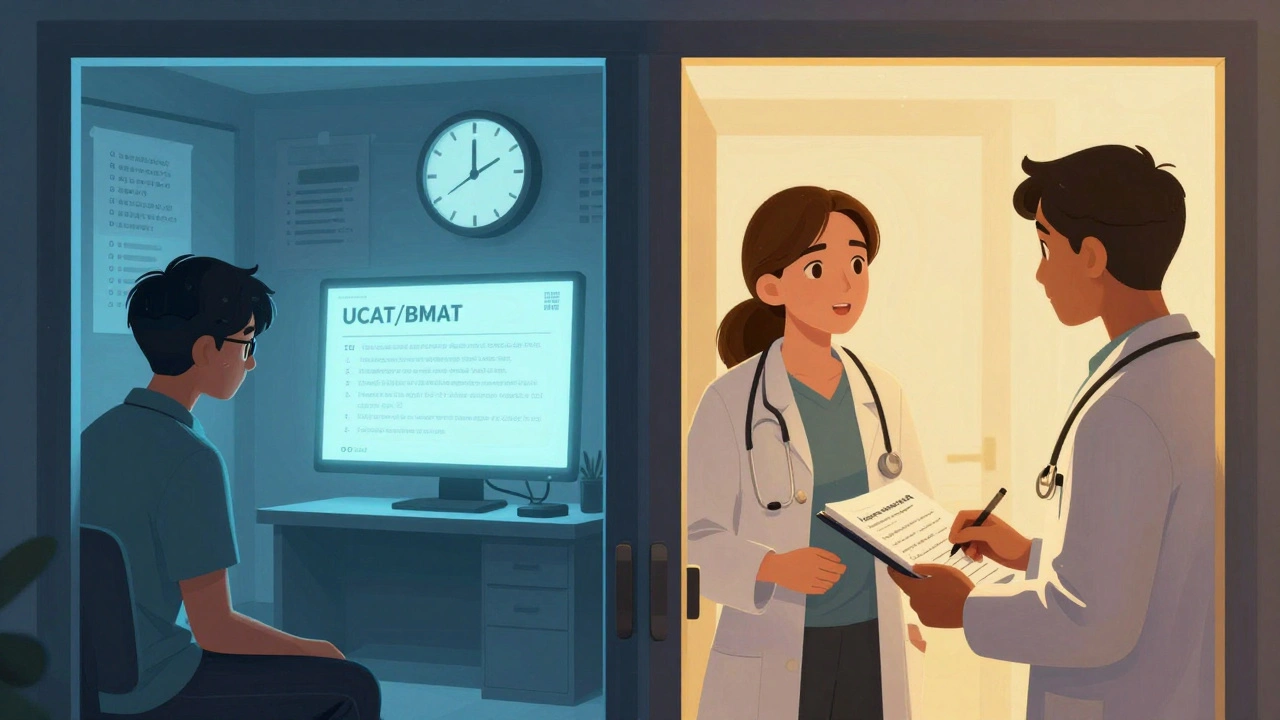
How to Find Schools That Don’t Require UCAT or BMAT
You can’t rely on general advice or forums. Each school changes its requirements yearly. The only reliable source is the UCAS course search tool. Filter by “Medicine” or “Dentistry,” then look at the “Entry Requirements” section for each program. If you don’t see UCAT or BMAT listed, you’re likely looking at a test-free option.
Here’s a quick list of UK medical schools that didn’t require UCAT or BMAT in 2025:
- Cardiff University
- University of Central Lancashire (UCLan)
- University of Buckingham
- University of Sunderland (Dentistry)
- University of East Anglia (Dentistry)
- St George’s, University of London (for some international applicants)
Always double-check the official university website. UCAS can be outdated by a few weeks.
What Do These Schools Look For Instead?
If you’re avoiding UCAT and BMAT, you need to stand out in other ways. These schools prioritize:
- Academic excellence: Most require A*AA or equivalent. No exceptions.
- Relevant work experience: Shadowing a doctor, volunteering in a care home, or even working as a healthcare assistant counts. Don’t fake it-admissions teams spot generic statements.
- Personal statement: This is your chance to show why you want medicine, not just why you’re good at science. Be specific. Mention a real moment that changed your perspective.
- Interview performance: Many use MMIs. Practice with friends. Record yourself. Answer questions like, “What would you do if a patient refused treatment?” with empathy, not textbook answers.
One applicant from Manchester got into Cardiff without UCAT because her personal statement described how she helped her grandmother navigate the NHS after a stroke. She didn’t have 100 hours of volunteering-just one deep, honest story.
Can You Apply to Both Test and Non-Test Schools?
Yes. You can apply to five medical schools through UCAS, mixing test-based and test-free options. Many students do this to hedge their bets. For example: apply to UCL (requires UCAT), Manchester (requires UCAT), Cardiff (no test), UCLan (no test), and Buckingham (SAT alternative).
This strategy increases your chances without doubling your workload. You don’t need to prep for UCAT if you’re only applying to two test-based schools. Focus your energy on the schools that match your strengths.

What If You Already Took UCAT or BMAT and Did Poorly?
You’re not out of options. Some schools, like the University of Central Lancashire, say they don’t consider UCAT scores at all. Even if you scored in the 20th percentile, it won’t hurt you if you’re applying to them.
Others, like the University of Buckingham, will look at your score but weigh it less than your personal statement or interview. A low UCAT score won’t automatically reject you if the rest of your application is strong.
Don’t assume a bad score ends your chances. It just means you need to apply strategically.
Preparing for Non-Test Routes: A Realistic Plan
If you’re skipping UCAT and BMAT, your prep looks different:
- Get top grades: Aim for A*A*A or IB 38+. No shortcuts.
- Find meaningful experience: Spend 40-60 hours in a clinical or care setting. Don’t count hours-focus on what you learned.
- Write a personal statement that feels human: Avoid clichés like “I want to help people.” Instead, say: “I realized medicine wasn’t about fixing problems-it was about listening. That happened when I sat with my neighbor during her chemo sessions.”
- Practice MMIs: Use free online MMI stations. Time yourself. Record answers. Get feedback.
- Apply to 2-3 test-free schools: Make sure they’re realistic based on your grades.
One student from Birmingham applied to Cardiff, UCLan, and Buckingham. She got into all three. She didn’t take UCAT. She didn’t take BMAT. She just had better grades, a stronger personal statement, and a clear interview presence.
Why This Matters Now More Than Ever
In 2025, over 1,200 UK medical school applicants didn’t take UCAT or BMAT-and nearly 40% of them got offers. That’s not a fluke. It’s a growing trend. Universities are moving away from standardized tests because they don’t predict success in medical school as well as real-world experience and communication skills.
Admissions teams want doctors who can talk to patients, not just ace multiple-choice questions. If you’re better at storytelling than test-taking, there’s a place for you.
Do any UK medical schools not require any entrance tests at all?
Yes. Cardiff University, the University of Central Lancashire, and the University of Buckingham do not require UCAT or BMAT for undergraduate medicine. They rely on academic grades, personal statements, and interviews instead. Some dentistry programs, like those at Sunderland and UEA, also have their own internal assessments instead of national tests.
Can I use my SAT or AP scores instead of UCAT or BMAT?
Only a few schools accept them. The University of Buckingham explicitly allows SAT scores (minimum 1350) and two APs in Chemistry and Biology in place of UCAT/BMAT. Other schools may consider them for international applicants on a case-by-case basis, but you must contact admissions directly to confirm.
Is it harder to get into medical school without taking UCAT or BMAT?
No-it’s just different. Schools without entrance tests often have higher academic requirements. For example, Cardiff requires A*A*A, while UCAT-requiring schools may accept A*AA. You’re trading one challenge (a high-stakes test) for another (top grades and a standout personal statement). Neither is easier, but one might suit your strengths better.
What if I already took UCAT and scored low? Can I still apply to schools that don’t require it?
Absolutely. Schools like UCLan and Buckingham don’t look at UCAT scores at all. Even if you applied to a mix of test and non-test schools, your low UCAT score won’t affect your application to the ones that don’t use it. Focus on strengthening your personal statement and interview prep.
Are there any disadvantages to applying to schools without UCAT or BMAT?
The main disadvantage is that these schools often have fewer spots available. For example, Cardiff admits only about 180 medical students per year, compared to 300+ at UCL or Manchester. Competition is still fierce, but it’s based on different criteria. You need stronger grades and a more compelling narrative.
If you’re reading this because you’re worried about UCAT or BMAT, remember: you’re not behind. You’re just choosing a different route. Medicine needs people who can connect, not just calculate. Your path might not be the most common one-but it’s still valid.