
If you're applying to a university in the UK, you're probably staring at the UCAS form right now wondering where to even begin. It’s not just another application. It’s your one shot to get into the course you want, and it’s different from anything you’ve done before. There’s no portal for each school - one form, one fee, and you can apply to up to five universities. But that simplicity hides a lot of traps. Miss a deadline? Your application vanishes. Write a weak personal statement? Even top grades won’t save you. This guide cuts through the noise. No fluff. Just what actually matters.
What is UCAS, and why does it matter?
UCAS stands for the Universities and Colleges Admissions Service. It’s the centralized system that handles undergraduate applications for almost every university in the UK. Whether you’re applying to Oxford, Manchester, or a small specialist college in Wales, you use UCAS. That means you don’t need to fill out five separate forms. One application, one payment (£28 for one choice or £29 for five), and you’re in the system. But here’s the catch: UCAS doesn’t make decisions. Universities do. Your job is to give them everything they need to say yes.
There’s no way around it - if you want to study in the UK as an undergraduate, UCAS is the only route. Even if a university says they accept direct applications, they’ll still ask you to submit through UCAS. There are exceptions - like some art schools or postgraduate programs - but for 98% of undergrad courses, UCAS is mandatory.
When should you start?
Start now. Seriously. Even if you’re not ready to hit submit, you need to be thinking about this in October 2025. The main deadline for most courses is January 31, 2026. But if you’re applying to Oxford, Cambridge, or any course in medicine, dentistry, or veterinary science, the deadline is October 15, 2025. That’s over two months ago. If you missed it, you’re already behind.
That means if you’re applying for a standard course - like psychology, business, or engineering - you have until the end of January. But don’t wait. Universities start reviewing applications in November. The earlier you submit, the more time they have to consider you. And if you’re applying from outside the UK, you need extra time for visa paperwork and document verification.
Step 1: Create your UCAS account
Go to ucas.com and click “Apply.” You’ll need a valid email address - not a school one, because you’ll still be using it after you graduate. Pick a password that’s strong but something you won’t forget. UCAS will send you a confirmation email. Click it. Then log in.
Once you’re in, you’ll see your dashboard. This is your control center. Everything you do - from adding your education history to checking your application status - happens here. Bookmark it. Check it every day. UCAS doesn’t send reminders. If you miss a step, you’re on your own.
Step 2: Fill in your personal details
This part seems simple, but it’s where most people mess up. Your name must match exactly what’s on your passport or ID card. No nicknames. No middle names unless they’re legally part of your name. If you’ve changed your name, you need official documentation ready to upload.
Your address matters too. If you’re applying from outside the UK, enter your current home address. Don’t use your school’s address unless you live there full-time. UCAS uses this to determine your fee status - UK, EU, or international. That affects how much you pay and whether you qualify for financial aid.
Don’t skip the nationality and residency questions. If you’ve lived in the UK for three years or more before starting your course, you might qualify for home fee status. That can save you £29,000 over three years. Get this wrong, and you’ll be charged international rates by mistake.
Step 3: Add your education history
Start with your most recent qualification and work backward. If you’re in your final year of high school, list your current courses and predicted grades. If you’ve already graduated, list your diploma or degree. UCAS doesn’t care about your middle school grades. Only post-16 qualifications matter.
For international students: Translate your grades into the UK system. If you’re from the US, list your GPA and the scale (e.g., 4.0). If you’re from India, convert your percentage to UCAS Tariff points. Most universities publish conversion tables on their websites. If you’re unsure, use the UCAS Tariff calculator. Don’t guess. A wrong conversion can make your application look weaker than it is.
Don’t leave gaps. If you took a year off, explain why. “Took time off to travel” is fine. “Took time off” is not. Be specific. Universities want to see you’ve used your time productively.
Step 4: Choose your courses
You can pick up to five courses. You don’t have to pick five. One is enough. But if you only pick one and get rejected, you’re stuck. Use all five slots wisely.
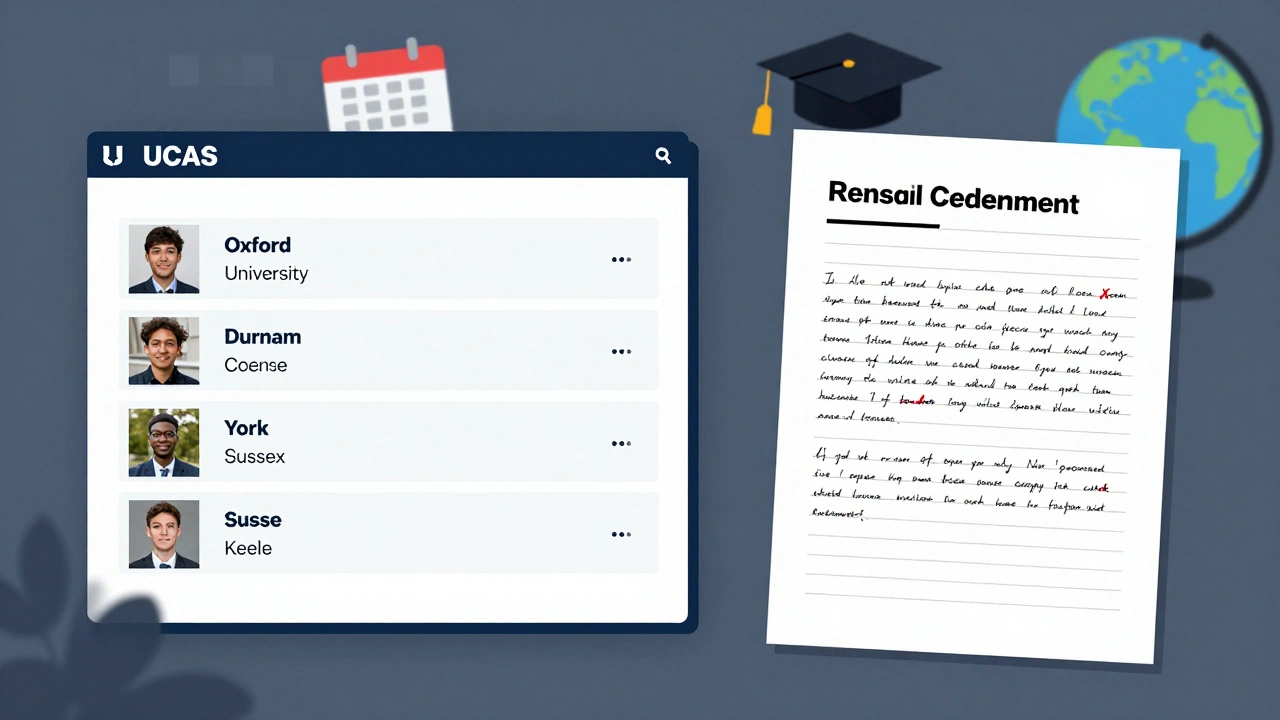
Don’t just list the most famous schools. Pick a mix: one reach, two solid matches, and one or two safety options. For example: Oxford (reach), Durham (match), York (match), Sussex (safety), and Keele (safety). Make sure the courses are actually different. Don’t apply to five versions of “Business Management” at different schools. That looks lazy.
Check the entry requirements for each course. Some require specific subjects. A biology degree might need A-level Chemistry. A computer science course might require Maths. If you don’t have the right subjects, your application gets auto-rejected. UCAS won’t warn you. You have to check yourself.
Step 5: Write your personal statement
This is the most important part of your application. It’s your 4,000 characters (including spaces) to convince them you’re not just another applicant. You have 47 lines. Use every one.
Start with why you want to study this subject. Not “I’ve always liked science.” Say: “I started researching renewable energy after seeing how solar panels transformed my uncle’s farm in Kenya.” Then show, don’t tell. Did you start a club? Write a blog? Take a MOOC? Do a project? Mention it. Include outcomes. “My school’s recycling program reduced waste by 40%.”
Don’t list your achievements like a resume. Connect them to your passion. If you played soccer, don’t say “captain of team.” Say: “Leading a team taught me how to manage conflict under pressure - a skill I’ll use in group research projects.”
Never copy a template. Universities have read thousands of them. They know the phrases: “Since childhood,” “I am passionate,” “I want to make a difference.” Be real. Be specific. Be you.
Step 6: Get your reference
You need a reference from someone who knows your academic abilities - usually a teacher, counselor, or tutor. Don’t ask your parent or a coach. They won’t carry weight.
Give your referee a head start. Share your personal statement. Tell them your top three course choices. Remind them of your grades and projects. Ask them to highlight your curiosity, work ethic, and ability to think critically. A vague reference like “Alex is a good student” won’t help. A strong one says: “Alex independently completed a 12-week data analysis project using Python - a rare initiative for a 17-year-old.”
Give them at least three weeks. Follow up politely. If they haven’t submitted by the deadline, email UCAS. They can chase it for you.
Step 7: Submit and track
Before you hit submit, read everything twice. Check your course codes. Confirm your predicted grades. Make sure your reference is marked as “submitted.”
After you submit, UCAS will email you a confirmation. Keep it. Then log in daily. You’ll see your application status: “Received,” “Under Review,” “Offer Made,” or “Rejected.” If you get an offer, you’ll have until June 10 to accept or decline. You can hold two offers - one firm and one insurance - until August.
If you miss the January deadline, you can still apply through Clearing. But that’s a scramble. You’ll be choosing from whatever courses still have space. Don’t wait for it.

What happens after you apply?
Some courses require interviews or entrance tests. Oxford, Cambridge, and medicine programs often do. If you’re invited, treat it like a job interview. Practice answering “Why this course?” and “What’s your biggest academic failure?” Be ready to discuss your personal statement in detail.
Some universities send additional forms - like a supplementary questionnaire or writing sample. Don’t ignore them. They’re part of your application.
If you get rejected, don’t panic. You can still use Clearing. Or you can reapply next year. Many students do. Use the time to strengthen your profile - take a relevant online course, volunteer, or get a job in the field.
Common mistakes to avoid
- Waiting until the last minute to start - applications get lost in the pile.
- Using the same personal statement for every course - universities notice.
- Ignoring entry requirements - you won’t get a second chance.
- Choosing five similar courses - it makes you look unsure.
- Forgetting to check your spam folder - UCAS emails get filtered.
- Not verifying your reference was submitted - it’s your responsibility.
Final checklist before you hit submit
- Personal statement under 4,000 characters?
- All predicted grades entered correctly?
- Course codes match exactly what’s on the university website?
- Reference submitted and confirmed?
- Payment completed?
- Spelling and grammar checked?
If you’ve done all this, you’ve done more than 80% of applicants. You’re ready.
Can I apply to UK universities without UCAS?
Almost always, no. UCAS is the only way to apply for undergraduate courses at UK universities. A few art schools or postgraduate programs might accept direct applications, but for standard degrees - business, engineering, law, etc. - UCAS is mandatory. Even if a university says you can apply directly, they’ll still require you to submit through UCAS. Skip it, and your application won’t be processed.
What if I miss the January 31 deadline?
You can still apply through Clearing, which runs from July to October. But your options shrink dramatically. You’ll be choosing from courses that still have vacancies - often less competitive schools or programs with lower entry requirements. You won’t get to pick your top choices. If you’re serious about a specific university or course, meet the January deadline. Clearing is a backup, not a plan.
How do I know if my grades are good enough?
Check the course entry requirements on each university’s website. They list grades like AAB or 320 UCAS Tariff points. If you’re international, use the UCAS Tariff calculator to convert your grades. For example, a US GPA of 3.7 on a 4.0 scale equals about 144 UCAS points. If your predicted grades are below the requirement, consider applying to a different course or university. Don’t waste a slot on a course you’re unlikely to get into.
Can I change my course choices after submitting?
Yes, but only before the application is sent to universities. Once you submit, you can’t change your course choices. If you realize you made a mistake before hitting submit, you can edit them. After submission, you can only add a new choice through UCAS Extra - but only if you haven’t received any offers yet. Extra runs from late February to July. Use it if you missed your top pick, but don’t rely on it.
Do I need to take an English test like IELTS?
If your first language isn’t English and you haven’t studied in an English-speaking system for at least two years, you’ll need to prove your language skills. Most universities require IELTS 6.5 overall, with no band below 6.0. Some top schools want 7.0. Check each course’s requirements. You can take the test anytime, but make sure your scores arrive before the deadline. UCAS doesn’t process applications without proof of English proficiency.
How long does it take to get a decision?
It varies. Some universities respond within two weeks. Others take up to eight weeks. If you applied before October 15, you’ll usually hear back by January. If you applied in January, expect decisions between February and April. You can check your status online anytime. Don’t call the university - they won’t give you updates faster than UCAS does.
What to do next
If you’ve submitted your application, congratulations. Now focus on preparing for interviews, keeping your grades up, and researching accommodation options. If you haven’t started yet - don’t wait. The clock is ticking. Use this guide as your checklist. One step at a time. You’ve got this.