
If you're thinking about going back to school after your bachelor’s degree, the UK offers more options than you might expect. It’s not just about picking a university-it’s about picking the right kind of degree. An MSc isn’t the same as an MA. An MBA isn’t just a fancy master’s. And professional qualifications? They don’t even always look like degrees. Knowing the difference can save you time, money, and a lot of confusion.
What’s an MSc?
An MSc, or Master of Science, is designed for students who want to go deeper into technical, scientific, or quantitative fields. Think engineering, computer science, data analysis, psychology, economics, or environmental science. If your undergrad was in a lab, a spreadsheet, or a code editor, an MSc is likely the next step.
Most MSc programs last one year full-time in the UK. That’s faster than in the US, but don’t mistake speed for simplicity. The workload is intense. You’ll spend most of your time in lectures, labs, and data analysis. The final project or dissertation usually makes up a third of your grade. Some programs even require you to complete an internship or industry placement.
For example, an MSc in Artificial Intelligence at Imperial College London includes modules on machine learning, neural networks, and natural language processing. Graduates often land jobs at firms like DeepMind, Rolls-Royce, or NHS Digital. The degree is respected globally because it’s grounded in measurable outcomes and technical rigor.
What’s an MA?
An MA, or Master of Arts, is the go-to for humanities, social sciences, and creative disciplines. Literature, history, philosophy, international relations, education, journalism, and fine arts-all fall under the MA umbrella.
Unlike the MSc, an MA doesn’t focus on numbers or experiments. It’s about critical thinking, writing, and interpretation. You’ll read lots of books, write essays, debate theories, and maybe produce a creative project-like a short film, a portfolio, or a research-based novel.
At the University of Edinburgh, an MA in Modern History might involve analyzing primary sources from the Cold War era, while an MA in Creative Writing at Manchester Metropolitan University asks you to submit a 20,000-word manuscript. Assessment is mostly through essays and presentations, not exams.
Many people choose an MA to shift careers. A teacher with a BA in English might get an MA in Education to become a curriculum designer. A journalist with a BA in Communications might pursue an MA in Media Studies to move into policy or academia.
What’s an MBA?
The MBA, or Master of Business Administration, is the most famous postgraduate degree in the world-and also the most misunderstood. It’s not for everyone. It’s for people who want to lead, manage, or start businesses.
Unlike the MSc or MA, an MBA is heavily focused on real-world business problems. You’ll study finance, marketing, strategy, operations, and leadership. But the real value isn’t in the lectures-it’s in the network. Classmates are often mid-career professionals with 5-10 years of work experience. You’ll learn from them as much as from professors.
Top UK schools like London Business School, Cambridge Judge, and Oxford Saïd offer one-year MBAs. Most require at least two years of work experience. Some even ask for GMAT or GRE scores. The cost? Between £30,000 and £60,000. But the return? Graduates from these schools often see salary increases of 50-100% within three years.
It’s not a degree for recent grads. If you’ve never managed a team or handled a budget, an MBA might not be the best fit. For those who have, it’s a fast track to senior roles in consulting, tech, finance, or entrepreneurship.

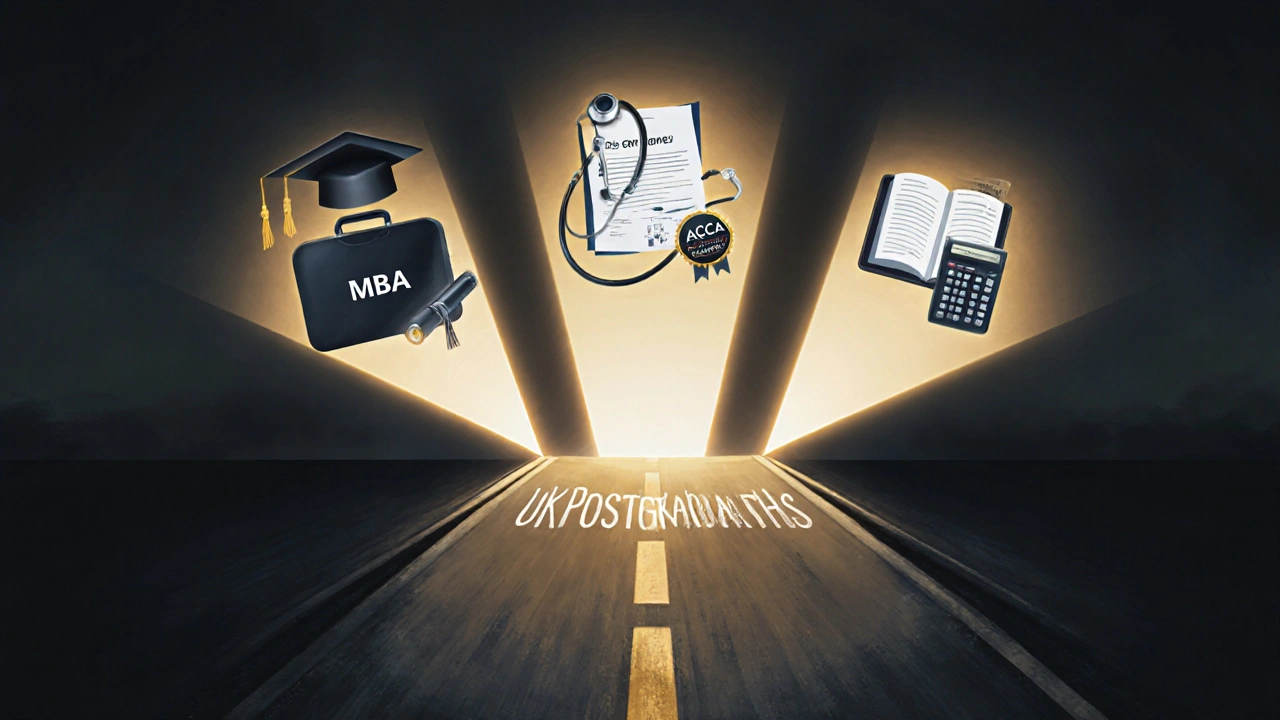
Professional Qualifications: The Hidden Path
Not every valuable postgraduate credential comes with the word “Master” in its title. In the UK, professional qualifications are often just as respected-and sometimes more practical.
Take the CFA (Chartered Financial Analyst). It’s not a degree, but it’s the gold standard in finance. Or the ACCA (Association of Chartered Certified Accountants)-required for many senior accounting roles. In law, the LPC (Legal Practice Course) is mandatory if you want to become a solicitor. In teaching, the PGCE (Postgraduate Certificate in Education) is the only way to qualify as a teacher in state schools.
These programs are usually shorter-6 to 18 months-and highly focused. They’re designed by industry bodies, not universities. That means they’re updated constantly to match what employers actually need.
For example, someone with a BA in Biology who wants to work in pharmaceutical sales might take the PGCert in Clinical Research. It’s not a full master’s, but it opens doors at companies like AstraZeneca or GlaxoSmithKline. Employers in the UK often list these qualifications right next to degrees on job postings.
How to Choose Between Them
So how do you decide? Start with your goal.
- If you want to work in tech, engineering, or research → MSc
- If you want to write, teach, or analyze culture and society → MA
- If you want to lead teams, run a company, or switch into business → MBA
- If you want to become a teacher, lawyer, accountant, or analyst → Professional qualification
Don’t pick based on prestige. Don’t pick because your friend did it. Pick based on what you’ll actually do after graduation.
Also, check the accreditation. A university degree should be recognized by the UK Quality Assurance Agency (QAA). Professional qualifications should be awarded by bodies listed on the UK Professional Standards Framework. If it’s not on those lists, ask why.
Cost and Funding
Tuition for UK postgraduate degrees ranges from £12,000 to £45,000 per year, depending on the field and school. MSc and MA programs are usually on the lower end. MBAs and professional qualifications can be much higher.
There are scholarships, but they’re competitive. The Chevening Scholarship covers full tuition and living costs for international students. Some universities offer merit-based discounts of up to 50%. If you’re from the EU or have UK residency, you might qualify for government loans through Student Finance England.
Professional qualifications often have payment plans. ACCA, for example, lets you pay per exam. Some employers even pay for your CFA or LPC if you commit to staying with them for a few years.
What Employers Really Want
UK employers don’t care if you have an MA or an MSc. They care if you can solve their problems.
Recruiters at firms like Deloitte, Barclays, or NHS Trusts look for three things:
- Relevant skills (Can you analyze data? Write reports? Lead projects?)
- Practical experience (Internships? Work placements? Volunteering?)
- Proof of commitment (Did you finish your degree? Did you pass your exams?)
A degree alone won’t get you hired. But a degree + a project + a portfolio + a recommendation from a professor? That’s powerful.
Many UK employers value professional qualifications more than degrees in certain fields. For example, in accounting, ACCA is often preferred over an MSc in Finance. In teaching, PGCE is non-negotiable. In project management, PRINCE2 certification can outweigh a master’s.
What Comes After?
After your postgraduate degree or qualification, you have options:
- Work in the UK under the Skilled Worker Visa (if you’re international)
- Apply for a PhD if you want to research
- Return home with a credential that’s respected globally
- Start your own business using what you learned
The UK doesn’t just hand you a degree. It gives you a launchpad. But you have to use it.
Can I do an MSc without a science background?
Yes, but it depends. Some MSc programs accept students from unrelated backgrounds if they complete a pre-master’s course or demonstrate relevant experience. For example, someone with a BA in English might get into an MSc in Data Science if they’ve taken online coding courses and built a portfolio of data projects. Schools like University College London and King’s College London offer conversion MSc programs specifically for this.
Is an MBA worth it if I’m not in business?
Only if you want to move into leadership. An MBA teaches management skills that apply to nonprofits, healthcare, arts organizations, and tech startups-not just banks and consultancies. If you’re a nurse wanting to run a hospital unit, or a teacher aiming to become a school principal, an MBA can help. But if you just want to deepen your subject knowledge, an MA or MSc is better.
Do I need to take the IELTS for a UK postgraduate degree?
Most universities require proof of English proficiency if you’re not from a majority-English-speaking country. IELTS Academic is the most common, with a minimum score of 6.5 overall (and often 7.0 in writing). Some schools accept TOEFL or PTE. Always check the specific requirements for your course-some programs, especially in creative fields, may waive it if you’ve studied in English before.
Can I work while studying for a postgraduate degree in the UK?
Yes. International students on a Student Visa can work up to 20 hours per week during term time and full-time during holidays. Many students take on campus jobs, tutoring, or internships related to their field. This helps with expenses and builds experience. Just make sure your visa allows it and your program doesn’t prohibit it.
Are UK postgraduate degrees recognized in the US?
Yes, generally. UK degrees are well-respected in the US, especially from top institutions like Oxford, Cambridge, LSE, and Imperial. Employers and graduate schools recognize the intensity of the one-year format. Some US institutions may ask for a credential evaluation from agencies like WES, but most accept UK degrees without issue.
Final Thoughts
The UK doesn’t offer one-size-fits-all postgraduate degrees. Each path-MSc, MA, MBA, professional qualification-serves a different purpose. Choose based on your goals, not your resume. If you want to build technical skills, go for the MSc. If you want to understand human behavior, choose the MA. If you want to lead, get the MBA. If you want to practice a regulated profession, earn the qualification.
There’s no shortcut. But there is a clear path. Figure out where you want to end up, then pick the right tool to get there.