
When a student in the UK struggles to focus in class, gets overwhelmed by noise, or can’t seem to tie their shoes despite repeated tries, it’s not about laziness or poor discipline. More often than not, it’s about how their brain works. Neurodivergent students - those with ADHD, autism, or dyspraxia - don’t need to be fixed. They need understanding, the right tools, and systems that work for them, not against them.
What Neurodivergence Really Means in UK Classrooms
Neurodivergence isn’t a diagnosis. It’s a category. It covers natural variations in how brains process information. In UK schools, this includes ADHD (attention-deficit/hyperactivity disorder), autism (autism spectrum disorder), and dyspraxia (developmental coordination disorder). These aren’t rare. One in five children in England shows signs of neurodivergence. That’s roughly 20% of every classroom.
ADHD isn’t just about being distracted. It’s about inconsistent focus. A student might ace a project they care about, then blank on a simple homework task. Autism isn’t about being "shy" - it’s about sensory overload, rigid thinking, and difficulty reading social cues. Dyspraxia? It’s not clumsiness. It’s the brain struggling to send clear signals to the body. Writing a paragraph can take three times longer. Holding a pencil feels like wrestling with a slippery stick.
These aren’t "learning disabilities" in the old sense. They’re different ways of learning. The problem isn’t the student. It’s the system.
The UK’s Legal Framework: What Schools Must Do
The UK has clear legal obligations. The Equality Act 2010 requires schools to make "reasonable adjustments" for neurodivergent students. That means not just accommodating, but actively redesigning environments so these students aren’t shut out.
Then there’s the SEND Code of Practice (Special Educational Needs and Disability). It’s the rulebook schools must follow. It says: if a student needs extra help to access education, the school must provide it. That includes:
- Extra time on exams
- Quiet testing rooms
- Use of speech-to-text software
- Flexible seating arrangements
- Visual schedules and clear instructions
But here’s the catch: schools aren’t always funded properly. Many rely on parents to push for support. A 2024 report from the National Autistic Society found that 63% of autistic students in England didn’t get the support outlined in their Education, Health and Care Plan (EHCP). That’s not a failure of the system - it’s a failure of implementation.
ADHD: The Invisible Distraction
ADHD students aren’t lazy. They’re wired to need movement, novelty, and immediate feedback. Sitting still for 45 minutes? That’s torture. A 2023 study from University College London found that ADHD students who were allowed to move - standing desks, fidget tools, short walk breaks - improved task completion by 41%.
What works in practice?
- Break tasks into 10-minute chunks with clear start/stop signals
- Use timers - not to pressure, but to create rhythm
- Let them chew gum or use a stress ball during quiet work
- Give verbal reminders before transitions: "In two minutes, we’re switching to math"
Teachers who treat ADHD as a behavior problem miss the point. It’s a regulation problem. The brain can’t filter out noise, delay impulses, or switch tasks smoothly. The solution isn’t punishment. It’s structure.
Autism: Beyond the Stereotypes
Autism isn’t one thing. One student might be nonverbal but brilliant at math. Another might talk nonstop about trains but panic when the fire alarm goes off. The common thread? Sensory sensitivity and predictability.
UK schools often assume autistic students need "social skills training." That’s backwards. The real fix? Make the environment fit them.
- Use visual timetables - pictures, not words
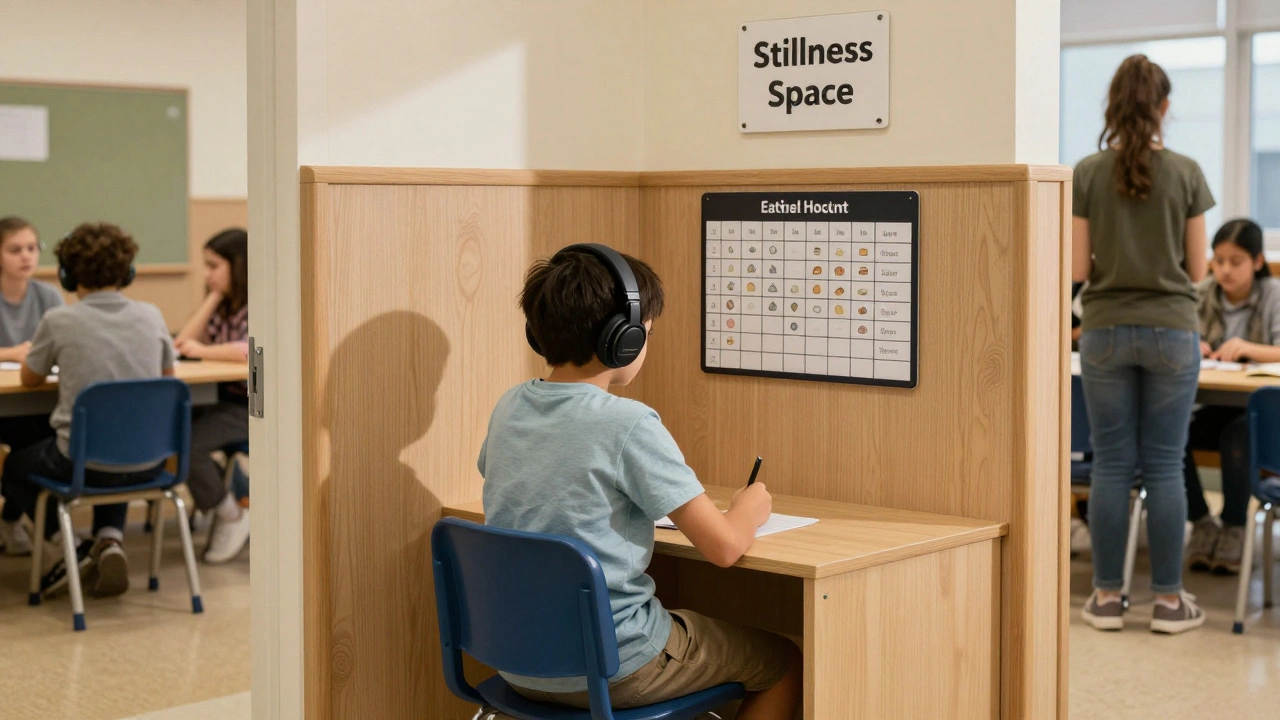
- Let them wear noise-canceling headphones without asking permission
- Warn about changes: "Tomorrow, the PE teacher is sick. Mrs. Patel will cover."
- Offer quiet zones - not punishment, but refuge
- Train staff on stimming: rocking, hand-flapping, pacing - these aren’t disruptions. They’re self-regulation
A 2025 survey of 800 UK autistic students found that those with access to sensory-friendly classrooms were 3x more likely to attend school daily. That’s not a perk. That’s a lifeline.
Dyspraxia: The Hidden Struggle with Movement
Dyspraxia gets ignored. Why? Because it doesn’t show up on a test score. A student with dyspraxia might understand calculus but can’t hold a pen long enough to write the answer. They trip over their own feet. They forget where they put their bag. They can’t tie shoelaces - not because they’re careless, but because their brain can’t coordinate the muscles.
What schools often miss:
- Handwriting isn’t a skill everyone can master - offer typing from Year 3
- Use digital notes, voice recorders, or scribes during exams
- Provide adaptive tools: pencil grips, weighted pens, keyboard shortcuts
- Allow extra time for moving between classes - corridors are overwhelming
- Don’t call them "clumsy." Call it motor planning difficulty
A 2024 study in the British Journal of Special Education showed that dyspraxic students who used speech-to-text software improved their written output by 67%. That’s not accommodation. That’s equity.
What Actually Works: Real Strategies from UK Classrooms
Some schools are getting it right. Take St. Mary’s Primary in Bristol. They started with one change: no more raising hands. Instead, students use colored cards - green for "I understand," yellow for "I need help," red for "I’m overwhelmed." Teachers scan the room. No one feels singled out.
Or consider Kingsmead High in Leeds. They redesigned their timetable:
- Math and science - morning, when focus is highest
- Art and PE - after lunch, for movement and creativity
- Quiet hour - 20 minutes daily, no talking, no screens
- Peer buddies - neurotypical students trained to help with transitions
Results? Attendance rose 19%. Suspension rates dropped 42%. And students? They said they felt seen.

The Bigger Picture: Why This Matters Beyond Grades
Supporting neurodivergent students isn’t about charity. It’s about justice. These kids aren’t falling behind because they’re broken. They’re falling behind because the system is rigid.
Without support, neurodivergent students are 4x more likely to be excluded from school. They’re 3x more likely to develop anxiety or depression by age 16. They’re far less likely to go to university - not because they can’t, but because no one showed them how to ask for help.
But when schools adapt? The outcomes change. A 2025 Department for Education pilot in 120 schools found that neurodivergent students with full support were 78% more likely to achieve expected GCSE grades. Not because they were "fixed." Because the system finally matched their needs.
What Parents and Students Can Do
Don’t wait for the school to act. Start here:
- Request an Education, Health and Care Plan (EHCP) - it’s your legal right
- Document everything: emails, observations, medical reports
- Ask for a SENCO (Special Educational Needs Coordinator) meeting - don’t accept "we’ll see"
- Use the UK government’s SEND Information Advice and Support Service - free, confidential, nationwide
- Teach your child to say: "I need this to learn. Can we try it?"
Students, too: if you’re struggling, you’re not alone. Ask for help. Use your rights. You don’t have to fit in. You just need to be heard.
Final Thought: Inclusion Isn’t a Program. It’s a Mindset.
There’s no magic wand. No single tool that fixes everything. But there’s a simple truth: when you design education for the most vulnerable, you make it better for everyone.
A quiet room helps a student with autism. It also helps a student with anxiety. A visual schedule helps a dyspraxic child. It helps a new immigrant who doesn’t speak English yet. A standing desk helps a student with ADHD. It helps a tall kid who can’t fit in a chair.
Neurodivergence isn’t a problem to solve. It’s a reminder that learning doesn’t look the same for everyone. And that’s okay. In fact, it’s necessary.
What legal rights do neurodivergent students have in UK schools?
Under the Equality Act 2010, schools must make reasonable adjustments to ensure neurodivergent students aren’t disadvantaged. This includes extra time, sensory accommodations, modified assessments, and access to assistive technology. The SEND Code of Practice requires schools to identify needs early and provide support through Education, Health and Care Plans (EHCPs) when necessary. Parents can request an EHCP assessment at any time - schools must respond within six weeks.
Can a student with ADHD get extra time in exams?
Yes. Students with ADHD are entitled to extra time in GCSEs, A-levels, and other formal assessments - typically 25% more, sometimes up to 50% if documented need is severe. This isn’t a special favor. It’s a legally required adjustment. Schools must apply through the exam board using evidence from teachers and specialists. A diagnosis alone isn’t enough - you need proof that the condition impacts exam performance.
Is dyspraxia considered a learning difficulty in the UK?
Yes. Dyspraxia is classified as a specific learning difficulty under the SEND Code of Practice. It’s recognized as a motor coordination disorder that affects writing, organization, and daily tasks. While it doesn’t impact intelligence, it can severely affect academic output. Schools must provide accommodations such as typing instead of handwriting, use of voice recorders, and extra time for tasks requiring fine motor skills.
How do I get an Education, Health and Care Plan (EHCP) for my child?
Start by asking your child’s school to request an EHCP assessment from the local authority. You can also request one directly. Gather evidence: teacher reports, medical records, therapy assessments, and examples of how your child struggles in school. The local authority has six weeks to decide whether to proceed. If approved, a multi-disciplinary team will create a legally binding plan detailing support, goals, and funding. If denied, you can appeal to the First-tier Tribunal.
What should I do if my child’s school refuses to provide support?
Document every conversation and refusal in writing. Contact your local SEND Information, Advice and Support Service (IASS) - they’re free and independent. They can help you draft formal letters, attend meetings, and understand your rights. If the school continues to ignore legal obligations, you can file a complaint with the Local Government Ombudsman or appeal to the Special Educational Needs and Disability Tribunal. You are not alone - thousands of families have successfully challenged schools in the UK.