
Imagine you're sitting in a glass-walled office in London or Manchester. The interviewer leans back, asks a tricky question about a time you failed, and waits. Your heart pounds. Do you ramble? Do you freeze? Or do you deliver a crisp, structured story that makes them nod along? That's where the STAR method comes in.
In the UK, most professional interviews aren't just about your CV. They are competency-based. Recruiters want proof that you can handle real-world pressure. They don't just want to hear that you are "a team player." They want a specific example of how you worked with a difficult colleague to save a project deadline. The STAR technique is the standard framework used by HR departments across the UK to help candidates organize these stories effectively.
Why the STAR Method Dominates UK Hiring
The UK labor market has a distinct preference for behavioral interviewing. Unlike some regions where technical skills might overshadow soft skills, British employers often view cultural fit and problem-solving ability as equal to technical proficiency. The STAR method provides a neutral, structured way to assess these soft skills without bias.
When you use this framework, you move away from vague generalizations. Instead of saying, "I am good at leadership," you describe a specific situation where you led a team through a crisis. This shift from abstract claims to concrete evidence is what hiring managers look for. It reduces the risk of hiring someone who sounds good on paper but struggles in practice.
Furthermore, the structure helps you manage time. Interviewers have a limited number of minutes per candidate. A rambling answer wastes their time and yours. A STAR-structured answer is concise, logical, and easy to follow. It shows that you can think clearly under pressure, which is exactly the skill they are testing.
Breaking Down the Four Components
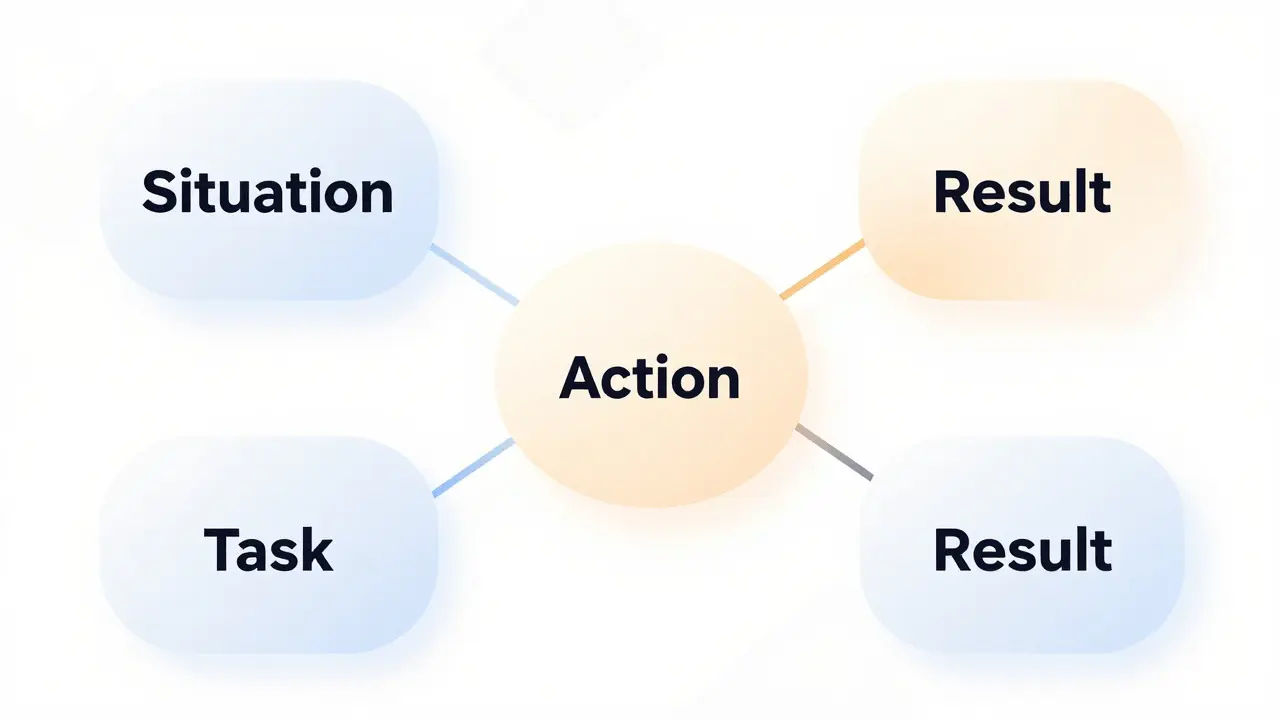
STAR is an acronym that stands for Situation, Task, Action, and Result. Each part plays a specific role in building your narrative. Understanding the weight of each section is crucial for delivering a balanced answer.
- Situation: Set the scene. Keep this brief. Provide enough context for the interviewer to understand the stakes, but don't bore them with irrelevant details. Mention the company, the project, or the specific challenge you faced.
- Task: Define your specific responsibility. What was your goal? What were you trying to achieve? This distinguishes your role from the rest of the team.
- Action: This is the core of your answer. Describe exactly what you did. Avoid saying "we" too much. Use "I" to highlight your individual contribution. Explain your thought process and the steps you took.
- Result: Quantify the outcome. Did sales increase? Did the project finish early? Was the conflict resolved? End with a positive impact or a lesson learned.
A common mistake candidates make is spending 80% of their time on the Situation and only 20% on the Action. Flip that ratio. The interviewer cares less about the background and more about how you handled it.
Crafting Your Stories Before the Interview
You cannot rely on improvisation during a high-stakes interview. You need a bank of prepared stories. Most UK job descriptions list 5 to 7 key competencies, such as communication, problem-solving, teamwork, and leadership. Prepare one strong STAR story for each competency.
Start by reviewing your past roles. Pick three to five significant projects or challenges. For each one, write down the S, T, A, and R components. Then, refine them. Ask yourself: Is the result measurable? Did I clearly state my action? Can I tell this story in under two minutes?
It helps to categorize these stories. Have one for a success, one for a failure (and how you recovered), and one for a conflict. Employers love asking about failures because it tests resilience. Having a pre-prepared story about a mistake you made and fixed shows maturity and self-awareness.
Adapting STAR for Different Job Levels
The depth of your answer should match the seniority of the role. For entry-level positions, focus on academic projects, internships, or volunteer work. The complexity of the situation doesn't need to be corporate-level; it just needs to demonstrate the required skill.
For mid-level roles, emphasize cross-functional collaboration and independent decision-making. Show how you navigated ambiguity. For senior or executive roles, the "Action" section should highlight strategic thinking. How did you influence policy? How did you allocate resources? The scale of the result should also reflect the level of the role, moving from individual task completion to departmental or company-wide impact.
| Job Level | Focus of 'Action' | Expected 'Result' Scale |
|---|---|---|
| Entry-Level | Execution of tasks, learning curve | Individual task completion, positive feedback from supervisor |
| Mid-Level | Problem-solving, collaboration, initiative | Project success, efficiency gains, team morale |
| Senior/Executive | Strategy, resource allocation, leadership | Revenue growth, market share, organizational change |
Common Pitfalls to Avoid
Even experienced professionals stumble over the STAR method if they aren't careful. One major pitfall is the "Groupthink" trap. If you say "We decided to..." without clarifying your specific role, the interviewer may wonder what you actually contributed. Always clarify your individual actions.
Another issue is the lack of quantification. Saying "it went well" is weak. Saying "we reduced processing time by 15%" is strong. UK employers value data-driven decision-making. Even if exact numbers aren't available, use approximations like "significantly improved" or "saved approximately 10 hours per week."
Finally, avoid negative framing. If you are discussing a failure, don't dwell on the mistake. Spend 30 seconds on the error and 90 seconds on the corrective action and the positive outcome. The goal is to show resilience, not incompetence.

Practical Example: Handling a Difficult Client
Let's look at a concrete example. Suppose you are applying for a customer service manager role. The interviewer asks: "Tell me about a time you dealt with a difficult client."
Situation: "In my previous role at a retail chain, we had a long-term corporate client who was unhappy with delivery delays. Their contract was worth £50,000 annually, so retention was critical."
Task: "My goal was to resolve their complaint within 48 hours to prevent them from switching to a competitor."
Action: "I scheduled an immediate video call with their procurement lead. I listened to their concerns without interrupting. I then audited our logistics data and identified a bottleneck in our warehouse packing process. I proposed a temporary dedicated shipping lane for their orders and offered a 10% discount on the next invoice as a goodwill gesture."
Result: "The client accepted the proposal. We retained the contract for another two years, and the new packing protocol reduced overall shipping errors by 5% across all accounts."
This answer is effective because it is specific, actionable, and results-oriented. It demonstrates communication, analytical skills, and business acumen.
Preparing for the UK Cultural Context
Interviews in the UK often have a slightly different tone compared to other regions. There is a greater emphasis on politeness and understatement. When using the STAR method, avoid sounding arrogant. Frame your achievements as collaborative efforts where you played a key role, rather than solo heroics. Phrases like "I worked closely with the team to..." resonate well, provided you still specify your individual contribution later in the 'Action' phase.
Also, be prepared for follow-up questions. After you finish your STAR story, the interviewer might dig deeper into the 'Action' section. They might ask, "What would you do differently now?" or "How did you communicate this change to your team?" Having a flexible mind allows you to pivot quickly while staying within the structured framework.
Frequently Asked Questions
How long should a STAR answer be?
Aim for 1.5 to 2 minutes. This is long enough to provide detail but short enough to keep the interviewer engaged. If you go over 3 minutes, you are likely including too much irrelevant detail in the Situation phase.
Can I use the same STAR story for multiple questions?
Yes, but tailor the focus. If one story highlights both leadership and problem-solving, you can use it for both questions. However, emphasize the relevant aspect for each specific question. For a leadership question, focus on how you motivated others. For a problem-solving question, focus on the analysis and solution.
What if I don't have a clear result for a story?
Focus on the learning or the interim outcome. If the project is ongoing, mention the current progress. If it was a personal development moment, explain how the experience changed your approach to similar situations in the future. Honesty is better than fabricating a metric.
Is the STAR method suitable for creative roles?
Yes. Even in creative fields, employers want to see how you handle deadlines, feedback, and collaboration. Use STAR to structure your response to questions about managing creative blocks or receiving critique. The structure adds professionalism to your artistic process.
How do I transition between the parts smoothly?
Use natural connectors. Instead of saying "Situation is...", say "At my last job, we faced a challenge where..." (Situation). "My specific role was to..." (Task). "To address this, I first..." (Action). "As a result, we saw..." (Result). This keeps the flow conversational rather than robotic.