
It’s 2 a.m. You’ve got an essay due at 9 a.m. You’ve skipped dinner, downed two energy drinks, and your eyes are burning. You tell yourself, Just one more hour. But that hour turns into two. And when you finally collapse, you’re not rested-you’re running on fumes. The next day, you zone out in class, forget key points, and feel like your brain is wrapped in cotton wool. Sound familiar? You’re not lazy. You’re just sleep-deprived. And for UK students, this isn’t just a bad habit-it’s a mental health crisis in slow motion.
Sleep Isn’t Optional. It’s Your Brain’s Maintenance Mode.
Your brain doesn’t shut off when you sleep. It’s busy. While you’re unconscious, it’s sorting through everything you learned that day, deleting the noise, and saving what matters. This process is called memory consolidation. Without enough sleep, your brain can’t do this properly. Studies from the University of Oxford show that students who sleep less than six hours a night remember 40% less of what they studied the day before. That’s not just inefficient-it’s a waste of time. You could study for eight hours, but if you only slept five, you might as well have studied for three.
And it’s not just memory. Sleep regulates stress hormones like cortisol. When you don’t sleep, cortisol stays high. That means your body stays in fight-or-flight mode-even when you’re just trying to finish a reading list. Over time, this leads to anxiety, irritability, and even depression. A 2025 survey by the UK Student Mental Health Network found that 68% of students who reported chronic sleep deprivation also scored in the clinically high range for anxiety. The link isn’t coincidence. It’s biology.
Why UK Students Are Sleeping Less Than Ever
It’s not just about partying or procrastination. The pressures on UK students today are different-and heavier. Tuition fees have climbed. Part-time jobs are no longer optional for many. Social media never sleeps, and neither do the expectations. Students feel like they have to be doing something productive 24/7. Why sleep when I could be revising? That mindset is dangerous.
Universities don’t help. Many lecture halls are packed, deadlines are clustered, and support services are stretched thin. A student at Manchester Metropolitan told a researcher: I have three essays due in a week, a lab report, and a group presentation. I didn’t sleep for 72 hours. I thought I was being disciplined. Turns out, I was just exhausted.
And then there’s the culture of busyness. If you say you got eight hours of sleep, people assume you’re not trying hard enough. But real productivity isn’t about burning out. It’s about working smarter. And smarter means sleeping.
What Happens When You Skip Sleep-Beyond the Tiredness
Think sleep deprivation is just about feeling groggy? Think again.
- **Decision-making crashes**. Your prefrontal cortex-the part that handles logic and impulse control-slows down. You’re more likely to pick the easy answer, skip a reading, or binge-scroll instead of studying.
- **Emotional control fades**. Small things set you off. A professor’s feedback feels like an attack. A friend’s text goes unanswered because you’re too drained to respond. Relationships fray.
- **Creativity dies**. Problem-solving needs fresh connections. Sleep helps your brain make those links. Without it, you’re stuck in the same loops. Your essay sounds flat. Your exam answers lack insight.
- **Immunity drops**. You get sick more often. One cold turns into two weeks of missed classes. Then you fall further behind. The cycle tightens.
A 2024 study from King’s College London tracked 1,200 undergraduates over a term. Those who averaged less than six hours of sleep were 2.7 times more likely to miss a deadline. They also reported 50% more panic attacks than peers who slept seven or more hours.

How to Sleep Better-Without Quitting Everything
You don’t need to quit your job, drop your course load, or turn into a monk to fix this. Small, consistent changes make the biggest difference.
- Set a sleep alarm, not just a study alarm. If you have a 9 a.m. lecture, work backward. If you need 7.5 hours, be in bed by 11:30 p.m. Set a phone reminder: Stop scrolling. Lights out in 30 minutes.
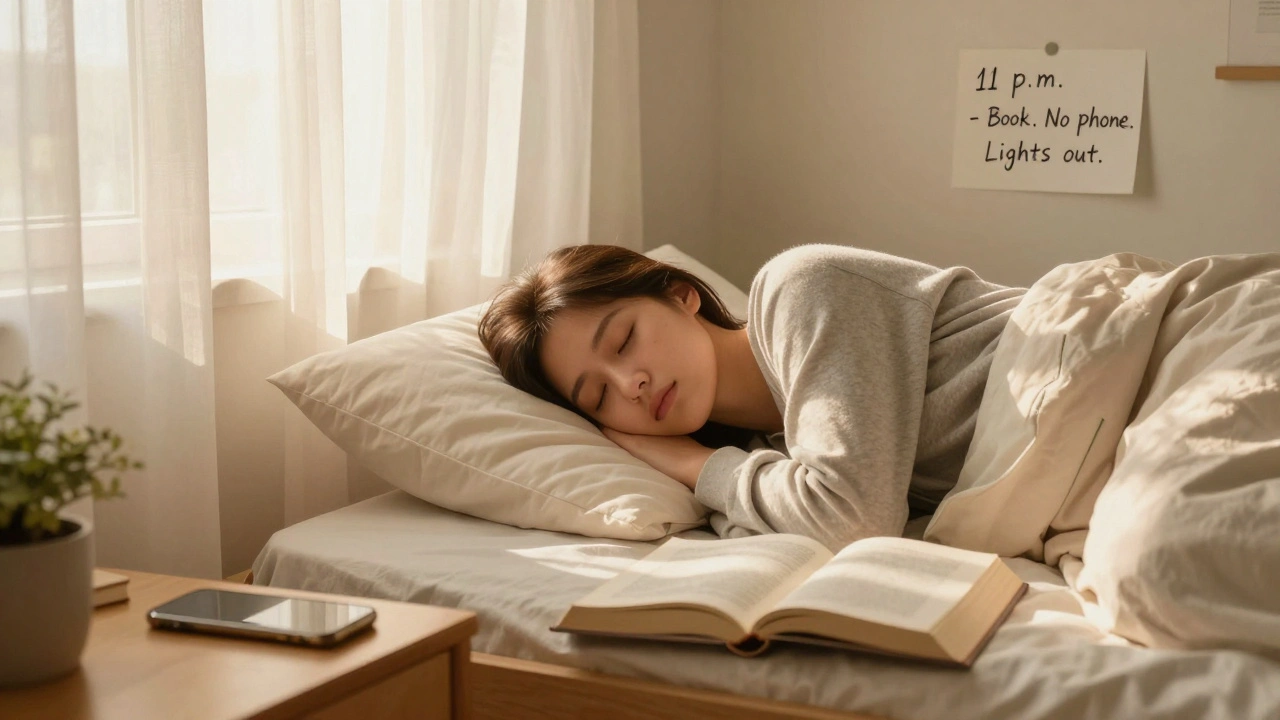
- Make your bedroom a sleep zone. No laptops. No phone charging on the nightstand. Use blue light filters after 8 p.m. If your phone is out of reach, you’re less likely to check it.
- Wind down for 20 minutes. Read a physical book. Listen to a calming playlist. Do five minutes of deep breathing. Your brain needs a signal that it’s time to switch off.
- Don’t nap after 3 p.m. Even a 20-minute nap later in the day can wreck your nighttime sleep.
- Get natural light in the morning. Open your curtains as soon as you wake up. Sunlight resets your internal clock. It’s free, fast, and more effective than any sleep supplement.
One student at Bristol University started writing her bedtime routine on her whiteboard: 11 p.m. - Book. No phone. Lights out. She stuck to it for three weeks. Her grades went up. Her panic attacks dropped. She didn’t study more. She just slept better.
What Universities Are (Slowly) Doing About It
Some UK universities are waking up to the problem. The University of Edinburgh now offers Sleep Smart workshops-free, 45-minute sessions that teach students how to track their sleep, understand circadian rhythms, and build routines. Cardiff University has quiet study zones with blackout curtains and nap pods. The University of Glasgow quietly removed all-night library access last year. The message? We want you to succeed. But not by breaking yourself.
These aren’t luxury perks. They’re necessary interventions. And they’re working. In Edinburgh, students who attended the workshops reported a 32% drop in self-reported anxiety over the term.
Sleep Is the Ultimate Study Hack
You don’t need to study longer. You need to study smarter. And the smartest thing you can do is sleep.
Think of your brain like a phone. You wouldn’t run it at 100% battery for 24 hours straight without charging. You’d plug it in. Your brain is the same. Sleep isn’t downtime. It’s the recharge. It’s the upgrade. It’s the update that makes everything else work.
Next time you feel guilty for going to bed early, remember: you’re not falling behind. You’re getting ready to catch up-faster, sharper, and calmer than you ever could on caffeine and panic.
Frequently Asked Questions
How much sleep do UK students actually need?
Most university-aged students need between 7 and 9 hours of sleep per night. Anything less than 6 hours consistently harms memory, mood, and focus. The idea that you can "get by" on 5 hours is a myth-your brain just gets worse at telling you how tired you are.
Can I catch up on sleep over the weekend?
Partially. Sleeping in on weekends helps reduce your sleep debt, but it doesn’t fully reverse the damage to your memory or stress levels. Worse, it throws off your body clock. If you sleep until noon on Saturday, you’ll struggle to fall asleep Sunday night. Consistency matters more than total hours.
Does caffeine affect my sleep even if I don’t feel it?
Yes. Caffeine can stay in your system for up to 8 hours. Even if you don’t feel wired, it reduces deep sleep-the most restorative stage. A 2023 study found that students who drank coffee after 3 p.m. had 23% less deep sleep, even if they fell asleep on time.
Is melatonin a good solution for sleep problems?
Melatonin helps reset your internal clock, especially if you’re jet-lagged or have irregular hours. But it doesn’t make you sleepy. It just tells your body it’s time to sleep. For chronic insomnia or anxiety-related sleep issues, it’s not a fix. Talk to a GP or student health service instead.
What if I have a mental health condition like anxiety or depression?
Sleep and mental health are deeply linked. Poor sleep worsens symptoms. Good sleep helps treatment work better. If you’re struggling, don’t wait until you’re overwhelmed. Talk to your university’s counselling service. Many offer free sleep coaching, mindfulness sessions, or cognitive behavioural therapy for insomnia (CBT-I)-which is proven to be more effective than sleeping pills.
Next Steps: Start Small, Sleep Better
Don’t try to overhaul your life overnight. Pick one thing: maybe it’s turning off your phone an hour before bed. Or moving your alarm clock across the room. Or writing your bedtime in your planner like an appointment.
Track it for a week. Notice how you feel. Are you less snappy? Did you remember more from your lecture? Did you finish your work faster because you weren’t foggy?
Sleep isn’t a reward for being productive. It’s the foundation. And for UK students, it’s the most powerful, free, and underused tool they’ve got.