
It’s January. The Christmas break is over. Your lectures are back. Your to-do list is longer than your sleep schedule. And for the first time since term started, you’re staring at your grades and wondering: how did I get here?
Halfway through the semester, most UK students hit a wall. Not because they’re lazy. Not because they’re bad at studying. But because the system doesn’t prepare you for the shift from high school structure to university chaos. Lectures are optional. Deadlines sneak up. Group projects vanish into Slack threads. And suddenly, you’re three weeks behind on a 40% weighted essay with no plan to catch up.
This isn’t failure. It’s normal. And it’s fixable.
Why Mid-Term Is the Perfect Time to Reset
Most students wait until finals to panic. That’s too late. Mid-term is your golden window - the point where you’ve got enough data to see what’s working and what’s not, but still enough time to change course.
Think of it like a car’s GPS. You took a wrong turn at Oxford. The system didn’t say ‘recalculating’ until you were in Birmingham. But if you check the map after the first exit, you can get back on the M40 before you waste two hours.
By week 6 or 7, you’ve had:
- At least one major assignment back
- One or two quizzes or in-class tests
- Feedback from tutors or peers
- Clear signs of which modules are draining you
That’s enough to make a smart pivot. Not a total overhaul. Not a breakdown. Just a reset.
Step 1: Audit Your Current Situation
Before you fix anything, you need to know what’s broken. Grab a notebook or open a blank document. Answer these honestly:
- What’s your actual grade in each module? Don’t guess. Check the VLE. Write down the percentage you’re sitting on right now.
- Which assignments are still due? List them with weights and deadlines. Highlight anything over 15% of your final grade.
- Where are you spending your time? Track your last 3 days. How many hours did you spend on: lectures, revision, social media, Netflix, part-time work, group chats?
- What’s making you feel overwhelmed? Is it the volume? The lack of clarity? The fear of failure? Write one sentence for each module that sums up your stress.
Example: ‘I’m failing Economics because I don’t understand the graphs, and I keep putting off reading the textbook because it feels too dense.’
This isn’t about blame. It’s about mapping your terrain. You can’t fix a road you haven’t seen.
Step 2: Pick Your One Big Win
Don’t try to fix everything. That’s how burnout starts.
Instead, pick one assignment or module that’s dragging you down - the one that, if improved, would give you the biggest confidence boost and grade lift.
For most students, it’s:
- A 30% essay due in 3 weeks
- A stats exam you’ve been avoiding
- A group project where no one else is doing their part
Focus on that one thing. Not because it’s easy. But because fixing it will prove to you that you can turn things around.
Once you pick it, write down:
- What you need to do (e.g., ‘write 500 words per day’)
- What resources you need (e.g., ‘book a tutoring session’, ‘watch YouTube playlist on regression analysis’)
- When you’ll do it (e.g., ‘Monday, Wednesday, Friday 4-5 PM’)
Then block that time in your calendar like it’s a doctor’s appointment. No exceptions.

Step 3: Kill the Time Leaks
Time isn’t the problem. Your attention is.
UK students lose 2-3 hours a day to low-value distractions. Not because they’re weak-willed. Because the environment is designed to pull focus.
Here’s what’s stealing your time:
- Scrolling TikTok between lectures
- Checking WhatsApp group chats for updates you don’t need
- Waiting for ‘the right mood’ to start studying
- Re-reading notes instead of testing yourself
Fix this with two simple rules:
- Phone in another room during study blocks. Use a timer. 50 minutes focused, 10 minutes off. No exceptions.
- Use the ‘2-minute rule’ for tasks. If it takes less than 2 minutes - do it now. Reply to that email. Add that reference. Send the group message. Don’t let tiny things pile up.
One student I spoke to cut her daily distraction time from 3 hours to 45 minutes. Her essay grade jumped from 52% to 74% in three weeks.
Step 4: Talk to Your Lecturer - Seriously
Most students think asking for help means they’re failing. It doesn’t. It means you’re smart.
UK universities have support systems. But they won’t reach out to you. You have to ask.
Here’s what to say:
‘Hi [Lecturer’s Name], I’m trying to improve my performance in [Module]. I’ve reviewed my feedback on the last assignment and I’m struggling with [specific point]. Could you recommend one resource or one thing I should focus on next? I’d really appreciate your guidance.’
That’s it. No drama. No excuses. Just a clear, respectful ask.
9 out of 10 lecturers will reply within 24 hours. And many will give you a revision tip you won’t find in the syllabus.
Step 5: Build a New Weekly Routine - Not a Perfect One
You don’t need to wake up at 5 AM. You don’t need to study 8 hours a day.
You need consistency. And structure that fits your life.
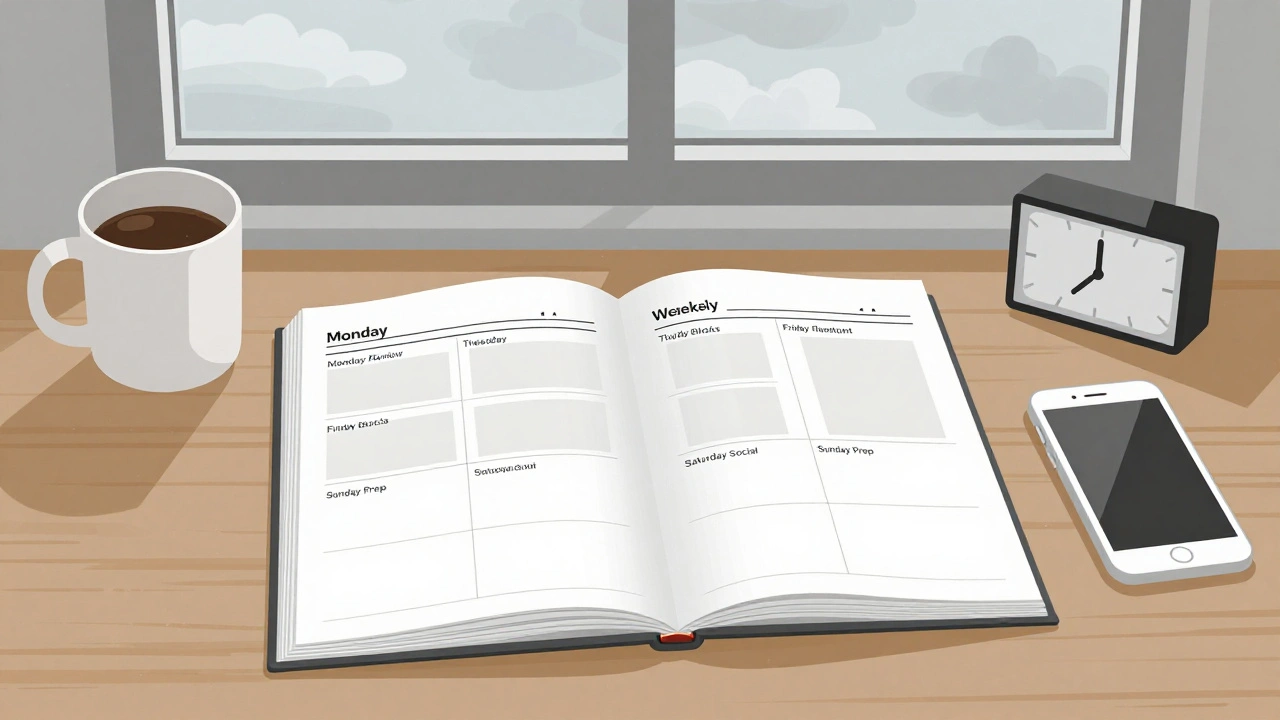
Try this basic weekly template:
- Monday: Review last week’s work. Plan this week’s top 3 tasks.
- Tuesday/Thursday: Focused study blocks (2-3 hours total). One subject per block.
- Wednesday: Meet with a study buddy or go to a drop-in tutorial.
- Friday: Light review. No new material. Just test yourself with flashcards or past questions.
- Saturday: Social time. No guilt.
- Sunday: Prep for next week. Laundry. Grocery run. Rest.
That’s 8-10 hours of real study time. Not 15. Not 20. Just enough to stay ahead.
And if you miss a day? Don’t quit. Just restart. One day off doesn’t ruin a semester. Two weeks of guilt do.
What to Do If You’re Already Behind
Some of you are reading this thinking: ‘I’m already failing. Is it too late?’
No. It’s not too late.
At the University of Manchester, students who improved their mid-term grades by 10% or more had a 78% chance of passing their module - even if they were on the edge before.
Here’s how to catch up if you’re drowning:
- Use the ‘50% Rule’: If you’ve missed half the work, aim to complete 50% of what’s left - not 100%. That’s often enough to pass.
- Ask for extensions early. Most universities allow one extension per module if you submit a short form explaining your situation. Don’t wait until the deadline.
- Focus on passable, not perfect. A 40% essay is better than a 0%. Submit something. Anything. You can’t improve what’s not turned in.
And if you’re mentally exhausted? Talk to your student support service. Most UK universities offer free, confidential counselling. No appointment needed. Just walk in.
What Not to Do
Don’t:
- Wait until after Christmas to start
- Compare yourself to others who seem ‘on top of it’
- Believe you need to ‘study harder’ - you need to study smarter
- Ignore feedback. It’s your roadmap, not your punishment
- Think you’re alone. Half your class feels the same way
Resetting isn’t about becoming a super-student. It’s about becoming a steady one.
Final Thought: Progress Over Perfection
The goal isn’t to get straight A’s this term. It’s to prove to yourself that you can recover.
That’s the real skill university teaches you - not how to memorise Kant, but how to keep going when things fall apart.
One small step today. One more tomorrow. That’s how you rebuild a semester.
You’ve got this.
What’s the best time to do a semester reset?
The ideal time is between weeks 6 and 8 of the semester - right after your first major assessments come back. That’s when you have enough data to see where you’re struggling but still enough time to make changes before finals. Waiting until after Christmas means you’re already behind.
Can I still pass if I’m failing mid-term?
Yes, absolutely. Many UK universities allow you to pass a module even if you’re below 40% mid-term, as long as you score well on remaining assessments. The key is to focus on high-weight assignments and submit everything. Even a 35% on your next essay can pull your average up enough to pass.
How many hours should I study per week to recover?
You don’t need more hours - you need better ones. Aim for 8-10 focused hours per week, spread across 3-4 days. That’s about 2 hours a day on weekdays. Quality matters more than quantity. One hour of active recall (testing yourself) is worth three hours of passive rereading.
Should I drop a module if I’m struggling?
Only if you’re at risk of failing multiple modules or your mental health is severely affected. Most UK universities let you withdraw from a module before the deadline (usually week 8-10) without penalty. But don’t do it out of fear. Talk to your academic advisor first. Often, a reset plan is better than a withdrawal.
Is it normal to feel this overwhelmed?
Yes. A 2025 survey by the UK Student Minds charity found that 68% of undergraduates felt overwhelmed by mid-term. You’re not lazy. You’re not broken. You’re just in a system that doesn’t teach you how to manage it. The fact that you’re looking for a way out means you’re already on the right track.