
When you’re picking a course in the UK, you’re bombarded with two big numbers: the league table rank and the accreditation stamp. One tells you how fancy the university is. The other tells you if your degree will actually mean something to employers. But which one should you trust?
What Rankings Really Measure
University rankings like the QS World University Rankings or The Times Higher Education list don’t measure how good your course will be. They measure how much money the university spends on research, how many Nobel laureates they have, and how many international students apply. A university might rank #1 because it has a massive physics lab and a global brand name - not because its English literature program is any better than the one down the road.
Take the University of Bath. It consistently ranks in the top 10 in the UK for engineering, but it’s not in the global top 50. Why? Because it doesn’t do much pure research. But if you want to study mechanical engineering and get hired by Jaguar Land Rover right after graduation, Bath’s program is one of the most respected in the country. Rankings don’t capture that.
And let’s be honest - rankings change every year. A university might jump from 25th to 12th because it hired a famous professor or got a big donation. That doesn’t mean the quality of your biology module improved. It just means the algorithm got a new data point.
What Accreditation Actually Means
Accreditation is the quiet, boring, but powerful signal. It’s not about prestige. It’s about standards. When a course is accredited by a professional body - like the Engineering Council, the British Psychological Society, or the Royal Institution of Chartered Surveyors - it means that body has checked the syllabus, the labs, the teaching staff, and the graduate outcomes. They’ve made sure you’re learning what employers actually need.
For example, if you’re studying architecture, you need accreditation from the Architects Registration Board (ARB). Without it, you can’t register as a chartered architect in the UK - no matter how high your university’s ranking is. Same goes for law: you need accreditation from the Solicitors Regulation Authority to become a solicitor. Rankings won’t help you get there.
Accreditation doesn’t make headlines. But it makes your CV stand out. Employers don’t care if your university is ranked #15. They care if your degree is stamped by the body that sets the rules for their industry.
When Rankings Matter - And When They Don’t
Rankings do have value - but only in specific situations.
If you’re applying for a PhD in theoretical physics, a high ranking might signal strong research supervision and access to cutting-edge labs. If you’re targeting a global employer like Google or McKinsey, they might use rankings as a quick filter for which schools to recruit from.
But for most students - especially those heading into practical fields like nursing, teaching, social work, or graphic design - rankings are noise. What matters is whether your course meets the professional standards to get you licensed, certified, or hired.
Consider this: in 2024, the UK’s Nursing and Midwifery Council rejected 17 new nursing programs for failing accreditation standards. Some of those programs were offered by universities ranked in the top 30. The rankings didn’t protect students. The accreditation did.
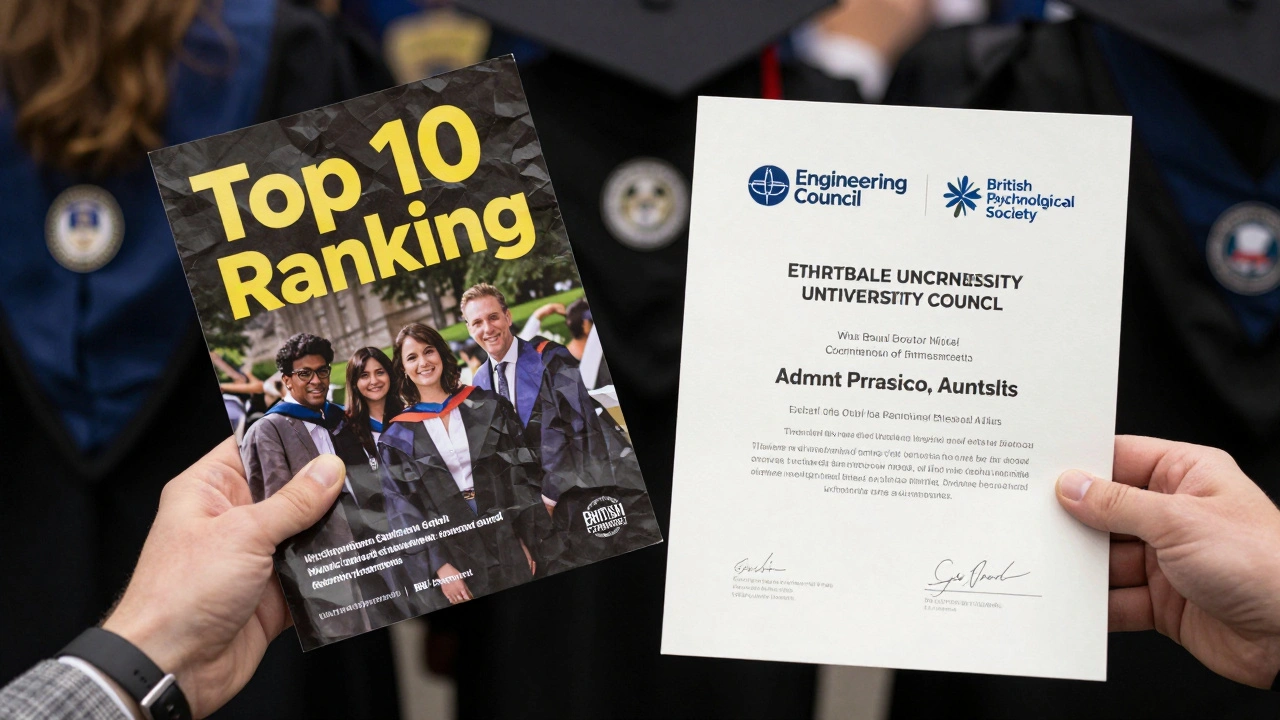
How to Check Accreditation (And Why You Must)
Don’t assume your course is accredited just because the university says so. Go straight to the source.
- Find the professional body that governs your field. For example: Engineering Council for engineering, British Psychological Society for psychology, General Medical Council for medicine.
- Visit their website and search their list of accredited programs.
- Match the course title, university, and location exactly.
- If it’s not listed, ask the department: “Is this course accredited by [body]? If not, what’s the plan for students to gain professional recognition?”
Some courses are “partially accredited” - meaning you’ll need extra training after graduation. That’s fine, as long as you know it upfront. Many students don’t realize this until their final year, and then it’s too late to switch.
The Real Cost of Choosing Wrong
Choosing a high-ranked university without accredited accreditation can cost you time and money. Here’s what happens:
- You graduate with a degree that employers don’t recognize.
- You need to take extra exams or courses to qualify - often at your own expense.
- You lose a year or more of career momentum.
- You might have to reapply for a different program later.
One student I spoke with in Manchester chose a top-20 university for her social work degree because of its reputation. But the course wasn’t accredited by the Health and Care Professions Council. After graduation, she spent 18 months and £4,000 on a top-up course just to become eligible for registration. She could’ve chosen a lower-ranked school with full accreditation and saved all that.
What Employers Actually Care About
Ask hiring managers. Not recruiters. Not university marketing teams. Real people who hire graduates.
In a 2023 survey of 300 UK employers across healthcare, engineering, education, and public sector roles, 87% said they prioritize accreditation over university ranking. Only 12% said they use rankings as a primary filter. And of those 12%, most were in finance or consulting - industries where brand matters more than technical standards.
For the rest? It’s simple: “We need someone who’s already qualified. If your degree isn’t accredited, we can’t hire you. It’s not about prestige - it’s about compliance.”

How to Make the Right Call
Here’s a simple rule: Accreditation is non-negotiable. Rankings are optional.
Start with this checklist:
- Is this course accredited by the official professional body for your field? (If no, walk away.)
- If yes, does the accreditation cover full professional recognition? (Some are partial - know the difference.)
- What’s the graduate employment rate in your field? (Don’t trust the university’s stats - check the HESA data.)
- Can you talk to recent graduates? Ask them: “Did your accreditation help you get your first job?”
If your course passes the accreditation test, then look at rankings as a bonus - not a deciding factor. A lower-ranked university with full accreditation will get you further than a top-ranked one without it.
What About International Students?
If you’re coming from outside the UK, rankings might seem like your only guide. But here’s the truth: your home country’s professional bodies (like the Indian Nursing Council or the Canadian Engineering Accreditation Board) often recognize UK accreditations - not rankings.
Make sure your course is accredited by a UK body that’s internationally recognized. For example, accreditation from the Engineering Council is accepted in over 40 countries under the Washington Accord. A top-5 ranking means nothing if your degree isn’t recognized back home.
Final Thought: Your Degree Is a License, Not a Trophy
Think of your degree like a driver’s license. You don’t care if the DMV is in a fancy building. You care that it’s official. That it’s valid. That you can use it to get a job.
In the UK, accreditation is that license. Rankings are just the color of the building.
Don’t chase prestige. Chase recognition. Your future self will thank you.
Are university rankings useless in the UK?
No, rankings aren’t useless - but they’re often misleading. They’re useful for research-focused fields like physics or chemistry where lab resources matter. But for most practical degrees - nursing, teaching, engineering, social work - accreditation is what actually determines your career eligibility. Rankings can help you narrow options, but never choose a course based on them alone.
How do I check if my course is accredited?
Go to the website of the professional body that regulates your field. For example, if you’re studying psychology, visit the British Psychological Society’s website and search their list of accredited courses. Match the exact course title and university. If it’s not there, contact the university’s admissions office and ask: “Is this course accredited by [body]? If not, what’s the pathway to professional recognition?”
Can I get accredited after graduation?
Sometimes, but it’s harder and more expensive. Many professional bodies require you to complete an accredited degree to qualify for registration. If your course isn’t accredited, you might need to take additional exams, complete a postgraduate conversion course, or even retake parts of your degree. This can cost thousands and delay your career by a year or more. It’s far better to get it right the first time.
Do employers really ignore rankings?
In most industries, yes. A 2023 survey of 300 UK employers found that 87% prioritize accreditation over university ranking. Employers in healthcare, education, engineering, and public services need to know you meet legal or professional standards. They don’t care if your university is ranked #12 - they care if your degree lets you legally practice. Only in finance, consulting, or global corporate roles do rankings carry more weight.
What if my course is accredited but the university has a low ranking?
That’s actually the best scenario. A low-ranked university with full accreditation means you’ve chosen a program that meets professional standards without paying a premium for brand name. Many of the best nursing, teaching, and engineering programs in the UK are offered by universities outside the top 20. Employers recognize the accreditation - not the ranking. Your degree will open doors. Your reputation will build from your skills, not your university’s name.