You’re staring at a blank Word document. The deadline is in three days. You’ve read the articles, you understand the theory, but when it comes time to write, your brain goes blank. So you open a source, copy a paragraph that explains the concept perfectly, and paste it into your draft. You think, "I’ll rewrite this later." But later never comes. You submit the assignment, and two weeks later, you get an email from your professor with a subject line that makes your stomach drop: Academic Misconduct.
This scenario plays out thousands of times every semester across the United Kingdom. Most students don’t set out to cheat. They aren’t trying to steal someone else’s work to save time on effort. Instead, they fall victim to what experts call "accidental plagiarism" or "patchwriting." It happens because the rules of academic referencing are complex, and the pressure to perform is high. If you are studying in the UK, understanding exactly what counts as plagiarism-and more importantly, how to avoid it-is not just about passing a class; it’s about protecting your degree.
What Actually Counts as Plagiarism?
Before we talk about avoiding it, we need to define it. Many students think plagiarism only means copying another student’s essay word-for-word. But in UK higher education, the definition is much broader. According to the Jisc Academic Integrity framework, which many UK institutions align with, plagiarism includes any attempt to pass off someone else’s work or ideas as your own without proper acknowledgment.
This covers several specific behaviors:
- Direct Copying: Using exact words from a source without quotation marks and citation.
- Patchwriting: Changing a few words in a sentence from a source but keeping the original structure and meaning, often without citing properly.
- Idea Theft: Using a unique argument or theory from a book or journal article without crediting the author, even if you wrote it in your own words.
- Self-Plagiarism: Submitting the same work for two different modules or assignments without permission. Yes, recycling your own work can get you flagged.
- Improper Paraphrasing: Rewriting a passage too closely to the original text so that it still feels like the original author’s voice rather than yours.
The key takeaway here is intent. In most UK university disciplinary procedures, whether you meant to cheat matters less than the fact that you didn’t cite correctly. Ignorance of the rules is rarely accepted as a defense.
The Role of Technology: Turnitin and AI Detection
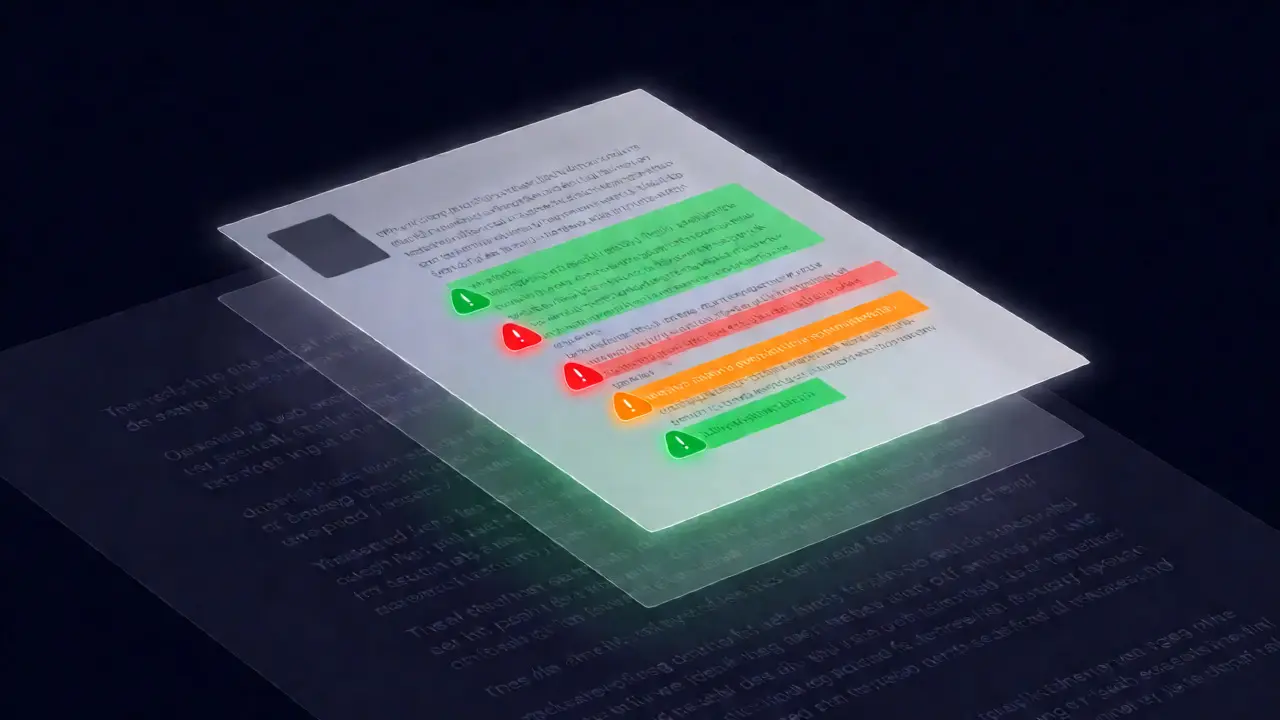
You might be wondering, "How do they catch me?" The answer is software. Almost every UK university uses similarity detection tools, with Turnitin being the industry standard. When you upload your assignment, the system scans your text against billions of web pages, academic journals, and previously submitted student papers.
A common myth is that a low similarity score (e.g., under 15%) means you’re safe, and a high score (e.g., over 30%) means you’re guilty. That’s not how it works. A high score could simply mean you used many short quotes from authoritative sources, which is fine if cited correctly. Conversely, a low score doesn’t guarantee safety if you have large blocks of uncited text that happen to be unique phrasings.
Recently, the conversation has shifted to AI-generated content. As of 2026, tools like GPT-4 and its successors are widely available. Universities are increasingly cautious about AI use. While some allow it for brainstorming, submitting AI-written essays without disclosure can trigger flags in newer detection systems integrated into platforms like Turnitin. Always check your specific department’s policy on AI usage before you start writing.
| Scenario | Risk Level | Why It’s Risky | Safe Practice |
|---|---|---|---|
| Copying a sentence and changing one synonym. | High | Structure remains identical; lacks original analysis. | Rewrite entirely in your own words and cite. |
| Using a quote but forgetting quotation marks. | Medium | Looks like you claimed the words as your own. | Add "quotation marks" and page number. |
| Submitting last year’s essay for a new module. | High | Considered self-plagiarism; double-dipping credit. | Ask tutor if reuse is allowed; adapt significantly. |
| Summarizing a blog post without citation. | Medium | Blogs are public sources; ideas must be credited. | Cite the blog author and URL/date. |
Mastering the Art of Paraphrasing
If there is one skill that saves you from accidental plagiarism, it is paraphrasing. But most students do it wrong. They look at the original sentence, then try to swap out nouns and verbs while keeping the syntax. This results in awkward sentences that still feel like the source material. True paraphrasing requires comprehension, not just substitution.
Try this method: Read the paragraph until you fully understand the point. Then, close the book or minimize the window. Open a separate document and write down the idea from memory. Finally, add the citation. This forces your brain to process the information and reconstruct it, ensuring the output is genuinely yours.
For example, consider this original text: "The rapid expansion of urban areas has led to significant biodiversity loss, particularly among bird species."
A bad paraphrase: "The quick growth of cities caused big loss of biodiversity, especially birds." (Too similar). A good paraphrase: "Bird populations have declined sharply due to the encroachment of city infrastructure on natural habitats (Smith, 2024)." (Different structure, same meaning, cited).
Referencing Styles: Harvard, APA, and Vancouver
UK universities typically require strict adherence to specific referencing styles. The most common is Harvard Referencing, which uses an author-date system in-text and an alphabetical reference list at the end. However, sciences often use APA or Vancouver (numbered citations), while law schools may use OSCOLA.
Mixing styles is a frequent error. If you take notes from a Harvard-style textbook and paste them into an APA-style essay, you’ll create inconsistencies that look sloppy and can confuse markers. Before you begin research, confirm which style guide your module handbook specifies. Use reference management software like Zotero or Mendeley. These free tools store your sources and automatically format citations and bibliographies according to the style you choose. This eliminates human error in formatting, which accounts for a significant portion of minor plagiarism flags.
Managing Your Notes to Prevent Patchwriting
Accidental plagiarism often starts during the note-taking phase. If you copy-paste quotes directly into your notes without marking them clearly, you might forget they are quotes when you draft your essay. Six months later, those lines look like your own thoughts.
Adopt a color-coded system. For instance: * Black text: Your own thoughts and summaries. * Blue text: Direct quotes (always include the page number immediately). * Red text: Questions or connections to other sources.
By separating your voice from the source’s voice visually, you reduce the chance of accidentally blending them. When you sit down to write, you know exactly which parts need quotation marks and which parts need to be rewritten.
What Happens If You Get Caught?
The consequences vary by institution and severity. For a first offense involving minor errors, you might receive a formal warning and a mark reduction. Some universities allow resubmission within a week. However, serious cases-like submitting a paper bought online or heavily reliant on AI without disclosure-can lead to failing the module, suspension, or even expulsion.
Don’t panic if you receive a flag. First, check the similarity report. Often, the matches are in the bibliography or common phrases (like "in conclusion" or "according to the data"). If the matches are substantive, contact your personal tutor immediately. Explain your process. Show them your drafts and notes. Demonstrating that you understand the error and know how to fix it goes a long way.
Frequently Asked Questions
Is using Wikipedia considered plagiarism?
Not necessarily, but it is rarely acceptable as a primary source in UK academia. Wikipedia is a tertiary source. You should use it to find background information and locate the original references listed at the bottom of the page. Cite the original books or journals, not Wikipedia itself. If you do cite Wikipedia, you must acknowledge it, but expect lower grades if it’s your main evidence.
Can I use my own previous work in a new assignment?
This is called self-plagiarism. Generally, you cannot submit the exact same text twice without permission. If you want to build on previous work, you must cite yourself (e.g., "As discussed in Jones, 2023...") and ensure the new assignment adds significant new value or analysis. Always ask your lecturer if reusing sections is permitted.
Does Turnitin detect AI-written text?
Yes, modern versions of Turnitin include AI detection features. However, these tools are not perfect and can produce false positives, especially for non-native English speakers or highly structured technical writing. Universities usually review AI flags manually before taking action. It is safer to use AI for brainstorming and outlining rather than generating full paragraphs, unless your course explicitly permits it.
What is the difference between quoting and paraphrasing?
Quoting involves using the exact words from a source, enclosed in quotation marks, with a citation including the page number. Paraphrasing involves restating the idea in your own words and sentence structure, also requiring a citation but usually without a page number (though some styles prefer it). Paraphrasing demonstrates deeper understanding and is generally preferred over excessive quoting in undergraduate essays.
Do I need to cite common knowledge?
No. Facts that are widely known and undisputed (e.g., "London is the capital of the UK" or "Water boils at 100°C at sea level") do not need citations. However, if a statement is specific, debatable, or derived from recent research, you must cite it. When in doubt, cite it. Over-citing is better than under-citing.
Next Steps for Stress-Free Writing
To keep your academic record clean, start small. Download your university’s official referencing guide today. Install a reference manager like Zotero and import your reading list. Practice paraphrasing one paragraph per day leading up to your next deadline. By making these habits routine, you remove the anxiety of accidental copying and focus on what actually matters: developing your own critical voice.