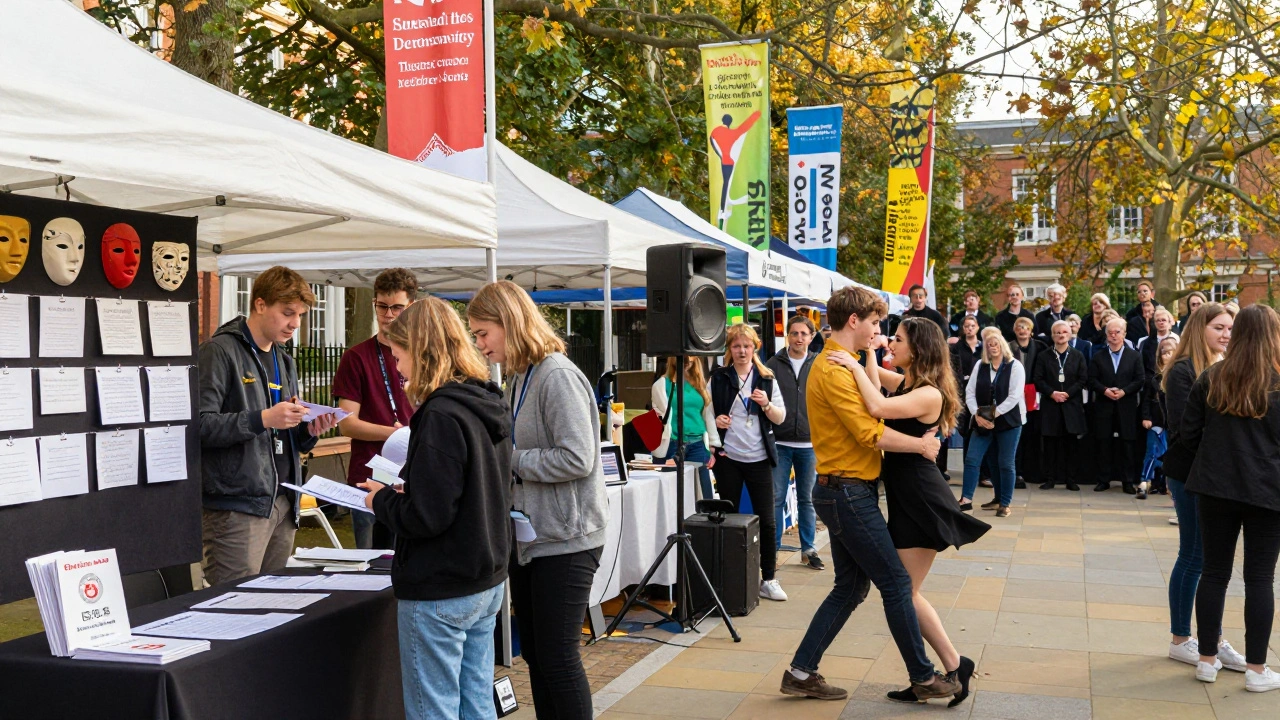
When you think of university life in the UK, you might picture lecture halls, libraries, and late-night cram sessions. But for thousands of students, the real heartbeat of campus life happens on stage, in rehearsal rooms, and behind the scenes of student-run theatre, dance, and music groups. These aren’t just clubs-they’re tight-knit communities where people learn to lead, collaborate, and create under pressure, all while having fun.
Why Student Performing Arts Groups Matter
Most UK universities have at least one student-run theatre company, a dance troupe, and a music society. Some, like Oxford and Cambridge, have dozens. These groups aren’t funded by the university like professional departments-they’re run by students, for students. That means they’re flexible, experimental, and often more daring than the official curriculum.
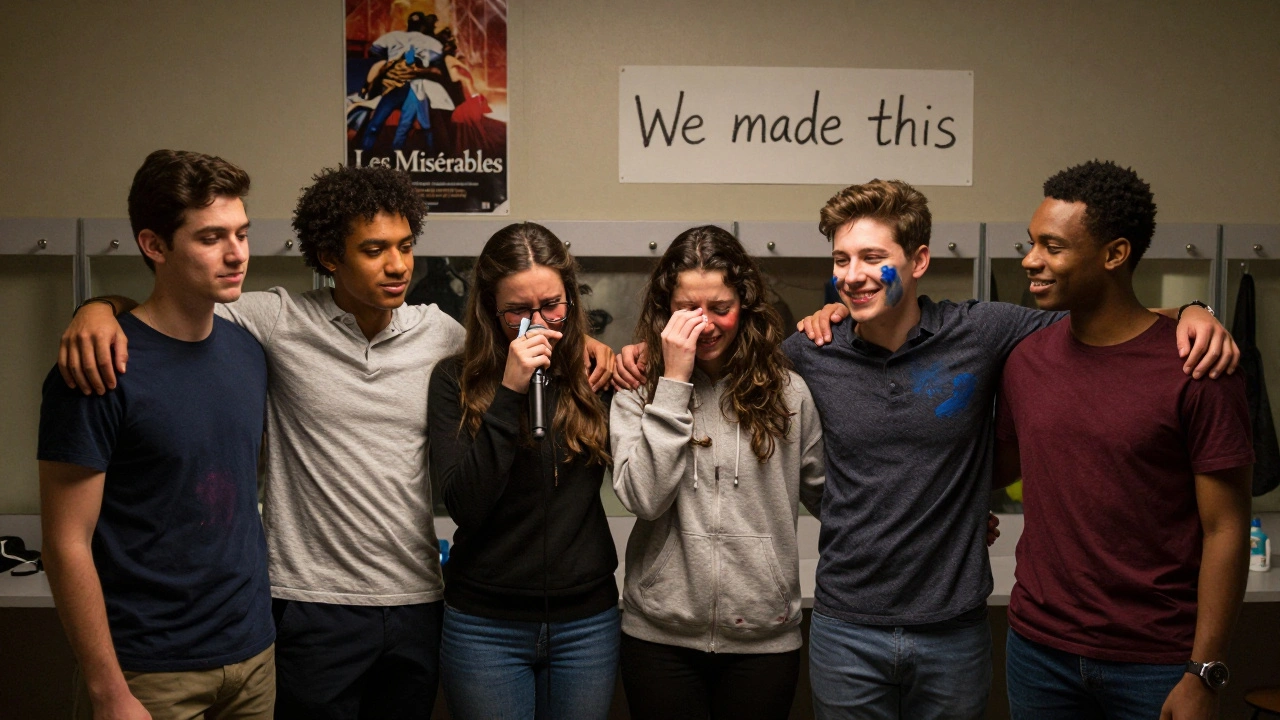
Take the Cambridge University Light Opera Society. In 2024, they staged a full-scale production of Les Misérables with 80 cast and crew members, all undergraduates. No professional directors. No paid technicians. Just students who learned stage management, lighting design, and vocal coaching by doing it. That’s the power of these societies: they turn passion into practical skills.
And it’s not just about putting on shows. Many students join because they need a break from exams. A 2023 survey by the National Union of Students found that 78% of performing arts society members said their group helped reduce stress levels during term time. For international students, these groups are often the first place they make friends outside their course. For others, it’s a chance to rediscover a hobby they gave up in high school.
How Theatre Societies Work
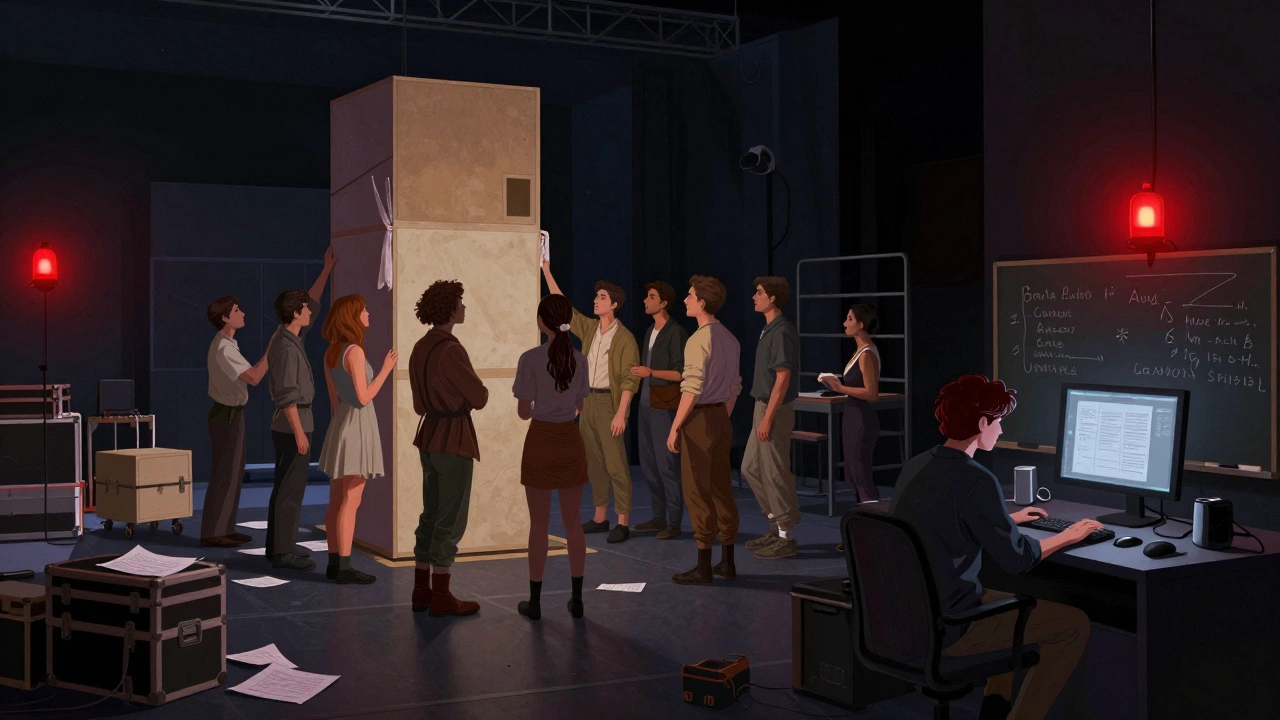
University theatre societies are usually structured like small production companies. You’ll find roles for actors, stage managers, set builders, costume designers, lighting operators, and even box office staff. Most operate on a termly cycle: auditions in October, rehearsals through November and December, then a performance in January or February.
At University College London, the UCL DramSoc runs three major productions a year. They cast open to all students, regardless of experience. One member, a first-year biology student, joined as a stagehand and ended up designing the entire lighting rig for their spring show. She later switched her minor to theatre technology.
These groups often collaborate with local venues. The Bristol University Theatre Company regularly performs at the Tobacco Factory Theatre, a professional space. That exposure gives students real-world experience with ticketing systems, press releases, and audience feedback-skills you won’t get in a classroom.
Dance Societies: More Than Just Ballet
Forget the stereotype of ballet slippers and mirrored walls. University dance societies in the UK cover everything from salsa and hip-hop to contemporary, tap, and even Bollywood. At King’s College London, the Dance Society has 12 different sub-groups, each with its own weekly rehearsal and termly showcase.
What makes these groups unique is their inclusivity. You don’t need prior training. Many members join with zero experience. The University of Edinburgh’s Urban Dance Crew started with five students who just wanted to learn how to breakdance. Now they perform at campus events and even compete in national university dance championships.
Training happens outside class hours-usually evenings or weekends. Some societies hire professional choreographers for a few sessions per term. Others rely on peer teaching. It’s a mix of discipline and creativity that builds confidence fast. One member told me she joined to lose weight. Two years later, she’s touring with a semi-professional dance company.
Music Societies: From Choirs to Rock Bands
Music societies are the most diverse group of all. You’ll find symphony orchestras, a cappella groups, jazz ensembles, folk circles, and full rock bands-all run by students.
At the University of Manchester, the Music Society manages over 40 ensembles. The Chamber Choir has toured Europe. The Rock Society books gigs at local pubs every month. The Samba Band plays at the city’s annual carnival.
Many of these groups have their own equipment. The University of Sheffield’s Jazz Band owns its own drum kit, saxophones, and amps-all stored in a dedicated music room on campus. Members pay a small annual fee to cover maintenance. That’s not charity-it’s ownership. Students learn how to manage budgets, schedule rehearsals, and book venues.
For non-music majors, these groups are a lifeline. A computer science student I spoke to said playing bass in the university jazz band was the only thing that kept him sane during his final year. He still plays every weekend.
Drama Societies: The Hidden Curriculum
Drama societies are often the most intense. They’re not just about acting-they’re about storytelling, emotional intelligence, and public speaking. Many students join because they’re shy. They leave because they can speak confidently in front of 200 people.
The Royal Central School of Speech and Drama in London is a specialist institution, but even non-specialist universities like Warwick and Leeds have thriving drama societies. At Warwick, the Drama Society runs a weekly ‘Open Mic’ night where students perform monologues, poetry, or stand-up comedy. It’s not judged. It’s not graded. It’s just safe space to try.
Some societies even run their own fringe festivals. The University of Glasgow’s Theatre Company hosts a three-day student-run festival every spring, with 15+ short plays, all written, directed, and performed by undergraduates. One play from 2023 was later picked up by a professional Edinburgh Fringe producer.
What You Gain Beyond the Stage
These societies teach things no lecture can. You learn how to give and receive feedback. You learn how to meet deadlines when no one is watching. You learn how to fix a broken mic at 11 p.m. the night before a show. You learn how to lead a team of 15 people who all have different ideas.
Employers notice this. A 2024 report by the Higher Education Careers Services Unit found that graduates who were active in student performing arts were 30% more likely to be hired in roles requiring teamwork, creativity, and communication-like marketing, project management, and public relations.
And it’s not just about the CV. These groups become your second family. Many lifelong friendships start in a dressing room. Romantic relationships form over shared coffee after midnight rehearsals. Alumni still come back to help with set builds or give advice to new members.
How to Get Involved
If you’re starting at a UK university, here’s how to find the right group:
- Check your university’s Students’ Union website. Look for ‘Societies’ or ‘Clubs and Groups’.
- Attend the Freshers’ Fair in September. Most performing arts groups have booths with flyers, videos, and sign-up sheets.
- Don’t be intimidated by auditions. Many groups welcome non-performers-lighting, sound, costumes, marketing.
- Try one rehearsal. Most societies let you come along for free the first time.
- Ask current members what they love most. Their answers will tell you if the culture fits you.
Some groups have waiting lists. Others are always looking for new people. The key is to show up. Even if you’ve never sung in public or danced in front of someone, just being there matters.
What to Expect
Rehearsals are long. Shows are stressful. Sometimes you’ll forget your lines. Sometimes the lights will go out. Sometimes you’ll cry after a bad review.
But you’ll also laugh until you cry during cast dinners. You’ll feel the rush of a standing ovation. You’ll realize you’ve made something beautiful with people who care as much as you do.
These societies don’t promise grades. They don’t hand out certificates. But they give you something harder to measure: belonging, resilience, and the quiet confidence that comes from knowing you can create something from nothing-and make it matter to others.
Do I need experience to join a performing arts society?
No. Most university theatre, dance, and music societies welcome complete beginners. Many members join with zero background. What matters is enthusiasm, reliability, and willingness to learn. Roles like stage management, lighting, costume design, and marketing don’t require performance skills at all.
How much time do these societies require?
It varies. Weekly rehearsals usually take 2-4 hours. For major productions, you might spend 10-15 hours a week in the weeks leading up to a show. Some members join just for social events or one-off gigs. Others go all-in. You control the level of commitment.
Are there costs to join?
Most societies charge a small annual fee-usually between £10 and £30-to cover costumes, props, or equipment maintenance. Some charge extra for show tickets or travel. But no one is turned away for inability to pay. Many groups have hardship funds or offer free membership for those on financial aid.
Can I join more than one society?
Absolutely. Many students are in two or three. A music student might join the choir and the jazz band. A biology major might do drama and salsa. The key is managing your time. Most societies are flexible and understand academic deadlines.
Do these societies help with job prospects?
Yes. Employers value the soft skills these groups build: teamwork, problem-solving under pressure, communication, and leadership. Graduates involved in student performing arts are more likely to be hired in roles requiring creativity and collaboration, like marketing, event planning, public relations, and education.