
Ever sat down to study at 11 p.m. and felt like your brain was running on fumes? Or tried to tackle calculus at 7 a.m. and ended up staring at the same paragraph for 20 minutes? You’re not alone. Thousands of UK students face the same dilemma: morning or evening study? There’s no one-size-fits-all answer, but there are clear patterns - and science - behind when your brain works best.
Why Timing Matters More Than You Think
It’s not just about how long you study. It’s about when. Your body runs on a biological clock - the circadian rhythm - that affects memory, focus, and even how fast you process new information. A 2023 study from the University of Edinburgh tracked 1,200 UK undergraduates over six months and found that students who studied during their personal peak hours scored 18% higher on average than those who forced themselves into a fixed schedule.
That doesn’t mean you should copy someone else’s routine. It means you need to figure out what works for you.
Morning Study: The Early Bird Advantage
If you’re someone who wakes up feeling sharp - no coffee needed - morning study might be your sweet spot. Here’s why:
- Your brain is fresh. After sleep, your prefrontal cortex - the part responsible for logic, planning, and problem-solving - is at its most active. This makes mornings ideal for complex subjects like maths, physics, or essay planning.
- Fewer distractions. No texts, no social media alerts, no roommates knocking. Just quiet and focus.
- Psychological momentum. Getting work done early gives you a sense of control for the rest of the day. A 2024 survey of 800 UK students found that 62% of morning learners reported lower stress levels by mid-afternoon.
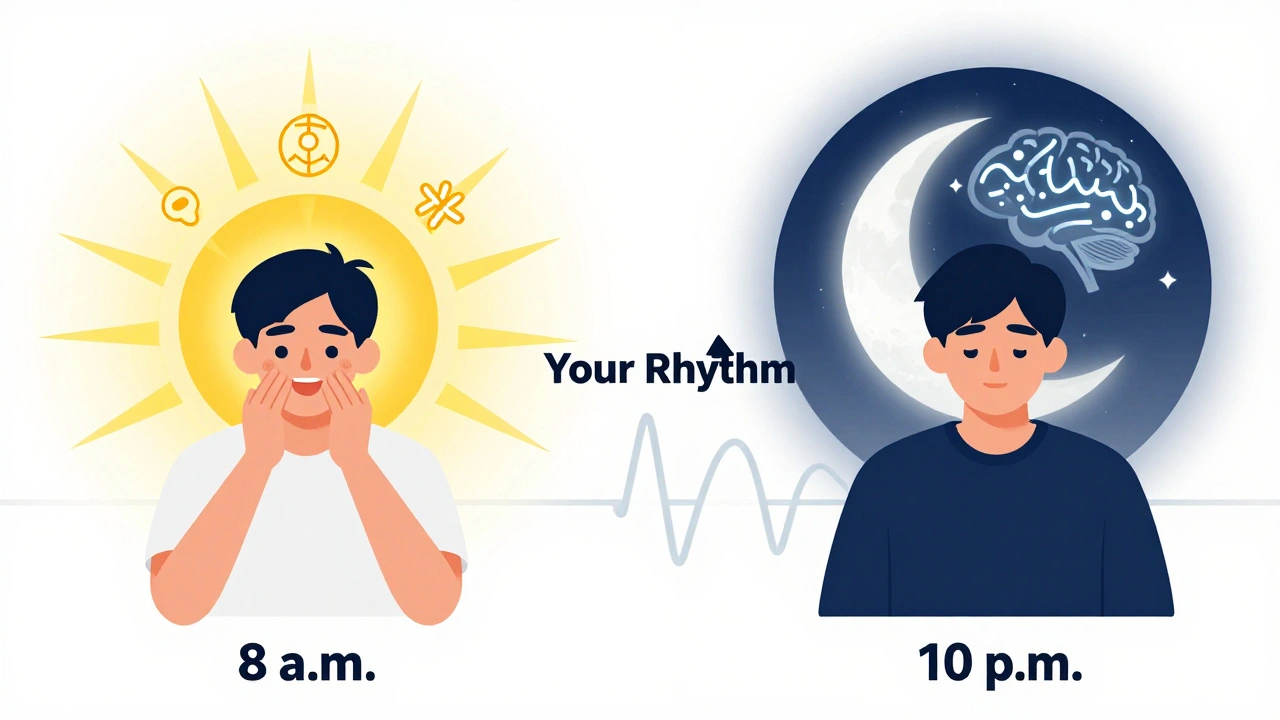
But here’s the catch: not everyone is built for 6 a.m. study sessions. If you’re a night owl by nature, forcing yourself into early hours can backfire. Your cortisol levels - the stress hormone that helps wake you up - peak naturally between 7 a.m. and 9 a.m. for early risers, but not until 10 a.m. or later for others. Trying to study before your body is ready leads to mental fatigue, not productivity.
Evening Study: When the Mind Comes Alive
For many students - especially those in their late teens and early twenties - the best focus doesn’t come until after dark. Evening study has its own perks:
- Deeper concentration. As the day winds down, external noise drops. You’re less likely to be interrupted by calls, messages, or family demands.
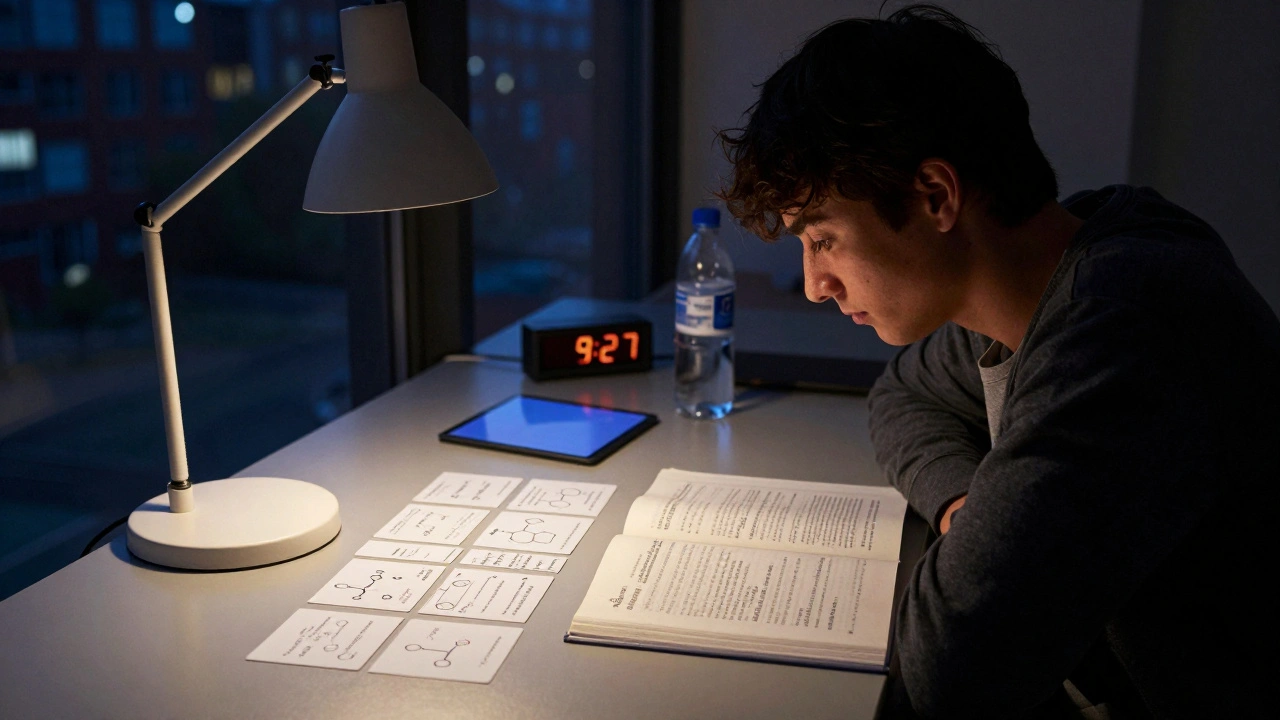
- Stronger memory consolidation. Research from UCL shows that studying material in the evening - especially before sleep - improves long-term retention. Your brain processes and files new information during sleep, making nighttime review particularly effective for memorizing facts, formulas, or vocabulary.
- More flexibility. If you’ve got evening classes, part-time work, or family responsibilities, studying after 8 p.m. fits naturally into your schedule.
But there’s a downside. Late-night studying often comes with trade-offs: poor sleep, reduced next-day focus, and higher caffeine intake. A 2025 report from the UK Sleep Foundation found that 47% of students who regularly studied past midnight reported poor sleep quality, and 31% admitted to skipping breakfast the next day. That’s not sustainable.
How to Find Your Peak Time
You don’t need a lab to figure out when you think best. Try this simple 7-day test:
- Choose one subject you find moderately challenging - say, chemistry or essay writing.
- Study it for 60 minutes at the same time each day: once in the morning (7-9 a.m.), once in the evening (8-10 p.m.).
- After each session, rate your focus on a scale of 1-10. Note how quickly you understood the material, how often your mind wandered, and how tired you felt afterward.
- At the end of the week, compare your scores. Which session felt easier? Which left you energized instead of drained?
This isn’t about being productive for hours. It’s about being productive in the right hours.
What the Science Says About UK Student Patterns
UK student data from the Higher Education Statistics Agency (HESA) shows that 58% of undergraduates study between 7 p.m. and midnight. Only 23% prefer morning sessions before 10 a.m. But here’s the twist: those who studied in the morning had higher average final grades - especially in STEM subjects.
Why? Morning learners tended to sleep more consistently, eat regular meals, and avoid last-minute cramming. Evening learners often compensated for lost sleep by napping during the day - which disrupted their nighttime rest and created a cycle of fatigue.
Practical Tips for Morning Study
- Prepare the night before. Lay out your books, notes, and coffee. Reduce decision fatigue in the morning.
- Get 7-8 hours of sleep. No exceptions. If you’re waking up tired, you’re not studying smarter - you’re studying exhausted.
- Start with active recall. Don’t reread notes. Quiz yourself. It’s more effective than passive reading.
- Use natural light. Open the curtains. Sunlight helps reset your circadian rhythm and boosts alertness.
Practical Tips for Evening Study
- Set a hard stop. No studying after 11 p.m. Your brain needs wind-down time before sleep.
- Avoid screens 30 minutes before bed. Blue light suppresses melatonin. Try reading a physical book instead.
- Review, don’t learn new stuff. Use evenings to reinforce what you learned during the day - not to tackle brand-new topics.
- Hydrate. Dehydration hits harder at night. Keep water nearby.
What If You’re in Between?
Some students don’t fit neatly into morning or evening. That’s okay. You might be a “twilight learner” - most alert between 4 p.m. and 7 p.m. That’s still a valid window. The key is consistency. Study at the same time daily, even on weekends. Your brain learns to expect focus at that slot.
Try this: block out 90 minutes in your calendar every day at your peak time. Treat it like a lecture. Don’t skip it. Over time, your brain will start to shift into gear as soon as the clock hits that hour.
Common Mistakes to Avoid
- Comparing yourself to others. Your friend who studies at 3 a.m. isn’t necessarily more disciplined - they might just be sleep-deprived.
- Believing you need to study longer. Two focused hours beat four distracted ones.
- Ignoring sleep quality. No amount of coffee fixes poor sleep. If you’re waking up tired, your study time doesn’t matter.
- Skipping meals. Low blood sugar = brain fog. Eat something balanced before you study.
Final Thought: It’s Not About When - It’s About How
Choosing between morning and evening study isn’t about being a morning person or a night owl. It’s about aligning your schedule with your biology. Your peak focus time isn’t a myth - it’s your body’s natural rhythm. Once you find it, stick to it. Don’t switch back and forth. Your brain will thank you.
Is it better to study in the morning or evening?
There’s no universal answer. Morning study works best for people who feel alert right after waking up and need to tackle complex subjects. Evening study suits those who focus better after dinner and benefit from memory consolidation during sleep. The key is matching your schedule to your natural energy rhythm - not forcing yourself into someone else’s routine.
Can I study both morning and evening?
Yes - but not for the same subjects. Use morning sessions for learning new, complex material when your brain is freshest. Use evening sessions for review, flashcards, or light practice. Trying to cram new content in both windows leads to overload and reduced retention.
Do UK students perform better studying in the morning?
Data from HESA shows that morning learners tend to achieve higher grades, especially in science and math subjects. But this is linked to better sleep hygiene and consistent routines - not just the time of day. Students who study early often sleep better and avoid last-minute cramming, which boosts long-term performance.
What if I’m not a morning person but I want to study early?
You can adjust your rhythm - but it takes time. Start by shifting your bedtime 15 minutes earlier each week. Avoid screens an hour before sleep. Get sunlight in the morning. Don’t force yourself into a routine that feels unnatural. Your body will resist. Focus on consistency, not perfection.
Does caffeine help with morning study?
A small amount - like one cup of coffee - can help if you’re not fully awake. But relying on caffeine to function means you’re masking fatigue, not fixing it. If you need coffee just to open your eyes, you’re likely not getting enough sleep. Prioritize rest over stimulants.
How do I know if I’m a night owl or morning person?
Look at your natural tendencies. When do you feel most alert without caffeine or pressure? When do you naturally fall asleep and wake up on weekends? If you’re most awake after 8 p.m. and struggle before 10 a.m., you’re likely a night owl. If you’re sharp before 8 a.m. and drag after 6 p.m., you’re probably a morning person. Your body already knows - you just need to listen.
Find your rhythm. Stick to it. And remember - the goal isn’t to study more hours. It’s to study smarter, when your brain is ready.