Ever sat down to review your lecture notes and felt like you’re staring at a wall of text? You underlined everything. Highlighted three colors. Wrote summaries. And still, half of it vanishes by the time you sit for the exam. That’s not memory failure-it’s presentation failure. Your brain doesn’t process raw text well. But it loves patterns, colors, and connections. That’s where mind maps come in.
Why Text Alone Fails Your Memory
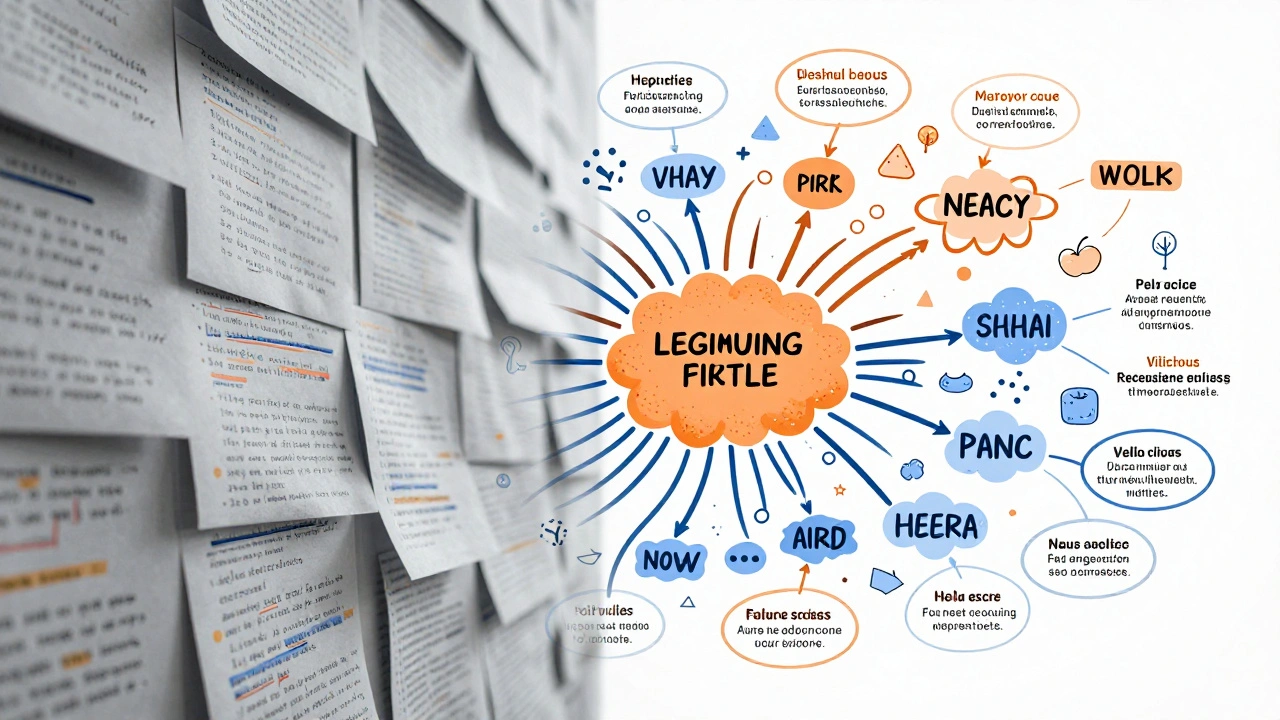
Most lecture notes are linear. You write down point A, then point B, then point C. It looks neat. It feels organized. But your brain isn’t built to store information like a spreadsheet. It’s built to link ideas like a web. Studies from the University of Warwick show that students who used visual mapping techniques remembered 30% more material after two weeks than those who reread text. Why? Because your brain remembers relationships, not lists.
Think about it. When you hear the word "photosynthesis," do you think of the word itself? Or do you picture a leaf, sunlight, carbon dioxide, and glucose? That’s a mental map. Your brain already works in visuals. You just need to give it the right structure.
What Is a Mind Map? (And What It’s Not)
A mind map isn’t just a fancy diagram. It’s a visual tool that mirrors how your brain stores knowledge. At its core, it has one central idea-like "Cell Biology" or "World War II Causes"-and branches out into related topics, subtopics, and details. Each branch uses keywords, not full sentences. Colors, symbols, and images are built in.
It’s not a flowchart. It’s not a bullet list with arrows. And it’s definitely not a PowerPoint slide. A true mind map grows organically from the center, like a tree with roots and branches. The goal isn’t perfection-it’s connection.
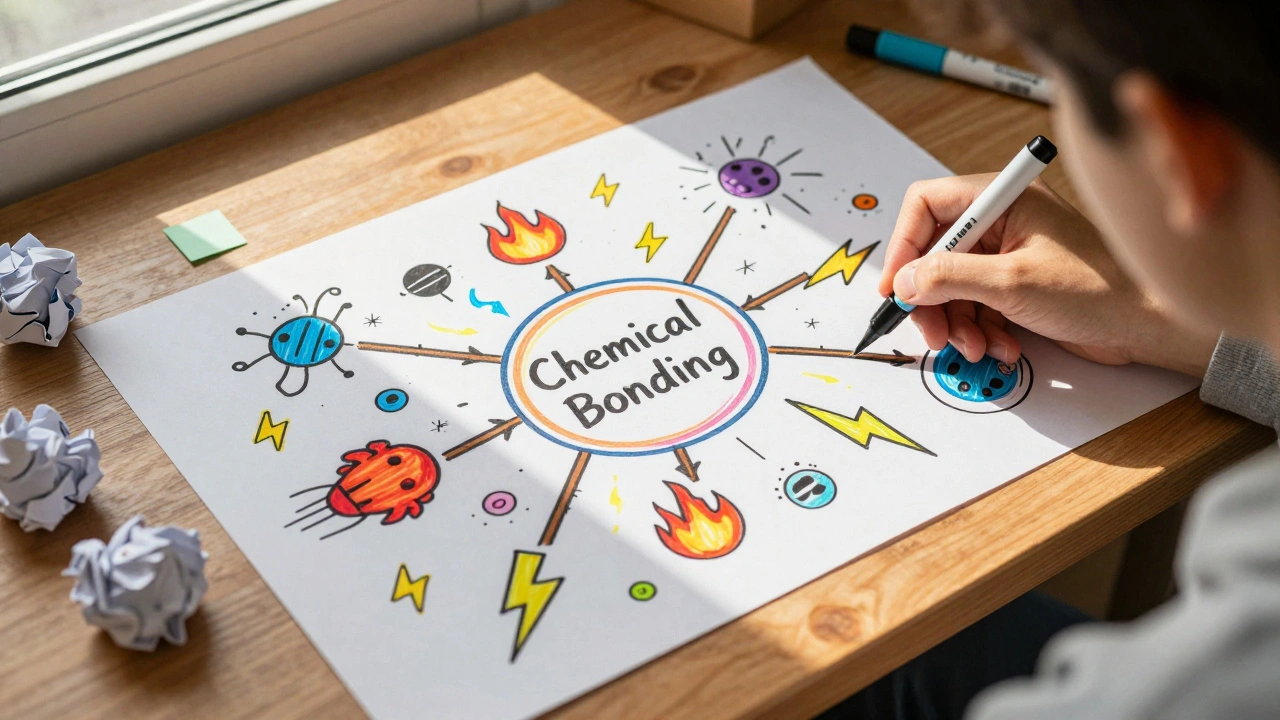
Here’s how a real student turned a messy chemistry lecture into a mind map:
- Center: "Chemical Bonding"
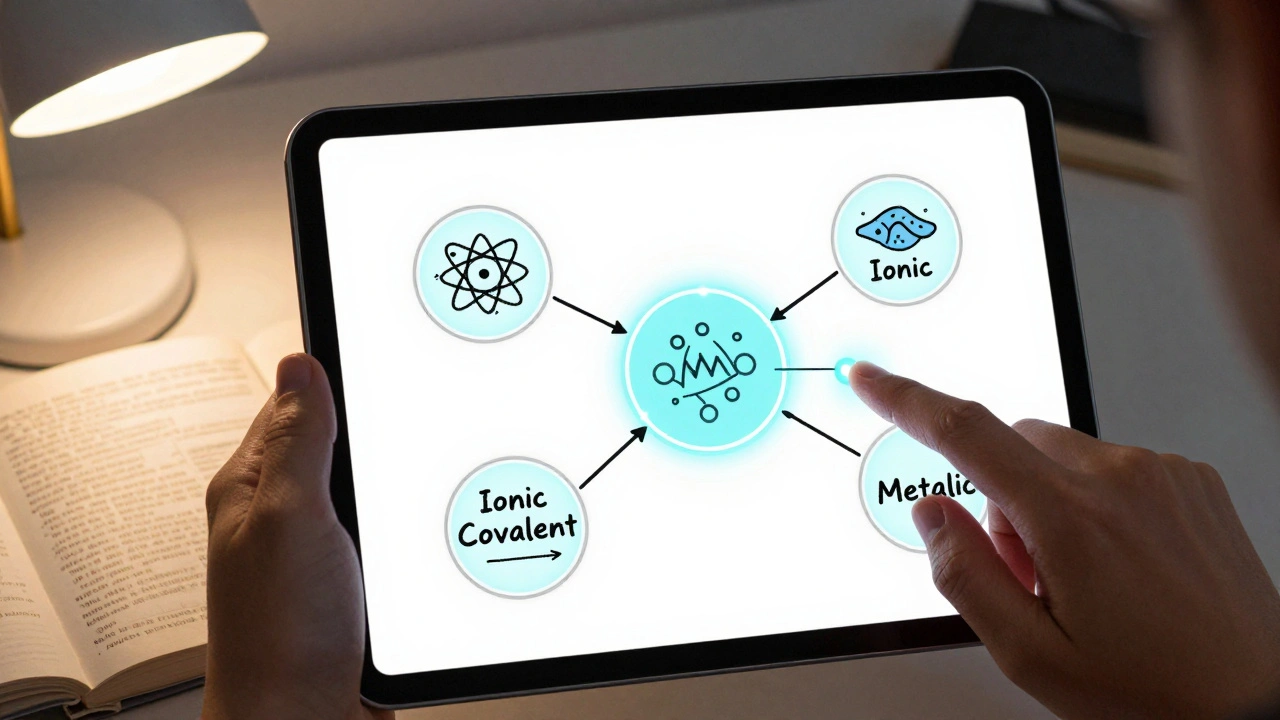
- Branch 1: "Ionic Bonds" → sub-branches: "Metal + Nonmetal", "Electron Transfer", "High Melting Point"
- Branch 2: "Covalent Bonds" → sub-branches: "Shared Electrons", "Nonmetal + Nonmetal", "Low Conductivity"
- Branch 3: "Metallic Bonds" → doodle of a sea of electrons, arrow labeled "Conducts Heat"
Notice the lack of full sentences. No "Ionic bonds occur when a metal transfers an electron to a nonmetal." Just keywords. That’s intentional. Your brain fills in the gaps better when you force yourself to recall, not just copy.
How to Build a Mind Map from Lecture Notes
Start with what you already have: your notes. Don’t rewrite them. Transform them.
- Grab a blank sheet (or a digital tool like XMind or Miro). Use landscape orientation. Bigger space = more freedom.
- Write the main topic in the center and circle it. Use a bold color. This is your anchor.
- Scan your notes for 3-5 major themes. These become your first branches. Don’t try to include everything. Just the big ideas.
- Use single words or short phrases on each branch. If you write a full sentence, you’re not mapping-you’re rewriting.
- Add color for each branch. Red for definitions, blue for examples, green for processes. Color triggers memory.
- Draw symbols where it helps. A lightning bolt for "energy," a flame for "combustion," a question mark for "unclear."
- Leave gaps between branches. Don’t crowd it. Space lets your brain breathe and connect.
- Review in 24 hours. Cover the map with your hand. Try to recall each branch. Then check. This is where the magic happens.
One biology student in North Carolina turned 40 pages of lecture notes into a single A3 mind map. She reviewed it for 15 minutes before her final. Scored 94%. She said: "I didn’t memorize the notes. I remembered the picture."
Tools: Paper vs. Digital
Some swear by pen and paper. Others live in Notion or Obsidian. Both work. But they serve different needs.
| Feature | Paper | Digital |
|---|---|---|
| Speed of creation | Instant | Slower (typing, dragging) |
| Memory retention | Higher (handwriting activates motor memory) | Lower |
| Editing | Hard (cross-outs, messy) | Easy (drag, resize, undo) |
| Sharing | Requires photo or scan | Instant (link or export) |
| Best for | Initial revision, tactile learners | Group study, long-term storage |
If you’re studying alone and want to lock in the material, start with paper. The physical act of drawing connects your hand to your memory. Later, if you need to share or update it, scan it and build a digital version.
Common Mistakes (And How to Fix Them)
People try mind mapping and quit because it feels "too messy" or "doesn’t help." Here’s why-and how to fix it.
- Mistake: Trying to make it look "professional." Fix: Messy is better than clean. If it looks like a spiderweb, you’re doing it right. Your brain doesn’t care about aesthetics-it cares about meaning.
- Mistake: Writing full sentences. Fix: Limit each branch to 1-3 words. If you need more, break it into a sub-branch.
- Mistake: Waiting until the night before the exam. Fix: Build your map within 24 hours of the lecture. That’s when your memory is still warm.
- Mistake: Not reviewing it. Fix: Treat it like flashcards. Cover one branch. Recall. Repeat. Do this three times in three days.
When Mind Maps Don’t Work
They’re not magic. Some topics don’t fit. If you’re studying linear processes-like the steps of mitosis or the water cycle-mind maps can feel forced. In those cases, use a flowchart instead. Or combine: make a mind map for concepts, and a flowchart for sequences.
Also, if you’re a purely auditory learner, you might prefer recording lectures and replaying them. That’s fine. Mind maps aren’t for everyone. But if you’ve ever said, "I just can’t remember what I read," you’re probably a visual learner. And this tool was made for you.
Pro Tip: Turn Mind Maps Into Flashcards
Once your map is done, turn each branch into a flashcard. Use Anki or Quizlet. Front: "What are the types of chemical bonds?" Back: your mind map branch. Now you’re not just reviewing-you’re testing yourself. That’s retrieval practice. The gold standard of memory retention.
A 2024 study from the University of Michigan tracked 200 undergrads using different revision methods. The group that combined mind maps with flashcards scored 22% higher on long-term retention than those who only reread notes. The difference wasn’t effort. It was strategy.
Start Small. Build Confidence.
You don’t need to map every lecture. Start with one. Pick a topic you struggled with. Spend 20 minutes. Make it messy. Use crayons if you have them. Don’t aim for perfect. Aim for connection.
After your first map, you’ll notice something: you start remembering things you didn’t even write down. That’s your brain filling in the gaps. That’s learning.
Next time you open your notes, don’t just read them. Transform them. Draw the story. Let your brain see the connections. And watch how much easier revision becomes.