
You know the feeling. It’s 2 AM, your essay is due in eight hours, and you’ve written exactly one sentence that you hate. You’re not lazy; you’re paralyzed. The task feels too big, too vague, and too heavy to lift. This is where micro-goals come in. They aren’t just a trendy productivity hack-they are a psychological tool to bypass the brain’s resistance to large, undefined threats.
If you’re studying in the UK, whether at Oxford or a local polytechnic, the workload is designed to test your endurance as much as your intellect. But endurance fails when you don’t have a map. By slicing massive assignments into tiny, doable steps, you stop dreading work and start doing it. Here is how to actually make micro-goals work for your degree, without turning your life into a robotic checklist.
Why Your Brain Hates Big Tasks
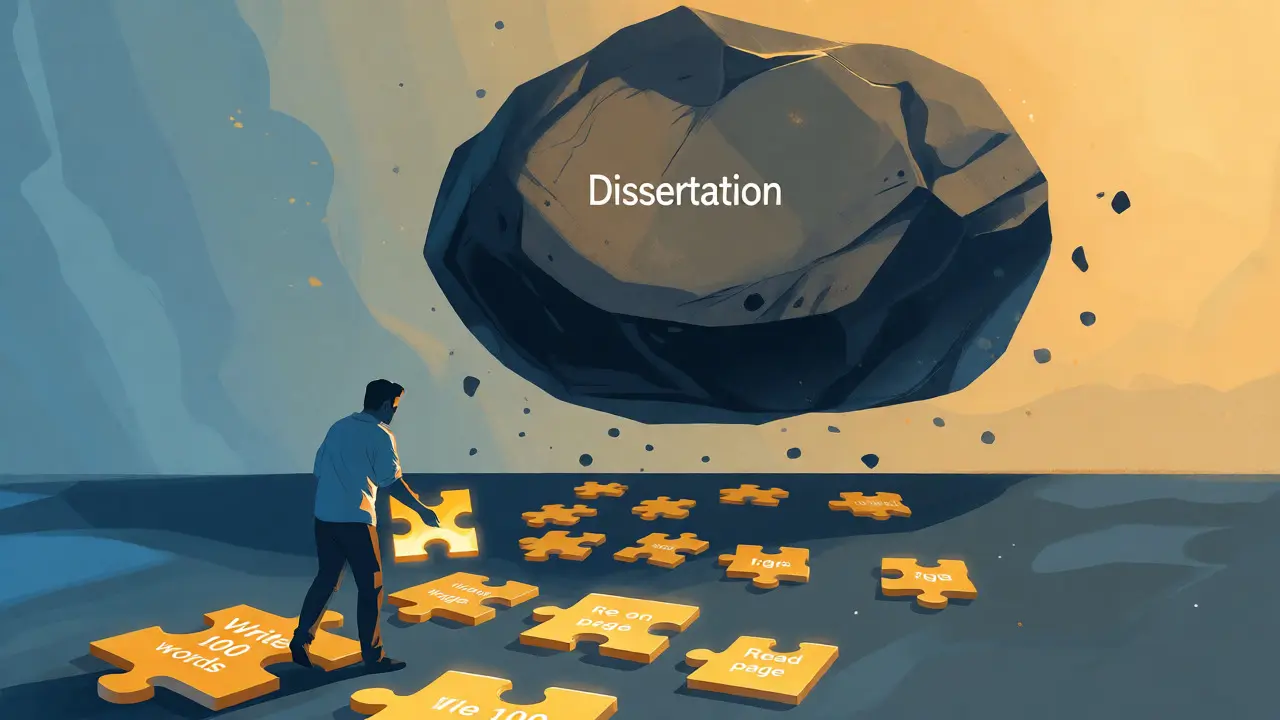
Your brain is wired for immediate reward. When you look at a task like "Write Dissertation," your amygdala-the fear center-lights up because the outcome is distant and uncertain. This triggers procrastination, which is really just an emotional regulation problem, not a time management one. Micro-goals fix this by shrinking the threat. A goal like "Write 100 words" isn’t scary. It’s manageable. Once you start, the dopamine hit from completing that small step keeps you going. This is known as the Zeigarnik effect: once you start a task, your brain wants to finish it.
For UK students facing tight deadlines and high stakes, this shift from "finish the project" to "start the next step" reduces anxiety significantly. You stop looking at the mountain and start looking at your feet.
The Anatomy of a Good Micro-Goal
Not every small task is a micro-goal. If you break "Read Chapter 4" into "Open book," you’re wasting time. A good micro-goal must be specific, actionable, and short. Ideally, it should take between 5 and 15 minutes to complete. If it takes longer, it’s still too big. If it takes less than a minute, it’s trivial clutter.
Here is the formula: Action Verb + Specific Object + Time Limit. Instead of "Revise notes," try "Summarize page 12 in three bullet points." Instead of "Work on code," try "Debug function X." This clarity removes decision fatigue. You don’t have to think about what to do next; you just do it.
| Vague Goal (High Friction) | Micro-Goal (Low Friction) | Time Estimate |
|---|---|---|
| Study for exam | Solve 5 past paper questions | 15 mins |
| Write essay intro | Draft thesis statement only | 10 mins |
| Clean room | Pick up clothes from floor | 5 mins |
| Research topic | Find 3 academic sources on JSTOR | 12 mins |
How to Break Down a Typical UK Assignment
Let’s take a common scenario: a 2,000-word critical analysis essay due in two weeks. Most students fail here because they treat writing as one monolithic block. They wait until the last minute to "write the essay." That’s a recipe for panic. Instead, deconstruct the process into phases, then break each phase into micro-goals.
- Phase 1: Understanding & Planning (Days 1-2)
- Micro-goal 1: Read the assignment brief and highlight key verbs (e.g., "analyze," "compare").
- Micro-goal 2: List three potential arguments.
- Micro-goal 3: Create a rough outline with headings.
- Phase 2: Research (Days 3-5)
- Micro-goal 1: Search library databases for five relevant articles.
- Micro-goal 2: Skim abstracts and save three promising PDFs.
- Micro-goal 3: Take notes on Article 1 using the Cornell method.
- Phase 3: Drafting (Days 6-9)
- Micro-goal 1: Write the introduction paragraph.
- Micro-goal 2: Write body paragraph 1 (focus on argument A).
- Micro-goal 3: Write body paragraph 2 (focus on counter-argument).
- Phase 4: Editing (Days 10-12)
- Micro-goal 1: Check all citations against Harvard style guide.
- Micro-goal 2: Read aloud to catch awkward phrasing.
- Micro-goal 3: Format headers and font size.
Notice how none of these goals require "inspiration." They are mechanical. You can do them even if you’re tired or unmotivated. That’s the power of specificity.
Tools That Help (And Ones That Don’t)
You don’t need fancy software to track micro-goals. In fact, complex apps often become distractions. For most students, a simple physical notebook or a basic digital list works best. However, if you prefer digital tools, keep them lightweight.
Trello is great for visualizing stages of a project. You can create columns for "To Do," "Doing," and "Done," and move cards representing micro-goals across them. Seeing a card move to "Done" provides a tangible sense of progress.
Todoist allows you to set recurring micro-goals, which is useful for daily habits like "Review lecture notes for 10 minutes." Its natural language input lets you type "Every day at 5pm review notes" and it sets it automatically.
Avoid tools that require extensive setup or tagging. If it takes more time to organize the task than to do the task, you’ve lost. The goal is friction reduction, not administrative overhead.
Common Pitfalls to Avoid
One major trap is over-planning. Some students spend hours breaking down tasks but never start them. This is called "productive procrastination." Set a timer for 10 minutes to plan your micro-goals. When the timer rings, pick the first one and go. Perfectionism is the enemy of progress.
Another issue is ignoring energy levels. Not all micro-goals are created equal. Save high-cognitive-load tasks (like writing or coding) for when your energy is highest, usually morning for many people. Use low-energy times for admin tasks like formatting or organizing files. Matching the task difficulty to your energy state prevents burnout.
Finally, don’t neglect breaks. Micro-goals work best within structured intervals, such as the Pomodoro Technique (25 minutes of work, 5 minutes of rest). During the break, step away from screens. Walk around, stretch, or make tea. This resets your attention span and makes the next micro-goal easier to tackle.

Real-Life Example: Surviving Finals Week
Imagine you’re preparing for three exams in one week. The sheer volume can feel crushing. Instead of saying "I need to revise everything," use micro-goals to compartmentalize.
Monday Morning: Micro-goal is to read Module A Lecture 1 slides. Tuesday Afternoon: Micro-goal is to answer five tutorial questions from Module B. Wednesday Evening: Micro-goal is to teach one concept from Module C to a friend (or your cat). By focusing on one tiny slice of revision per session, you build confidence. You realize you actually understand the material, which reduces exam anxiety.
This approach also helps with sleep. When you’ve completed your micro-goals for the day, you can genuinely relax. You’re not lying in bed worrying about what you didn’t do, because you did what was planned. This mental separation between work and rest is crucial for long-term sustainability during stressful periods like finals.
Frequently Asked Questions
What if I miss my micro-goals?
Don’t panic. Missing a few goals doesn’t mean failure. Adjust your schedule. Maybe the task took longer than expected, or maybe you underestimated the difficulty. Re-evaluate the size of your goals. If you consistently miss them, your goals might be too ambitious. Shrink them further until they feel effortless to start.
Do micro-goals work for group projects?
Yes, but communication is key. Assign specific micro-goals to each team member with clear deadlines. For example, instead of "Someone needs to write the intro," assign "Sarah drafts the intro by Thursday." This clarifies responsibilities and prevents social loafing, where individuals assume others will handle the work.
How many micro-goals should I set per day?
Start with three to five significant micro-goals per day. Quality matters more than quantity. If you achieve these, consider adding bonus goals. Overloading your day leads to frustration. Remember, the goal is consistency, not maximum output every single day.
Can micro-goals help with ADHD?
Absolutely. People with ADHD often struggle with executive function, making large tasks overwhelming. Micro-goals provide external structure and frequent rewards. Breaking tasks into small, concrete steps reduces the cognitive load required to initiate action. Many find that combining micro-goals with timers creates a powerful framework for focus.
Is this different from SMART goals?
They overlap but serve different purposes. SMART goals (Specific, Measurable, Achievable, Relevant, Time-bound) are typically broader objectives, like "Get a First Class degree." Micro-goals are the tactical steps that help you achieve those larger SMART goals. Think of SMART goals as the destination and micro-goals as the individual steps on the path.