
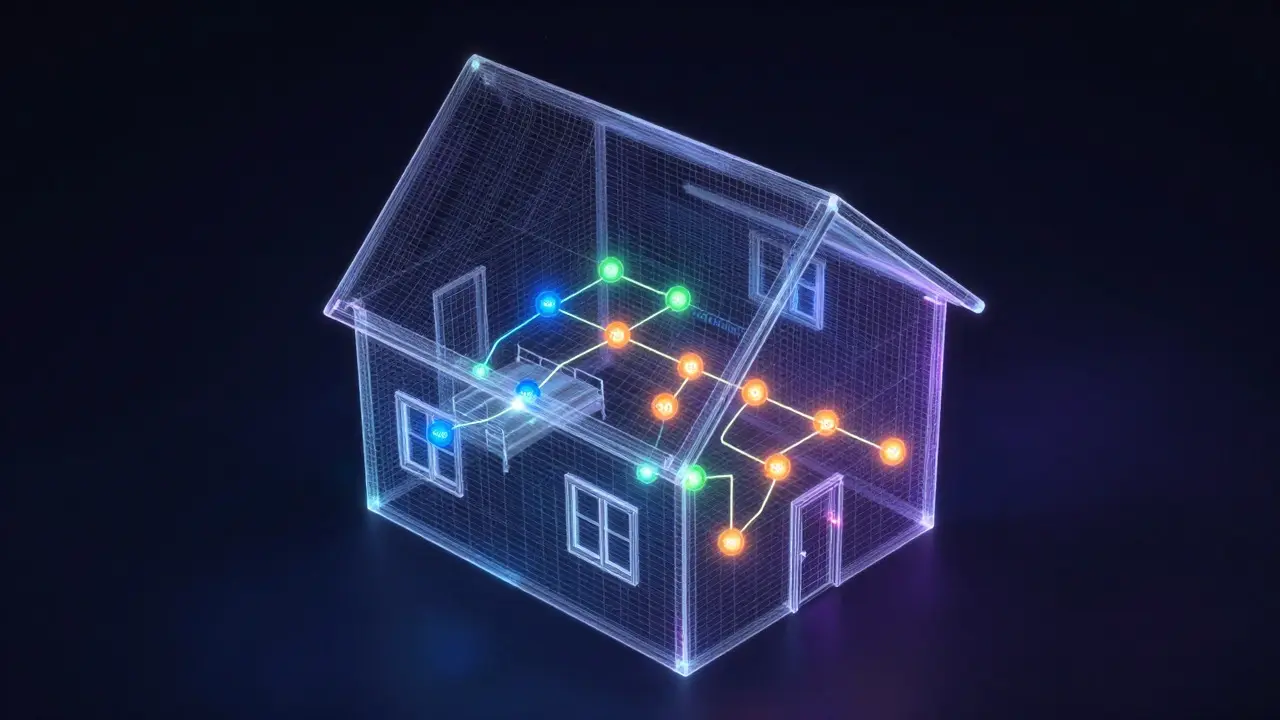
Imagine walking through your childhood home and finding a history date hiding in the kitchen sink, a biology definition taped to the bathroom mirror, and a math formula scrawled on the front door. That’s not a dream-it’s how the Memory Palace is a mnemonic technique that uses spatial memory to store and retrieve complex information by associating it with specific locations in a familiar environment. For students drowning in textbooks and flashcards, this ancient Greek strategy offers a way out of rote memorization. Instead of forcing your brain to hold onto abstract facts, you anchor them to physical spaces your mind already knows cold.
The core problem with standard studying is that it treats information as isolated data points. Your working memory can only handle about seven items at once before things start slipping away. When an exam asks you to connect multiple concepts, those disconnected facts often fail to link up under pressure. The Loci method solves this by turning linear lists into a navigable map. You don’t just remember the list; you remember the journey.
Why Spatial Memory Beats Rote Memorization
Your brain didn’t evolve to memorize lists of chemical elements or historical treaties. It evolved to navigate environments. This is why you can probably remember where you left your keys yesterday, but struggle to recall the capital of a country you learned last week. Spatial memory is deeply rooted in the hippocampus, a part of the brain responsible for mapping physical space. By hijacking this system, you convert weak semantic memories (facts) into strong episodic memories (experiences).
Research from the University of Edinburgh has shown that individuals using the Loci method can recall significantly more items than those using simple repetition. In one notable study, participants who used mental imagery to place objects in a room remembered over 80% of a list after several days, whereas control groups dropped below 50%. The key isn’t just remembering the fact; it’s remembering the *context* of where you placed it. If you visualize a giant apple sitting on your sofa, you’re not just recalling "apple"-you’re recalling the image of the fruit crushing the cushions. That vividness creates a stronger neural pathway.
Building Your First Memory Palace: Step-by-Step
You don’t need a castle or a mansion. The best palaces are places you know intimately: your current apartment, your bedroom, or even the route you walk to campus. Here is how to construct one effectively:
- Choose a Familiar Location: Pick a place you visit daily. The more comfortable you are there, the easier it will be to mentally walk through it without getting lost.
- Create a Fixed Path: Decide on a specific route. Start at the front door, move to the living room, then the kitchen, and end in the bedroom. Keep the path consistent every time you use the palace. Changing the route confuses the retrieval process.
- Identify Loci (Stations): Select distinct spots along your path. These are your "stations." Aim for 10 to 15 stations per palace initially. Examples include: the doormat, the shoe rack, the sofa armrest, the coffee table, the TV stand, the fridge handle, and the stove knob. Each station must be visually distinct so you don’t mix them up.
- Assign Information to Stations: Take the first item you want to memorize and create a bizarre, vivid image involving that item and the first station. Place the second item at the second station, and so on.
The rule of thumb here is exaggeration. Boring images fade quickly. Vivid, weird, or violent images stick. If you need to remember that mitochondria are the powerhouse of the cell, don’t just write it down. Imagine a tiny, muscular power plant exploding inside your sofa cushion, sending sparks flying across the carpet. The weirder the image, the harder it is for your brain to ignore.

Techniques for Making Images Stick
Once you have your structure, the quality of your associations determines your success. There are three primary ways to link information to your loci:
- Interaction: Make the object interact with the location. Don’t just put a book on the table; imagine the book biting your hand as you try to pick it up. Movement creates dynamic memory traces.
- Transformation: Change the nature of the object or the location. Turn the kitchen sink into a waterfall of equations. Transform the light switch into a glowing DNA helix.
- Emotion: Attach a feeling to the scene. Fear, humor, or disgust are powerful anchors. If you’re studying for a chemistry exam, imagine sulfuric acid melting your favorite shoes. The discomfort makes the memory unforgettable.
A common mistake students make is creating static, realistic images. If you picture a normal chair with a normal book on it, your brain might treat it as unimportant. But if the chair is made of cheese and the book is screaming, your brain flags it as significant. This is known as the von Restorff effect, or the isolation effect, which states that items that "stand out" from their surroundings are more likely to be remembered.
Applying the Method to Different Subjects
The beauty of the Memory Palace is its versatility. It works for anything that can be visualized or converted into a visual metaphor. Here’s how to adapt it for various academic fields:
| Subject Type | Challenge | Loci Strategy | Example Image |
|---|---|---|---|
| History/Dates | Abstract numbers and timelines | Use number shapes or sound associations to turn dates into objects | For 1945, imagine a giant "1" shaped like a spear piercing a "9" balloon on the front door |
| Science/Biology | Complex processes and structures | Break processes into steps and assign each step to a station | Photosynthesis Step 1: Sunlight hitting the window blinds. Step 2: Water droplets falling from the ceiling fan |
| Foreign Languages | Vocabulary retention | Associate words with similar-sounding native words or visual puns | Spanish "manzana" (apple) -> Imagine a giant apple zapping you with electricity on the couch |
| Math/Formulas | Abstract symbols and variables | Convert variables into characters or objects that perform actions | Pythagorean theorem: A right triangle wrestling with a square root symbol on the kitchen floor |
For essay-based exams, you can use the palace to structure your arguments. Assign each main point of your thesis to a different room. As you walk through the palace during the exam, each room triggers the next argument, ensuring you don’t forget a key section of your response. This turns writing from a blank-page panic into a guided tour.
Common Pitfalls and How to Avoid Them
Even experienced users stumble when they rush the setup. The most frequent error is choosing stations that are too close together or too similar. If your first two stations are "left shoe" and "right shoe," you’ll constantly mix them up. Ensure there is enough physical distance between stations-aim for at least a few feet apart. Another trap is overloading a single station. If you try to cram five facts into one image, the image becomes cluttered and hard to retrieve. One clear, dominant image per station is the gold standard. If you have more facts than stations, build a new palace rather than crowding the existing one. Finally, neglecting review kills the method. A memory palace is not a fire-and-forget tool. You need to walk through it mentally at least twice a day for the first week. This active retrieval strengthens the neural connections. After that, weekly reviews are usually sufficient to keep the information accessible for long-term exams.
When to Use a Memory Palace vs. Other Techniques
The Memory Palace is powerful, but it isn’t the right tool for every job. It excels at ordered lists, sequences, and structured information. However, for understanding deep conceptual relationships, it might feel artificial. If you’re trying to understand *why* a historical event happened, a narrative approach or concept mapping might serve you better than placing facts in a hallway. That said, for high-stakes exams where precision and speed matter, the Loci method is hard to beat. It reduces cognitive load because you aren’t actively searching for the answer; you are simply navigating to it. Think of it as the difference between digging through a messy drawer to find a pen versus having a dedicated pen holder on your desk. The information is always exactly where you expect it to be.
Start small. Build a palace for your next upcoming quiz, not your final exam. Master the technique with ten items before scaling up to fifty. Once you feel confident in your ability to visualize and navigate, you’ll find that studying becomes less about endurance and more about creative storytelling. And honestly, making up ridiculous scenes is a lot more fun than staring at a textbook until your eyes blur.
Do I need to draw my memory palace?
No, drawing is optional. While some people find sketching the layout helpful for initial planning, the actual technique relies entirely on mental visualization. If you are a visual learner, a quick sketch can help you lock in the sequence of stations, but once the path is established in your mind, you can discard the paper.
How long does it take to build a memory palace?
Setting up the structure takes about 10-15 minutes for a familiar location. Assigning information to the stations depends on the complexity of the material, but generally, you should spend no more than 30-60 seconds per item creating the image. The real time investment is in the subsequent reviews, which should take 5-10 minutes per session.
Can I use the same palace for different subjects?
It is possible, but not recommended for beginners. Reusing a palace risks interference, where old memories overwrite new ones. If you must reuse a space, wait until the previous information is firmly stored in long-term memory (usually after a month). Ideally, build separate palaces for different major subjects or exam periods to keep the mental maps distinct.
What if I get stuck while walking through the palace?
If you lose your place, don’t force it. Stop and visualize the previous station clearly. Often, re-establishing the context of the prior location helps trigger the next one. If you still can’t proceed, skip ahead to the next station you can see clearly and work backward. This gap-filling exercise actually strengthens the missing links over time.
Is the memory palace good for short-term notes?
Yes, it is excellent for short-term retention, such as remembering a grocery list or a speech outline. For these tasks, you can use a smaller, simpler path like a single room. The technique scales well from temporary tasks to long-term academic goals, making it a versatile tool for both daily life and serious study.