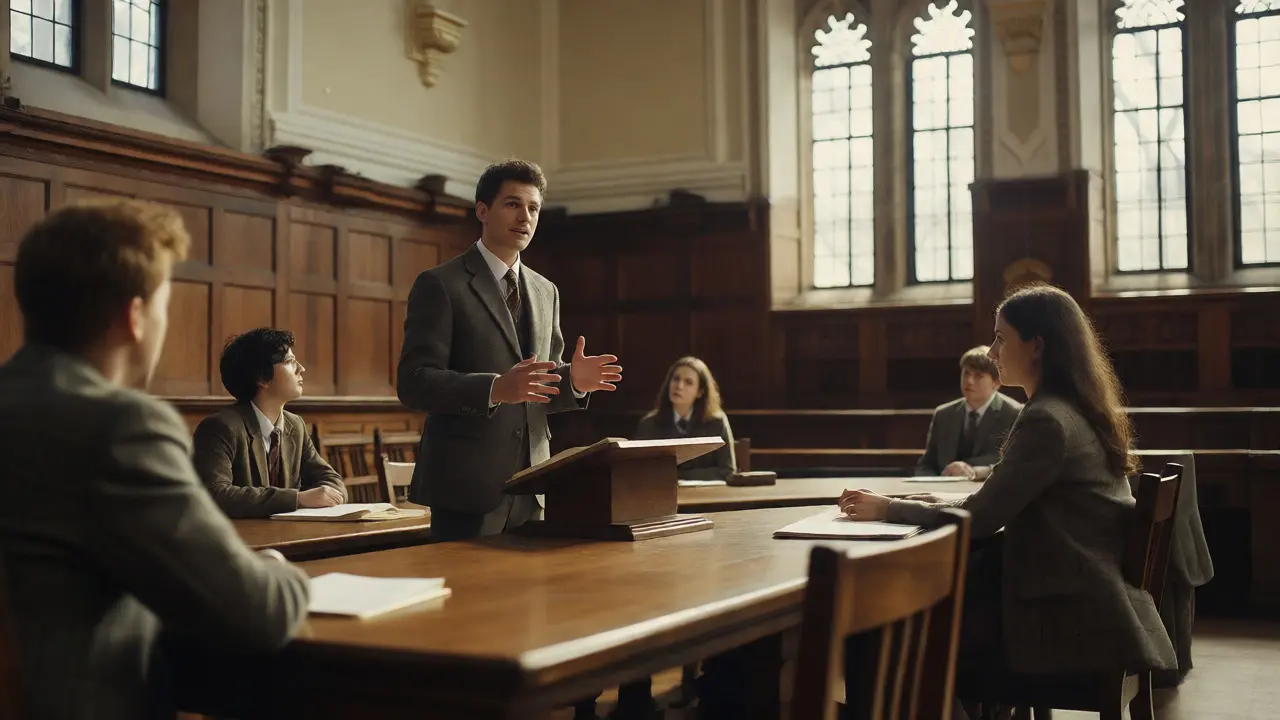
You’ve spent weeks researching, reading, and writing. You know your topic inside out. But when you step up to the podium in a UK seminar, a small-group academic session common in British universities where students discuss prepared topics with a tutor, things can fall apart if you haven’t planned how to speak. It’s not just about what you say; it’s about how you hold the room, manage your time, and support your argument without hiding behind bullet points.
Many international and domestic students struggle here. They assume that because their written essay was strong, their talk will be too. That’s a mistake. Writing is static; speaking is dynamic. In the UK higher education system, seminars are designed for debate and critical engagement, not just recitation. If you read your notes verbatim, you’ll lose your audience-and likely your marks. This guide breaks down exactly how to build a presentation that feels natural, professional, and persuasive.
The Three-Act Structure of a Winning Talk
Think of your presentation like a short play. It needs a beginning that hooks, a middle that argues, and an end that lands. Unlike an essay, where you can bury your main point in the conclusion, a seminar talk must signal its direction immediately. The standard UK academic expectation is clarity over complexity in delivery.
The Introduction (10-15% of time): Don’t start with "My name is... and my topic is..." Start with a question, a startling statistic, or a brief anecdote related to your thesis. Then, state your central argument clearly. Tell them what you’re going to tell them. For example, instead of saying "I will look at climate change," say "Climate policy fails because it ignores local economic realities." Now they have a lens through which to listen.
The Body (70-80% of time): Limit yourself to three main points. Cognitive psychology suggests that audiences retain three key ideas far better than five or seven. Each point should follow a mini-structure: claim, evidence, analysis. Use signposting language-words like "firstly," "in contrast," or "building on this"-to guide listeners through your logic. If you’re discussing a complex theory, break it down into digestible chunks. Remember, you are guiding a conversation, not dumping data.
The Conclusion (10-15% of time): Do not introduce new information here. Summarize your three main points briefly and restate your thesis in light of the evidence you’ve presented. End with a "so what?" factor. Why does this matter to the field? What should the audience think about after they leave? A strong closing line sticks in memory long after the details fade.
Slides: Visual Support, Not Teleprompters
If your slides contain paragraphs of text, you’ve already lost. The biggest error students make is treating PowerPoint as a document viewer. Your audience can read faster than you can speak. If they’re reading your slide, they aren’t listening to you.
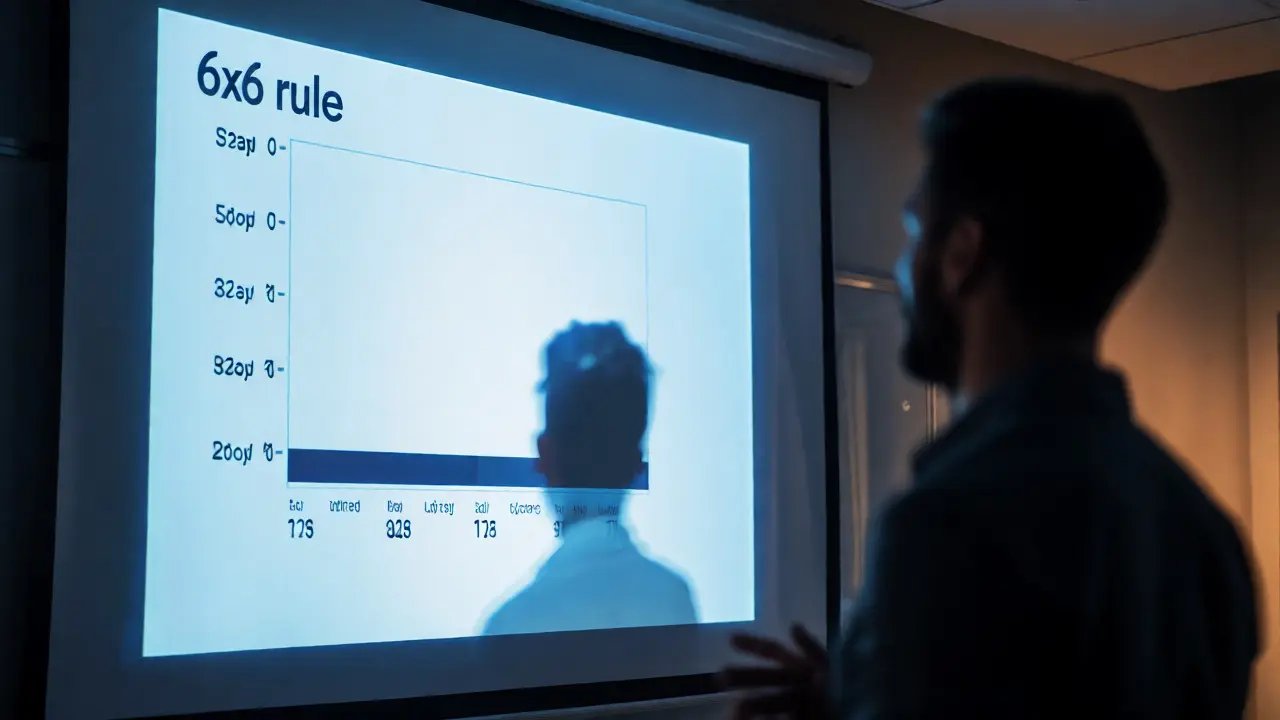
Follow the 6x6 rule: no more than six words per line, no more than six lines per slide. Ideally, aim for even less. One powerful image, a single chart, or three bullet points are often enough. The slide is there to anchor a concept visually, not to replace your voice.
| Element | Best Practice | Common Mistake |
|---|---|---|
| Text Volume | Keywords only; max 3 bullets | Full sentences or paragraphs |
| Font Size | Minimum 24pt for body, 30pt+ for headers | Small fonts (12-14pt) hard to read from back |
| Color Contrast | Dark text on light background or vice versa | Low contrast (e.g., yellow on white) |
| Visuals | High-res charts/images with clear labels | Pixelated clipart or irrelevant stock photos |
| Citations | Brief source note at bottom (Author, Year) | No citation or full bibliography on slide |
Keep citations visible but unobtrusive. Put "Smith (2023)" in small font at the bottom right. This shows academic rigor without cluttering the visual space. Also, check your university’s accessibility guidelines. Many UK institutions require high-contrast modes and alt-text for images, ensuring your presentation is inclusive for all attendees.
Delivery: Voice, Eye Contact, and Presence
Nerves are normal. In fact, a little adrenaline makes you sharper. The goal isn’t to eliminate nervousness but to channel it. Here’s how to project confidence even if you feel shaky inside.
- Vary your pace: When you’re nervous, you tend to speed up. Consciously slow down during key arguments. Pause after making a strong point. Silence is powerful-it lets the idea sink in and gives you a moment to breathe.
- Eye contact strategy: Don’t scan the whole room vaguely. Pick one person in the left sector, speak to them for a sentence, then move to someone in the center, then the right. This creates connection rather than broadcasting.
- Body language: Stand tall. Avoid crossing arms or putting hands in pockets. Use open gestures to emphasize points. If you use a lectern, don’t hide behind it; stand beside it or lean slightly forward to engage the front row.
- Vocal variety: Monotone kills interest. Raise your volume slightly for emphasis, drop it for serious or confidential-sounding points. Change your pitch to keep attention.
A pro tip: Record yourself practicing. Most people hate watching themselves, but it’s the fastest way to spot filler words like "um," "like," or "basically." Replace these pauses with silence. Silence sounds confident; fillers sound unsure.

Handling Q&A Sessions Like a Pro
In UK seminars, the discussion phase is often weighted heavily in assessment. Tutors want to see if you can defend your position and admit limitations. Don’t panic if you don’t know an answer.
Listen carefully to the question. If it’s unclear, paraphrase it: "So you’re asking whether this applies to developing economies specifically?" This buys you thinking time and ensures you address the actual query. If you don’t know the answer, say so honestly but constructively: "That’s an interesting angle I hadn’t considered. My current research focuses on X, but Y might provide insight there." Never bluff. Academic integrity matters.
Also, prepare for hostile questions. Sometimes peers challenge you to test your robustness. Stay calm, acknowledge their point, and return to your evidence. "I appreciate that perspective, however, the data from Jones (2024) suggests..." keeps the tone collaborative rather than defensive.
Preparation Checklist Before You Speak
Don’t leave logistics to chance. Technical failures are the most common cause of anxiety spikes right before a talk.
- Tech Check: Arrive 15 minutes early. Test your laptop with the projector. Bring your file on a USB drive AND email it to yourself. Have a PDF backup in case fonts shift.
- Time Rehearsal: Practice out loud at least three times. Time each run. If you have 10 minutes, aim for 9. Always leave buffer time for transitions.
- Note Cards: Use index cards, not full sheets of paper. Write only keywords or first sentences of paragraphs. Number them so if you drop them, you can reorder quickly.
- Dress Code: Smart casual is usually safe for UK seminars. Comfortable shoes matter-you’ll be standing.
Remember, the tutor knows you’re a student. They expect imperfection. They reward clarity, preparation, and engagement. Focus on communicating your ideas clearly, and the rest will follow.
How long should a typical UK seminar presentation be?
Most undergraduate seminars allocate 10-15 minutes for presentations, followed by 5-10 minutes of Q&A. Postgraduate sessions may allow 20-30 minutes. Always confirm the specific time limit with your module leader, as exceeding it can result in being cut off mid-sentence.
Should I memorize my entire presentation?
No. Memorizing word-for-word makes you sound robotic and increases anxiety if you forget a line. Instead, memorize your opening and closing statements. For the body, know your key points and transition phrases well enough to speak naturally around them. Use cue cards for safety nets.
What if I go blank during the talk?
Pause. Take a sip of water. Look at your next slide or note card. Audiences rarely notice a 3-second pause; they interpret it as thoughtful deliberation. If you truly lose your place, skip to the next major point. You can circle back later if time permits, but usually, moving forward is better than stopping entirely.
Is humor appropriate in academic seminars?
Yes, but sparingly. Light, relevant humor can humanize you and engage listeners. Avoid sarcasm or jokes that rely on cultural nuances unless you’re certain the audience shares them. Self-deprecating humor about the difficulty of the topic often works well.
Do I need to cite sources verbally?
Briefly, yes. When presenting data or theories, mention the author and year verbally (e.g., "According to Smith, 2023..."). Full citations belong on the slide footer or in your handout. Verbal attribution establishes credibility and helps listeners track where your ideas come from.