
The real problem isn't that you're lazy or messy. It's that university is the first time most people have to manage a full-time job (studying) and a full-time home manager role (cleaning) without any external structure. When your environment falls apart, your focus usually follows. The goal isn't to have a showroom-perfect apartment, but to create a functional space that supports your brain, not fights it.
Quick Wins for a Cleaner Space
- The 5-Minute Reset: Set a timer for five minutes every evening. Put away shoes, throw away trash, and clear your desk.
- Don't Put It Down, Put It Away: If a coat takes two seconds to hang up but ten minutes to find later in a pile, hang it up now.
- The One-Room Rule: Focus on the area where you spend the most time. A clean desk in a messy room is better than a clean kitchen in a room where you can't find your notes.
Structuring Your Chores Around Your Degree
You can't treat cleaning like a separate hobby; it has to be integrated into your academic calendar. Many students make the mistake of "Marathon Cleaning," where they spend an entire Sunday scrubbing the baseboards and then realize they have no energy left for the week's readings. This leads to burnout and a cycle of avoidance.
Instead, use Time Blocking is a productivity method where you assign a fixed block of time to a specific task to prevent multitasking and decision fatigue . By treating "Cleaning" as a class on your schedule, you remove the guilt of not studying. If you schedule 30 minutes of tidying at 4 PM, you aren't "wasting time"-you're executing your plan.
Consider the energy levels of your day. If you have a heavy lecture from 9 AM to 1 PM, your brain will be fried by 2 PM. That is the perfect time for low-cognitive tasks like doing the dishes or vacuuming. Use these chores as a "brain break" to transition from your academic mindset back to your personal life.
| Phase | Academic Intensity | Cleaning Strategy | Key Focus |
|---|---|---|---|
| Normal Week | Moderate | Consistent Maintenance | Daily resets, laundry once a week |
| Mid-Term Peak | High | Minimum Viable Cleaning | Trash removal, clear desk, hygiene |
| Exam Finals | Critical | Survival Mode | Dish rotation, no deep cleaning |
| Break/Holiday | Low | Deep Clean / Reset | Fridge purge, window washing, organizing |
The Science of the 'Clean Space, Clear Mind' Connection
It's not just a cliché; visual clutter competes for your attention. When you're trying to memorize complex theories or solve equations, your brain is already working at capacity. If your peripheral vision is picking up on a pile of dirty clothes, your Cognitive Load increases. Essentially, your brain is spending energy ignoring the mess, which leaves less energy for the actual studying.
This is why many high-achieving students use the Pomodoro Technique-a method involving 25-minute work intervals followed by a 5-minute break-not just for studying, but for chores. Try this: study for two cycles, then spend one 5-minute break doing a "micro-chore" like emptying the dishwasher. This physical movement wakes up your body and provides a mental reset, making your next study block more effective.

Handling Shared Spaces and Roommate Friction
Living with others adds a layer of complexity. Conflict over a sink full of dishes can be more distracting than the dishes themselves. The secret is to move away from "asking for help" and toward a documented system. Verbal agreements like "we'll just keep it clean" usually fail because everyone has a different definition of "clean."
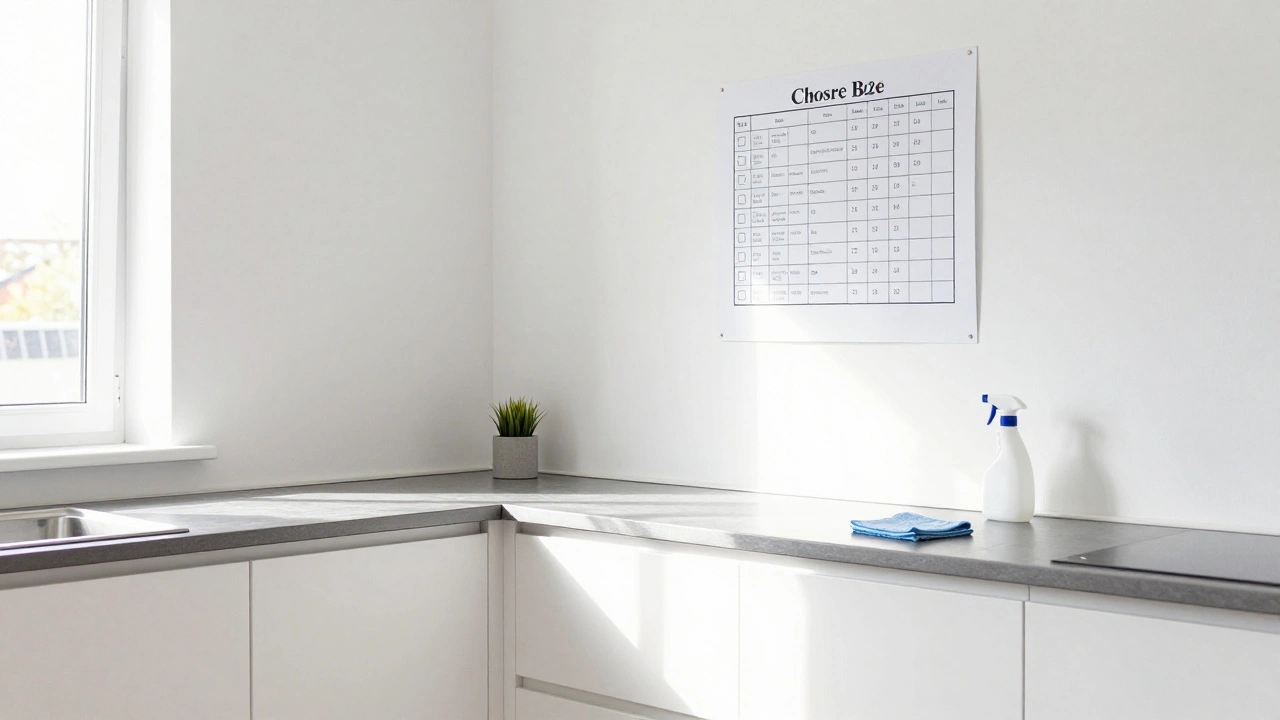
Create a Chore Chart that defines specific expectations. Instead of saying "clean the kitchen," specify "wipe counters and take out trash." This removes the ambiguity that leads to arguments. When everyone knows exactly what is expected, you spend less time negotiating and more time focusing on your degree.
If you're the only one cleaning, don't let it become a source of resentment that ruins your study sessions. Hold a house meeting and explain that a tidy environment helps everyone's grades. Frame it as a collective academic strategy rather than a complaint about hygiene.
Low-Effort Systems for High-Stress Periods
There will be weeks where you simply cannot spend three hours cleaning. During finals, you need a "Survival Mode" system. This means prioritizing tasks that impact your health and mental state over those that are purely aesthetic.
Focus on these three pillars during peak stress:
- The Trash Cycle: Prevent smells and pests by ensuring the trash goes out daily, even if you don't vacuum.
- The Dish Rotation: You can't eat or drink if you have no clean mugs. Wash just enough for the next day.
- The Bed Reset: Making your bed takes 60 seconds but tricks your brain into feeling like the room is more organized than it actually is.
Avoid the temptation to "deep clean" as a form of productive procrastination. You know the feeling: you have a massive project due, so you suddenly decide that today is the day to organize your spice rack or alphabetize your books. Recognize this for what it is-fear of the task. When you feel the urge to deep clean during a deadline, tell yourself, "I will clean this on Saturday as a reward for finishing my paper."
The Role of Tools in Student Efficiency
You don't need an industrial cleaning crew, but a few strategic tools can slash your time. A handheld vacuum is faster for a quick desk cleanup than dragging out a full-sized machine. A set of cleaning wipes allows you to sanitize a surface in ten seconds without needing to find a spray bottle and a cloth.
Invest in a laundry hamper with wheels or a foldable one that you can easily move to the laundry room. The less friction there is between "the chore" and "doing the chore," the more likely you are to actually do it. Remember, the goal of time management for students isn't to work harder, but to reduce the friction of daily life so the academic work becomes the path of least resistance.
How do I stop cleaning from becoming a way to avoid studying?
This is called 'productive procrastination.' To stop it, set a strict time limit for cleaning. Use a timer and tell yourself that once it goes off, you must return to your desk regardless of whether the room is perfect. Also, write a 'to-do' list for cleaning for the weekend so you can tell your brain, 'I've already planned to do that later,' which reduces the urgency to do it now.
What's the best day of the week to do big chores?
Generally, Friday afternoon or Saturday morning is best. Cleaning on Friday afternoon acts as a psychological 'closing' of the academic week, allowing you to enjoy your weekend without the guilt of a messy home. If you leave it for Sunday, you may spend your last hours of rest stressing about the mess or the upcoming Monday.
How can I motivate myself to clean when I'm exhausted from classes?
Pair the chore with something you enjoy, a technique called 'temptation bundling.' Listen to your favorite podcast, a high-energy playlist, or an audiobook only while you are cleaning. This changes the chore from a boring task into a reward-based activity. If you're really drained, start with just one small area-like the sink-and let the small win build momentum.
How do I handle roommates who don't clean their share?
Shift from vague requests to a concrete system. Use a shared digital calendar or a physical chart in the kitchen. Instead of saying 'the place is messy,' say 'it is Tuesday, and the chart says it's your turn for the trash.' If conflict persists, suggest a 'cleaning hour' where everyone puts on music and cleans for 60 minutes together; the social pressure often motivates the slackers more than a list does.
Is it better to clean before or after studying?
For most people, a 'pre-study reset' is best. Spending 5-10 minutes clearing your immediate workspace removes visual distractions and signals to your brain that it's time to focus. However, if you're feeling mentally blocked, doing a physical chore *during* a break can help clear your head and provide a necessary change of scenery.
Next Steps for a Balanced Routine
If you're currently overwhelmed, don't try to implement everything at once. Start with the '5-Minute Reset' tonight. Once that feels natural, try blocking out one hour on your calendar for a weekly reset. As you get comfortable, you can start adjusting your strategy based on the academic phases mentioned in the table above. The goal is a sustainable rhythm that keeps your living space healthy and your GPA high.