
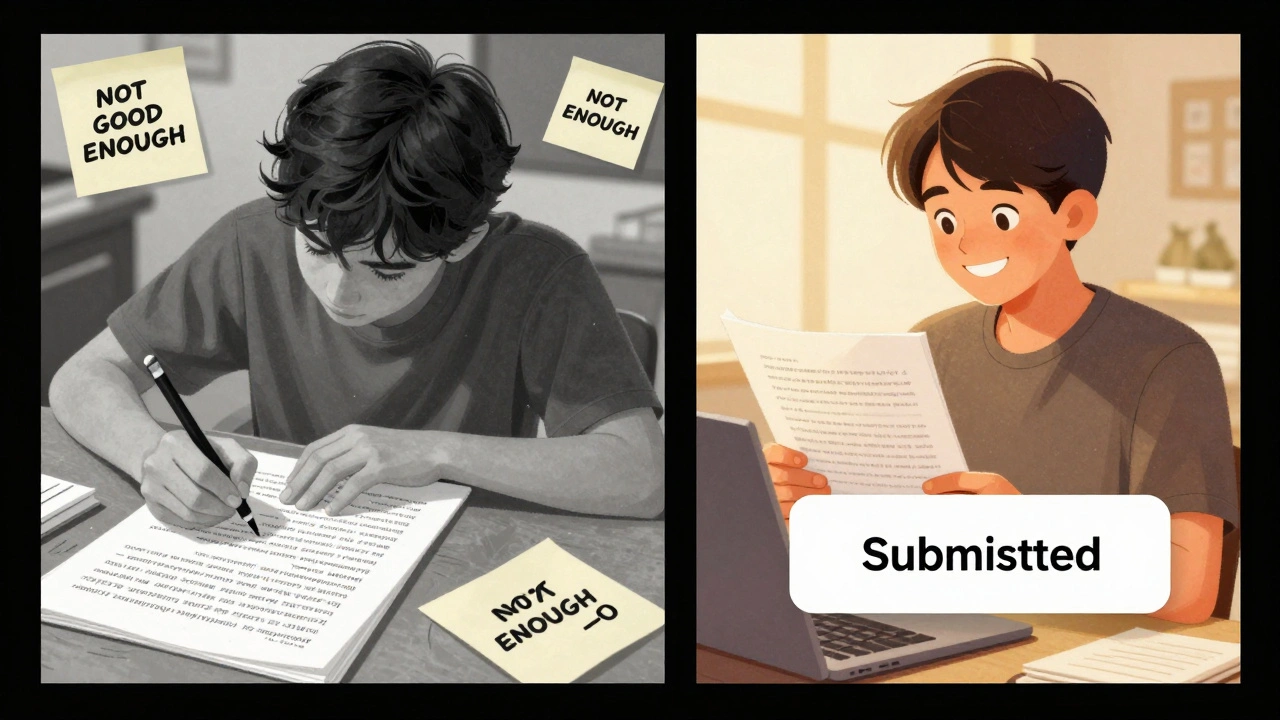
You’ve spent six hours on a 1,500-word essay. You’ve rewritten the introduction five times. You’ve checked every citation twice. You’re still not sure it’s good enough. Sound familiar? If you’re a student in the UK, you’re not alone. Perfectionism isn’t just a habit-it’s a trap that eats time, drains energy, and kills progress. And it’s not making your work better. It’s making you exhausted.
Why Perfectionism Feels Like a Virtue
Most students think being a perfectionist means they care. That they’re serious. That they’ll get top marks because they won’t settle for less. But the truth? Universities don’t reward perfection. They reward clarity, consistency, and meeting deadlines. A B+ essay submitted on time beats an A+ essay submitted three days late every time. The UK grading system doesn’t reward last-minute brilliance-it rewards reliability.Perfectionism tricks you into believing that if you don’t nail every detail, your work is worthless. But no essay, no project, no dissertation is ever truly perfect. Even published academics rewrite their work ten times. The difference? They know when to stop.
The Cost of Waiting for Perfect
Let’s say you’re writing a 4,000-word dissertation. You’ve got eight weeks. You plan to spend two weeks on research, four on writing, and two on editing. Sounds reasonable. But perfectionism changes the math.You spend three weeks on the literature review because you keep finding "better" sources. You rewrite your methodology section four times because you’re worried a professor might question your approach. You delay submitting because you’re still tweaking the conclusion. Now you’ve got three days left to edit, proofread, and format. You’re sleep-deprived. You miss the submission deadline. Your grade drops from a potential First to a solid 2:1-not because your work was bad, but because you ran out of time.
Studies from the University of Oxford show that students who struggle with perfectionism are 3.2 times more likely to miss deadlines than those who set realistic standards. And it’s not just about grades. Chronic perfectionism is linked to higher levels of anxiety, burnout, and even depression among UK undergraduates. The pressure to be flawless isn’t motivating-it’s damaging.
Good Enough Isn’t Mediocre-It’s Strategic
The idea of "good enough" sounds like giving up. But it’s not. It’s a skill. It’s knowing when your work meets the criteria, not when it matches your inner critic’s impossible standard.Here’s how to apply it:
- Start with the rubric. What does your tutor actually want? Structure? Analysis? Evidence? Clarity? Focus on those. Ignore the rest.
- Set a time limit for each stage. Research: 3 days. Draft: 5 days. Edit: 2 days. Stick to it.
- Use the 80/20 rule. 20% of your effort creates 80% of the impact. Identify that 20%-usually the thesis statement, key arguments, and evidence-and nail those first.
- Write a "good enough" draft. Then stop. Sleep on it. Come back tomorrow. You’ll find the flaws aren’t as bad as you thought.
One student I spoke with at the University of Edinburgh stopped rewriting her essay after the third draft. She submitted it. Got a 78%. She was stunned. She’d expected a 65%. The feedback? "Clear structure, strong analysis, well-supported arguments. Well done." Not perfect. But excellent.
How to Spot Perfectionism in Your Work
Perfectionism doesn’t always look like endless editing. Sometimes it looks like procrastination. Or over-researching. Or asking for feedback too early. Here are the real signs:- You can’t start because you’re afraid it won’t be good enough.
- You keep re-reading the same paragraph for 45 minutes.
- You delete entire sections because you think they’re "not academic enough."
- You compare your draft to published papers and feel ashamed.
- You ask your tutor for feedback on a first draft-and then panic when they suggest changes.
If you recognize any of these, you’re not lazy. You’re stuck in a loop. And the only way out is to change your definition of success.
What Great Looks Like in Practice
Great isn’t flawless. Great is thoughtful, timely, and complete. Great essays have a clear argument. They use evidence well. They answer the question. They’re written in plain language. They’re submitted on time.Think of it this way: a great essay is like a well-built house. You don’t need gold-plated doorknobs. You need solid foundations, a roof that doesn’t leak, and windows that open. If you spend all your time polishing the doorknobs, the roof will collapse.
Top UK universities don’t want students who chase perfection. They want students who can manage complexity under pressure. Who can prioritize. Who can deliver. That’s the real skill.

Tools to Break the Cycle
You don’t need to fight perfectionism alone. Here are three practical tools that work:- Time boxing: Use a timer. 25 minutes to write. 5 minutes to walk away. Repeat. No editing during writing time. Just get words down.
- The 10-minute rule: If you’re stuck on a section, set a timer for 10 minutes. Write the worst version possible. Then move on. You’ll fix it later-or realize it didn’t matter.
- Deadline stacking: Set your own mini-deadlines. Draft due: Friday. Feedback requested: Sunday. Final edit: Tuesday. Submit: Thursday. Give yourself breathing room.
One student at King’s College London used a simple Google Calendar hack: she blocked out 3 hours for each essay, no more. She couldn’t extend it. She had to work within the time. She stopped checking citations until the final hour. Her grades improved. Her sleep improved. Her stress dropped.
When Great Is Worth the Extra Effort
This isn’t about slacking off. Some work deserves your best. A final dissertation. A scholarship application. A research proposal. But even then, you don’t need to be perfect. You need to be strong.Ask yourself: Will this piece be read again in six months? Will it change someone’s mind? Will it open a door? If the answer is yes, then invest the extra time. If not-do it well, submit it, and move on.
Perfectionism isn’t a sign of high standards. It’s a sign of fear. Fear of failure. Fear of judgment. Fear that you’re not enough. But your worth isn’t tied to your essay grade. Your value isn’t measured by how many drafts you wrote.
What Comes After Good Enough
Once you stop chasing perfection, something surprising happens. You start writing faster. You start thinking clearer. You start enjoying your work again. You have time to read. To rest. To talk to friends. To breathe.You’ll still make mistakes. You’ll still get feedback that stings. But you’ll learn from it-not freeze because of it. You’ll submit work that’s strong, not flawless. And you’ll realize: you’ve been holding yourself back-not because you’re not good enough, but because you thought you had to be perfect to be accepted.
Good enough isn’t the enemy of great. It’s the path to it.
Is perfectionism really a problem in UK universities?
Yes. Studies from the University of Oxford and King’s College London show that up to 40% of UK undergraduates show signs of clinical perfectionism. It’s linked to higher dropout rates, increased anxiety, and lower academic performance over time-not higher. Universities see it as a mental health issue, not a work ethic problem.
Does submitting a "good enough" essay hurt my chances of a First?
No. Most First-class essays in the UK aren’t flawless. They’re clear, focused, and well-structured. They answer the question directly. They use evidence effectively. They’re submitted on time. Perfectionism often leads to overcomplicating ideas, which confuses markers. Clarity beats complexity every time.
How do I stop rewriting the same paragraph?
Use the 10-minute rule: write the worst version possible in 10 minutes, then move on. You’ll often find the paragraph was fine. If not, you can fix it later-after you’ve finished the whole draft. Perfectionism thrives in isolation. Breaking the cycle means stepping away.
Should I ask my tutor for feedback before submitting?
Only if you’ve already done a full draft. Asking for feedback on a half-written piece usually leads to endless revisions. Tutors expect you to submit your best effort first. Then they’ll give you targeted advice. Don’t use feedback as a crutch to avoid making decisions.
What if I’m still not confident my work is good enough?
Confidence doesn’t come from perfection. It comes from action. Every time you submit a draft-even if you’re scared-you build proof that you can handle it. You’re not waiting to feel ready. You’re becoming ready by doing. That’s how real growth happens.
If you’re reading this and you’ve been stuck on an essay for days, stop. Open the document. Write one sentence. Then close it. Tomorrow, write another. You don’t need to fix everything today. You just need to start-and then stop before you break yourself.