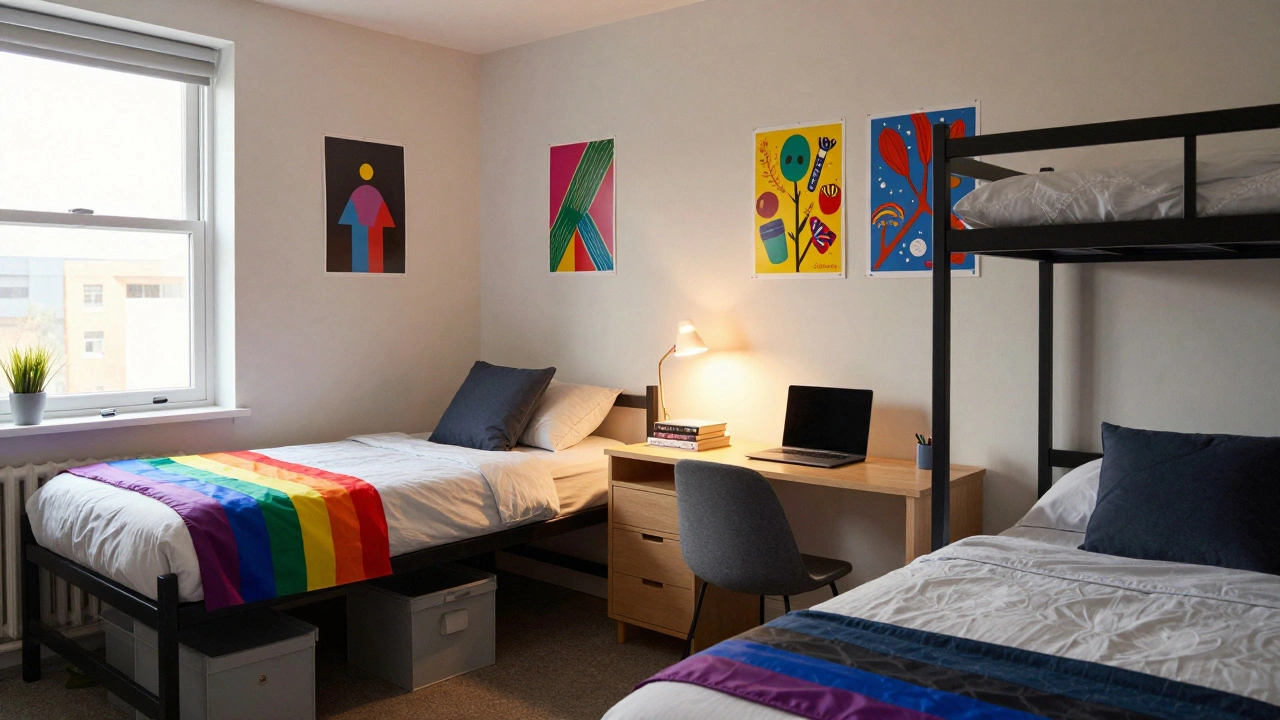
Quick Summary: Key Takeaways for Your Search
- University halls often have specific inclusive policies, but private rentals require more vetting.
- Look for "Rainbow-friendly" labels or specific LGBTQ+ housing networks.
- Vet potential housemates through direct questions about their values and boundaries.
- Know your legal rights under the Equality Act 2010 to fight discrimination.
- Utilize campus LGBTQ+ societies to find vetted sub-lets and shared houses.
Navigating University Halls and Campus Living
Most UK universities offer a range of accommodation, from traditional dorms to self-catered flats. While most institutions claim to be inclusive, the reality depends on the specific floor or building you end up in. University Halls is managed residential buildings provided by higher education institutions to house students. These spaces usually have a built-in support system, which can be a lifesaver for first-year students.
When applying, check if your university offers "inclusive living" clusters. Some campuses have dedicated wings or floors for LGBTQ+ students or those who prefer gender-neutral living arrangements. If they don't have a dedicated zone, look for the university's housing policy on gender-neutral room assignments. Asking the accommodation office specifically about their "safe space" protocols can tell you a lot about whether they're just ticking a box or actually committed to your safety.
One pro tip: get in touch with the Students' Union is a democratic organization that represents students and provides support services within a university. The LGBTQ+ officer at the SU often knows which halls are genuinely welcoming and which ones have a reputation for being exclusionary. They can give you the "unfiltered" version of the housing experience that isn't in the official brochure.
The Private Rental Market: Red Flags and Green Flags
Moving into a private rental is a different beast. You're dealing with landlords and housemates who aren't bound by university codes of conduct. To find a queer-friendly spot, you have to be a bit of a detective. Start by looking for rentals through platforms that explicitly mention inclusivity or use "rainbow'" keywords in their descriptions.
When you're viewing a property, don't just look at the kitchen cabinets. Look at the environment. Are there inclusive stickers in the window? Is the landlord open about their diversity policy? If a landlord seems overly curious about your personal life in a way that feels invasive, that's a red flag. Conversely, a landlord who mentions they have a diverse tenant base or explicitly states they follow Equality Act 2010 is a UK law that protects people from discrimination in the workplace and in wider society, including housing which is a huge green flag.
If you're joining an existing house share, the vibe check is everything. Don't be afraid to ask potential housemates directly: "How do you feel about LGBTQ+ people living in the house?" or "What are your boundaries regarding inclusive spaces?" If they hesitate or give a vague "I don't mind" answer, they might not be the allies you're looking for. You want people who say, "We're a queer-friendly house," or "I've lived with LGBTQ+ people before and it's totally normal here."
| Feature | University Halls | Private Shared House | Private Studio/Flat |
|---|---|---|---|
| Safety Net | High (Campus Security/RA) | Medium (Depends on housemates) | Low (You're on your own) |
| Control Over Peers | Low (Random allocation) | High (You choose roommates) | Total (No roommates) |
| Cost | Predictable/Fixed | Variable/Competitive | Highest |
| Inclusivity Risk | Institutional support | High social risk | Low social risk |
Using Community Networks to Find Homes
The best way to find a safe home is often through people who have already done the legwork. LGBTQ+ student networks are goldmines for finding "hidden" housing options. These are often apartments where queer students have banded together to create a safe haven. When a spot opens up, they usually post it within their own community first rather than on a public site like Rightmove.
Check local queer housing groups on Facebook or Discord. Many cities have "Queer Housing" networks specifically for students and young professionals. These groups often list properties where the landlord is known to be an ally. If you're in a city like Manchester, Birmingham, or London, these networks are incredibly active. Even in smaller university towns, the local LGBTQ+ Society is a student-led organization that provides support, social events, and advocacy for queer students on campus usually maintains a list of recommended landlords or friendly house shares.
Be careful with anonymous listings. If a deal seems too good to be true and the person is rushing you to pay a deposit without a viewing, it's likely a scam. Always insist on a video call or a physical walkthrough of the property, and if possible, talk to a current or former tenant about their experience with the landlord.
Dealing with Housing Discrimination
Even with the best research, you might encounter a landlord or housemate who isn't welcoming. It's vital to know that discrimination based on sexual orientation or gender identity is illegal in the UK. If a landlord refuses to rent to you because you are LGBTQ+, they are violating the law. However, proving this can be tricky because they often use excuses like "the property is no longer available."
Keep a paper trail. Save screenshots of messages and emails. If you feel you've been discriminated against, document the date, the time, and exactly what was said. You can report these incidents to the Citizens Advice is a network of independent advice bureaus in the UK providing free legal and consumer guidance which can help you understand if you have a legal case. Additionally, your university's student services or wellbeing team can offer support and potentially help you find emergency alternative housing if you feel unsafe.
If you're already living in a place and the environment becomes toxic, don't stay in silence. Check your tenancy agreement for "break clauses" that might allow you to leave early. If the harassment is severe, you may be able to argue that the landlord has failed to provide a safe environment, which could help you terminate the lease without penalty.

Practical Checklist for Your Housing Search
To make your search more systematic, use this checklist every time you look at a new potential home. It helps remove the emotion and focuses on the facts.
- The Listing: Does it use inclusive language? Does it mention "all welcome" or "LGBTQ+ friendly"?
- The Landlord: Are they transparent about their rules? Do they seem respectful of personal identity?
- The Area: Is the neighborhood generally safe? Are there LGBTQ+ hubs (cafes, bookstores, community centers) nearby?
- The Housemates: Have I asked them specifically about their views on queer identity? Do they seem genuine or just "tolerant"?
- The Contract: Are there any weird clauses about "guest policies" that could be used to restrict your partner or friends?
- The Support: Do I have a contact at the university or a local society who can verify the reputation of this landlord?
Can a landlord legally refuse to rent to me because I'm LGBTQ+?
No, it is illegal. Under the Equality Act 2010, it is unlawful for a landlord or letting agent to discriminate against someone based on their sexual orientation or gender reassignment. If this happens, you should document all communications and contact Citizens Advice or your university's legal support services.
How do I find gender-neutral housing in UK universities?
Start by contacting the accommodation office during the application process. Specifically ask about "gender-neutral room allocation" or "inclusive living clusters." If the university doesn't offer this officially, the LGBTQ+ society can often point you toward student-led arrangements or specific flats known for being inclusive.
What are the safest cities for LGBTQ+ students in the UK?
While safety varies by neighborhood, cities like Manchester, Brighton, and London have the most robust LGBTQ+ infrastructure, including dedicated queer housing networks and a high density of inclusive businesses. However, many smaller university towns also have very strong, supportive campus communities.
Should I tell a potential landlord I'm LGBTQ+ before signing?
This is a personal choice. Some students prefer to "out" themselves early to filter out bigoted landlords immediately. Others prefer to secure the place first and then share their identity once they feel safe. If safety is your priority, using a vetted LGBTQ+ housing network is the best way to avoid this dilemma.
What should I do if my housemates are making me feel unwelcome?
First, try to address it through direct communication if you feel safe doing so. If that fails, document the behavior. If you're in university halls, contact your Resident Assistant (RA) or the accommodation manager. In private rentals, check your lease for mediation clauses or consider seeking a new place through your university's support network.
Next Steps for Your Move
If you're just starting your search, your first move should be to join your future university's LGBTQ+ society on social media. Don't wait until you arrive on campus; start the conversation now. If you're already in the UK and feeling unsafe, reach out to a local housing charity or the university's wellbeing hub for immediate support.
For those moving into private rentals, make a list of "non-negotiables" (e.g., "Must be okay with my partner staying over," or "Must have a landlord who respects my pronouns"). Being firm about your needs from day one prevents a lot of heartache later in the semester. Remember, your home is your sanctuary-don't settle for a place that makes you feel like you have to hide.