
It’s 48 hours before your UK exam and your notes are a mess. You’ve got three subjects to cover, half a textbook left to read, and your brain feels like it’s running on fumes. Sound familiar? You’re not behind-you’re normal. Thousands of students in the UK face this same panic every exam season. The good news? You don’t need to relearn everything. You need to focus on what moves the needle.
Stop Re-reading. Start Retrieving.
Re-reading your notes feels productive. It’s not. Your brain tricks you into thinking you know the material because it looks familiar. Real learning happens when you force your brain to recall information without looking. This is called retrieval practice, and it’s the most powerful tool you have right now.
Here’s how to do it: Take a blank sheet of paper. Write down everything you remember about a topic-dates, formulas, definitions, key arguments. Don’t peek. Then check your notes. Circle what you missed. Repeat. This isn’t passive review. It’s mental weightlifting. A 2011 study from Washington University found that students who used retrieval practice scored 50% higher on exams than those who just re-read.
Use flashcards if you must, but only if you’re testing yourself-not just flipping them. Try the Leitner system: Put cards you get right in a pile to review less often. Cards you keep missing? Put them in a daily pile. Focus on the weak spots.
Target the High-Yield Topics
You don’t have time to cover everything. So don’t try. Look at past papers. UK exam boards like AQA, Edexcel, and OCR release them publicly. Find the topics that show up every year. For example, in GCSE Biology, photosynthesis and inheritance appear in nearly every paper. In GCSE Maths, quadratic equations and probability are almost guaranteed.
Go to the exam board’s website and download the last three years’ papers. Tally up which topics come up most. Focus 70% of your time on those. Skip the niche stuff-like that one obscure theory your teacher mentioned once. If it hasn’t appeared in three exam cycles, it’s low priority.
Use the 80/20 rule: 20% of the content makes up 80% of the marks. Find that 20% and own it.
Use Active Recall + Spaced Repetition (Even in 48 Hours)
Spaced repetition isn’t just for people who start studying in September. You can still use it-even if you’ve got two days.
Break your remaining time into blocks. Do one subject per 90-minute block. After each block, take a 15-minute walk or nap. Then, two hours later, test yourself again on what you just learned. Do it again before bed. Do it again the next morning. This isn’t magic-it’s how memory works.
Studies from the University of California show that spacing out review sessions-even just 20 minutes apart-boosts long-term retention by up to 300% compared to cramming it all in one go. Your brain needs time to consolidate. Don’t fight it. Work with it.
Teach It Out Loud
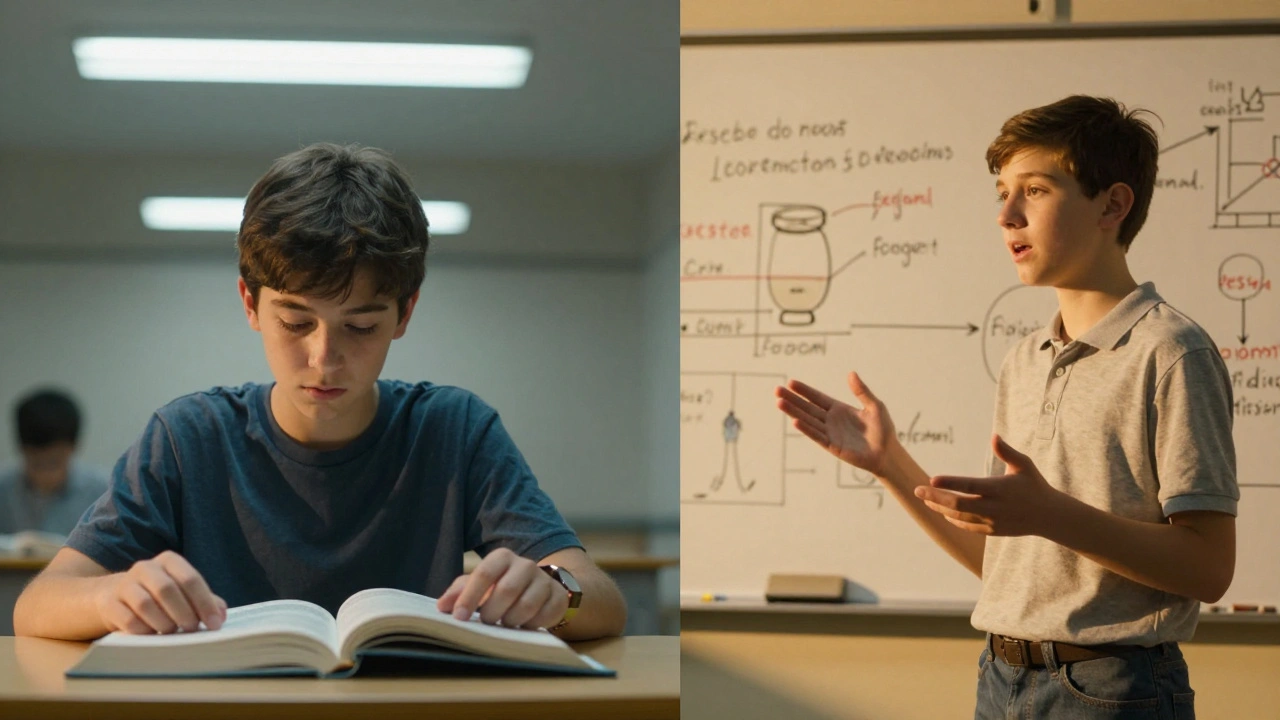
Try this right now: Pick one topic. Stand up. Pretend you’re teaching it to a 12-year-old. Explain it out loud, step by step. If you stumble, you’ve found a gap. If you can’t explain it simply, you don’t understand it well enough.
This is called the Feynman Technique. It forces you to strip away jargon and get to the core. You’ll catch misunderstandings you didn’t even know you had. For example, if you say, “The mitochondria is the powerhouse of the cell,” but can’t explain why that matters in energy transfer, you’re memorizing, not learning.
Record yourself on your phone. Play it back. Does it sound clear? If not, fix it. Teaching is the ultimate test of understanding.
Structure Your Time Like a Pro
Don’t just say, “I’ll study all day.” That’s a recipe for burnout. Use the Pomodoro Technique-but tweak it for survival mode.
- Work for 50 minutes
- Rest for 10 minutes (stand up, stretch, drink water)
- After four cycles, take a 30-minute break
Set a timer. No exceptions. When the timer stops, stop. Don’t “just finish one more page.” That one more page turns into three hours. You’ll exhaust yourself and remember less.
Also, study in the same place every time. Your brain links environment to memory. If you always study at the kitchen table, your brain starts associating that spot with focus. Don’t switch between bed, couch, and floor. Pick one spot and stick with it.
Don’t Sleep Less-Sleep Smarter
Skipping sleep to cram is the biggest mistake you can make. Sleep isn’t downtime. It’s when your brain files away what you learned. Without it, everything you studied today vanishes by tomorrow.
Research from Harvard Medical School shows that students who slept 7-8 hours before an exam scored 20-30% higher than those who pulled all-nighters-even if the all-nighters studied more hours.
Here’s your plan: Get at least 6 hours of sleep the night before the exam. If you can manage 7, even better. If you’re tempted to stay up until 3 a.m., remind yourself: Your brain needs to consolidate. You’re not gaining knowledge by staying awake. You’re losing it by not sleeping.
What to Avoid Like the Plague
- Watching YouTube summaries-they’re entertaining, not educational. You’ll feel like you’ve learned, but you haven’t retained.
- Highlighting everything-it’s visual noise. You’re not processing. You’re decorating.
- Comparing yourself to others-you’re not competing with the student who started in August. You’re competing with the version of you from yesterday.
- Drinking energy drinks-they spike your heart rate and crash your focus. Water, tea, or black coffee are better. No sugar bombs.

Final 24 Hours: The Reset
Twenty-four hours before the exam, stop learning new things. Your brain is in consolidation mode. Now, do this:
- Review your flashcards one last time-only the ones you keep missing.
- Do one full past paper under timed conditions. Don’t worry about the score. Just get used to the rhythm.
- Write down three key formulas, dates, or concepts you’re most worried about. Stick them on your mirror or phone lock screen.
- Prepare your exam kit: pens, calculator, ID, water bottle. Lay it all out. No surprises on exam day.
- Go to bed early. No exceptions.
You don’t need to know everything. You just need to know enough to answer the questions that matter.
What to Do During the Exam
When you sit down, don’t start writing. Read every question. Underline key words: “explain,” “compare,” “evaluate.”
Start with the question you feel most confident about. It builds momentum. Don’t waste time on a question you’re stuck on. Skip it. Come back later. You’ll often find the answer comes to you after you’ve moved on.
Use the structure: Point, Evidence, Explanation. For essays or long answers, start with a clear point. Give one piece of evidence. Then explain why it matters. Even if you don’t remember all the details, this structure earns you marks.
And if you blank? Breathe. Write down anything related-even a keyword. Your brain will connect the dots. Most examiners give partial credit for partial knowledge.
Can I really pass my UK exam after just one day of cramming?
Yes-if you use the right strategies. Cramming won’t turn you into an expert, but it can help you recall enough key facts to pass. Focus on high-yield topics, use active recall, and prioritize sleep. Many students pass exams with under 24 hours of focused revision by targeting exactly what’s likely to appear on the paper.
Is it better to study all night or sleep before the exam?
Sleep. Every time. Studies show students who sleep 7-8 hours before an exam outperform those who study all night-even if the all-nighters spent more hours reviewing. Sleep consolidates memory. Without it, you forget what you learned. A well-rested brain retrieves information faster and more accurately.
What’s the most effective way to use flashcards at the last minute?
Use them for active recall, not passive review. Shuffle them. Test yourself. Put correct answers in a pile to review once. Put wrong answers in a daily pile. Focus 80% of your time on the daily pile. Don’t make new cards now-use the ones you already have. Quality over quantity.
Should I re-read my notes before the exam?
No. Re-reading gives you a false sense of confidence. Your brain thinks, “I’ve seen this before,” but that’s not the same as remembering it. Instead, close your notes and write down everything you can recall. Then check. That’s retrieval practice-and it’s proven to work.
How do I know which topics to focus on?
Look at past papers from the last three years. Count how often each topic appears. Focus on the ones that show up repeatedly. For example, in GCSE English, character analysis and language techniques appear in every paper. In A-Level Chemistry, equilibrium and titration are high-frequency. Ignore topics that haven’t come up in years.
Next Steps After the Exam
Once your exam is over, don’t dwell on what you got right or wrong. You did what you could with the time you had. Now, reflect: What worked? What didn’t? Did you stick to the Pomodoro method? Did you actually test yourself, or just re-read? Write it down. Next time, you’ll know what to do differently.
And if you’re reading this before your next exam? Start earlier. But if you’re here now-right before the test-you’ve got everything you need. Focus. Recall. Rest. You’ve got this.