
You’ve got the big idea. You know what you want to research. But if you hand your supervisor a messy collection of thoughts and vague hopes, they’ll likely send it back with red ink everywhere. In UK university contexts, the dissertation proposal isn’t just a formality-it’s your audition tape. It proves you can think critically, plan logically, and actually finish the work.
Most students fail not because their topic is bad, but because their structure is weak. Supervisors are busy. They need to see clarity immediately. If your proposal looks like a novel, they’ll skim it. If it looks like a blueprint, they’ll read it closely. Here is exactly how to build that blueprint so you get approved on the first try.
The Core Purpose: Why This Document Exists
Before you write a single word, understand the job this document does. A dissertation proposal is a contract between you and your department. It answers three questions: What are you studying? Why does it matter? And how will you pull it off?
Think of it as a feasibility study. Your supervisor needs to know that your scope is manageable within the time limit (usually 3-6 months for a Master’s, longer for PhDs). If you promise to interview every teacher in London, they’ll worry you’ll drown in data. If you promise to analyze one specific policy change in 2015, they’ll nod. Keep it tight. Keep it real.
Step 1: The Title That Works Hard
Don’t be poetic. Be precise. A good title tells the reader exactly what variables you’re looking at and who or what you’re studying. Compare these two:
- Vague: "Social Media and Mental Health"
- Precise: "The Impact of Instagram Usage on Anxiety Levels Among Undergraduate Students in Manchester"
The second title gives me a platform, a metric, a population, and a location. It shows I’ve already thought about boundaries. Use this formula: [Effect/Relationship] of [Variable A] on [Variable B] among [Target Group] in [Context].
Step 2: Introduction and Background
This section sets the stage. Start broad, then narrow down fast. You don’t need to explain the history of the internet if you’re studying TikTok algorithms. Start with the current landscape, identify the gap, and state your aim.
Here’s the flow that works:
- The Hook: A brief statement about why this topic is relevant right now. Cite a recent statistic or news event.
- The Problem: What is missing from current knowledge? Is there a contradiction? A lack of data on a specific group?
- The Aim: One clear sentence stating what your research will achieve.
Keep this under 500 words. If you’re rambling here, you haven’t refined your focus yet.

Step 3: Literature Review - Show Your Homework
This is where most proposals die. Students often list books and articles like a shopping list. "Smith said X. Jones said Y." That’s boring and useless. Instead, synthesize. Group sources by themes, not by authors.
For example, if you’re researching remote work productivity, don’t just list studies. Create sections like "Technological Barriers," "Psychological Effects of Isolation," and "Management Strategies." Then, place the evidence inside those buckets. This shows you can organize complex information-a key skill for any researcher.
| Weak Approach | Strong Approach |
|---|---|
| Chronological listing of sources | Thematic grouping of arguments |
| Passive voice: "It was found by Smith..." | Active synthesis: "While Smith argues..., Jones counters..." |
| Focuses on what has been done | Focuses on what is missing (the gap) |
Your goal here is to prove that your research isn’t redundant. Find the hole in the wall and show them you have the brick to fill it.
Step 4: Research Questions and Objectives
These must align perfectly. Your objectives are the steps; your questions are the destinations. If your objective is to "interview 10 participants," your question shouldn’t be "What is the meaning of life?" It should be "How do participants perceive X?"
Use action verbs for objectives: Identify, Analyze, Evaluate, Compare. Avoid vague verbs like Understand or Explore unless you’re doing purely qualitative ethnography. For questions, keep them open-ended. Yes/no questions kill discussion.
Step 5: Methodology - The Engine Room
This is the section supervisors scrutinize the hardest. They want to know if your method actually answers your questions. Don’t just say "I will use surveys." Explain why.
Break this down into four parts:
- Research Design: Qualitative, quantitative, or mixed methods? Justify this choice based on your research questions.
- Data Collection: How will you get the data? Online survey? Semi-structured interviews? Archival analysis? Specify tools (e.g., NVivo for coding, SPSS for stats).
- Sampling Strategy: Who are you studying and how many? Purposive sampling? Random sampling? Be realistic about access. Can you actually reach these people?
- Ethical Considerations: Mention consent, anonymity, and data storage. UK universities take GDPR seriously. Acknowledge this early.
If you’re using a specific framework, name it. Are you using Grounded Theory? Thematic Analysis? Case Study approach? Naming the methodology signals competence.
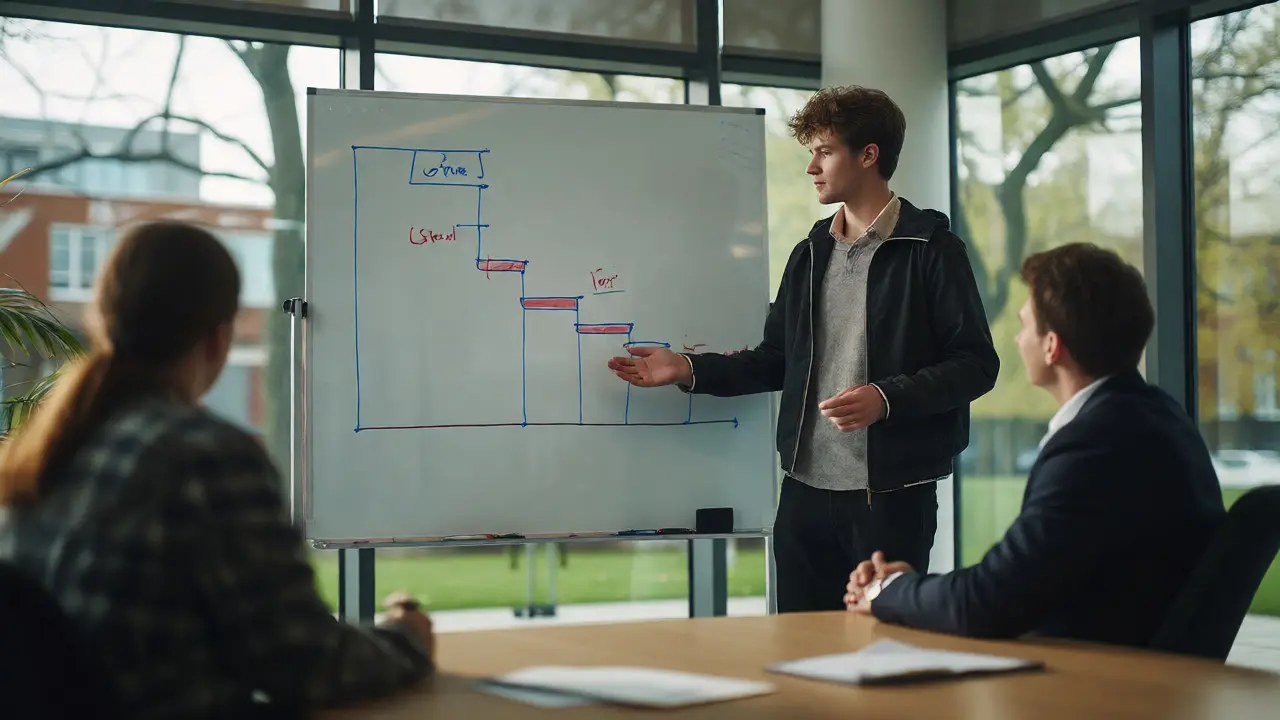
Step 6: Timeline and Resources
Show you’re organized. Create a simple Gantt chart or a week-by-week breakdown. Include time for unexpected delays-because there will be delays. Add a buffer week before submission for editing and formatting.
List resources too. Do you need software licenses? Travel budget for fieldwork? Access to a specific database? If you need money or equipment, ask now. Don’t wait until month three to realize you can’t afford the transcription service.
Common Pitfalls to Avoid
I’ve seen hundreds of these. Here are the mistakes that trigger immediate revisions:
- Scope Creep: Trying to solve world hunger in a 10,000-word paper. Narrow it down.
- Mismatched Methods: Asking "Why" questions but planning a multiple-choice survey. Quantitative data rarely explains deep motivations.
- Ignoring Feedback: If your supervisor suggests a reading, read it. Ignoring guidance looks arrogant, not independent.
- Bad Referencing: Inconsistent Harvard or APA style. It screams carelessness. Use a reference manager like Zotero or Mendeley from day one.
Final Checklist Before Submission
Read your proposal aloud. Does it flow? Does each paragraph connect to the next? Check the word count limits strictly. UK departments are pedantic about this. Exceeding the limit by 10% can lead to penalties.
Finally, check the tone. It should be confident but humble. You’re proposing a path, not declaring absolute truth. Use phrases like "This study aims to explore..." rather than "This study will prove..." Science is about inquiry, not certainty.
Get this right, and the rest of your dissertation becomes much easier. You’ve already done the heavy lifting of planning. Now you just have to execute.
How long should a dissertation proposal be?
Typically, UK universities expect a proposal between 1,500 and 2,500 words. However, always check your specific department's guidelines, as some require only a 500-word abstract while others demand a full 3,000-word document including a detailed bibliography.
Do I need to include a bibliography in the proposal?
Yes, absolutely. Even if not explicitly requested, including a preliminary bibliography demonstrates that you have engaged with existing scholarship. It usually accounts for 10-15% of your total word count and should follow the required citation style (e.g., Harvard, APA).
Can I change my topic after submitting the proposal?
Minor adjustments are common and expected as your research evolves. However, major changes to the core research question or methodology usually require formal approval from your supervisor and sometimes the department head. It is better to refine the scope during the proposal phase to avoid significant rework later.
What is the difference between a research proposal and an essay?
An essay argues a position using existing evidence. A proposal outlines a future plan of action. While an essay concludes with findings, a proposal concludes with a methodology and timeline. The proposal focuses on 'how' and 'why' you will conduct the research, not just what you think about the topic.
How important is the ethical section?
Critical. UK universities have strict ethical review boards. If your research involves human participants, you must address informed consent, data protection (GDPR), and potential risks. Failing to address ethics can delay your project start date significantly, even if the rest of the proposal is perfect.