
Studying with friends can make revision feel less lonely and even fun-but too often, it turns into a social hour with flashcards on the side. You show up ready to crush your biology midterm, and by 3 p.m., you’re debating the best pizza place in town and wondering why your notes still look blank. The problem isn’t your friends. It’s the lack of structure.
Set a clear goal before you even sit down
Don’t just say, "Let’s study together." That’s like saying, "Let’s go to the gym," and then spending the whole time talking about your weekend plans. Every study session needs a specific target. Write it down. Something like: "Review Chapter 5 on cellular respiration and complete 10 practice questions by 4 p.m." Or: "Go over all the formulas in the thermodynamics cheat sheet and quiz each other until we can explain them without looking." This isn’t about being rigid-it’s about giving your brain a finish line. When you know exactly what you’re trying to accomplish, it’s easier to say, "We’ve got 20 minutes left-let’s finish this one diagram," instead of letting the conversation drift.Use the Pomodoro method with a twist
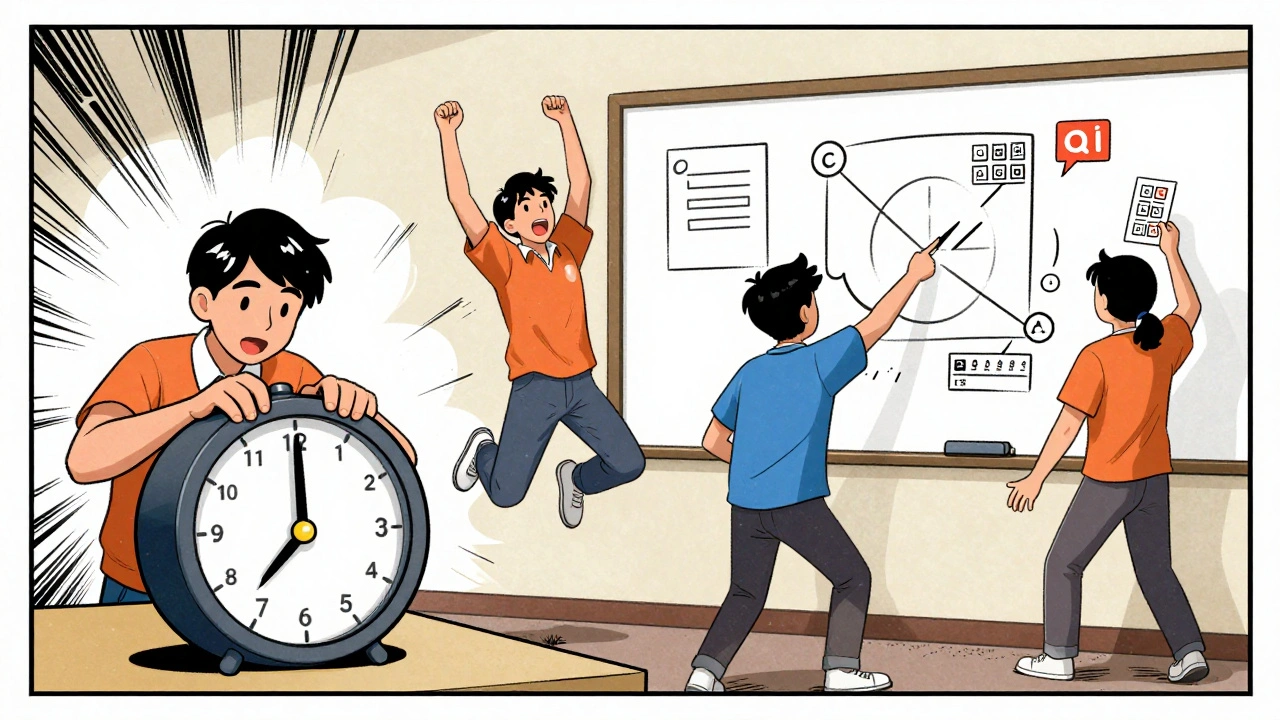
The Pomodoro Technique-25 minutes of work, 5 minutes of break-isn’t new. But most people use it alone. With friends, you need to sync it. Set a timer on your phone and put it in the middle of the table. When it rings, you both stop. No exceptions. No "just one more question." When the timer goes off, you either switch to break mode or move to the next topic.Here’s the twist: make the break *active*. Don’t scroll TikTok. Don’t check Instagram. Stand up. Stretch. Walk around the room. Talk about something *unrelated* to your exam-your dog, your favorite show, what you ate for breakfast. This gives your brain a real reset. When the timer starts again, you’re not still mentally chatting about last night’s party. You’re ready to refocus.
Assign roles so no one’s just along for the ride
In a group of three or four, someone always ends up doing all the work. Someone else just nods along. Avoid that by giving each person a role for the session.- Quiz Master: Prepares 5-7 questions ahead of time and leads the questioning.
- Note Taker: Summarizes key points in a shared Google Doc as you go.
- Time Keeper: Watches the clock, calls out when it’s time to switch topics or take a break.
- Clarifier: Asks "Why?" when someone gives an answer-forces deeper understanding.
Rotate roles every session. That way, everyone stays engaged, and no one feels like they’re just tagging along. Plus, when you’re the Quiz Master, you’re forced to really understand the material to create good questions.
Designate a "no-phone zone"-and stick to it
Phones are the number one distraction in group study. Even if you think you’re just checking a message, your brain is still distracted. Put your phone in your bag. Turn it face down. Better yet, put it in a different room.If you absolutely need your phone for a timer or a digital textbook, use an app like Forest or Focus To-Do that locks your phone for the session. Or better yet-use a physical timer. The sound of a kitchen timer going off is way less tempting than a phone notification.
And here’s a trick: if someone’s phone buzzes, they owe the group $1. Put it in a jar. At the end of the week, buy coffee for everyone. It sounds silly, but it works. People start thinking twice before checking their phone.
Choose the right space-quiet, but not too quiet
Studying in your dorm room? Bad idea. Too many distractions: your bed, your roommate, the snack drawer. The library? Too silent. You might feel pressured to stay quiet, but you also can’t ask questions out loud.Look for a middle ground: a study room in the student center, a quiet corner of the campus café, or a reservable group study booth in the library. These places have enough ambient noise to feel alive, but not so much that you can’t hear yourself think. Bonus: if you’re in a semi-public space, you’re less likely to start laughing loudly about your professor’s weird accent.

End with a quick recap-no exceptions
Don’t just pack up and leave. Spend the last 5 minutes summarizing what you covered. Each person says one thing they learned or one thing they’re still confused about. Write it down. This isn’t fluff-it’s memory reinforcement.And if someone says, "I still don’t get oxidation-reduction reactions," don’t just say, "Yeah, me too." Say, "Let’s meet again tomorrow at 10 a.m. and tackle that before lecture." That turns a vague feeling of confusion into a concrete next step.
Know when to bail-or when to switch groups
Not every study group is right for you. If you’ve tried the above tips and you’re still getting distracted, it’s not you-it’s the group dynamic. Maybe one person is always late. Maybe another dominates the conversation. Maybe the whole group just prefers gossiping over grammar.That’s okay. You don’t have to stay in a group that doesn’t work. Find a new one. Talk to someone in your class who seems focused. Join a subject-specific study club. Even better-form a group with two other people who are serious about grades. One focused person can change the whole energy of a session.
And if you’re the one who keeps getting distracted? Own it. Maybe you need to study alone for a few days to reset. That’s not failure. It’s strategy.
Track your progress-so you can see the difference
Keep a simple log: date, topic covered, how long you studied, and one thing you learned. After three sessions, look back. You’ll see patterns. Maybe you remember more when you quiz each other. Maybe you learn faster when you draw diagrams together. Use that data to improve your next session.And if you’re still struggling? Ask yourself: "Am I here to learn-or just to hang out?" If the answer leans toward the second, it’s time to adjust-or go solo for a while.
Studying with friends doesn’t have to mean wasting time. It can mean learning faster, remembering longer, and feeling less alone. But only if you treat it like a mission-not a hangout.
Can studying with friends actually improve my grades?
Yes-if you do it right. A 2020 study from the University of Chicago found that students who regularly studied in structured groups scored 15% higher on final exams than those who studied alone. The key was active recall and teaching concepts to each other. Just sitting next to someone while scrolling through notes doesn’t count. You need to explain, question, and test each other.
What if my friends are always late to study sessions?
Set a hard start time and stick to it. If someone’s 10 minutes late, begin without them. Don’t wait. After two times, say, "We start on time, or you miss the session." Most people adjust when they realize they’re losing out. If they don’t, you’re better off studying with someone who respects your time.
Should I study with people in my class or from other courses?
Stick to people taking the same course. Studying with someone from a different subject might feel nice, but they won’t know the material you’re struggling with. You’ll spend more time explaining basics than actually revising. Group study works best when everyone’s on the same page-literally and figuratively.
How many people should be in a study group?
Three to four is ideal. With two, you might not get enough different perspectives. With five or more, it’s harder to keep everyone engaged, and conversations get messy. If your group grows too big, split into two smaller teams. Each can focus on different topics and then quiz each other later.
What if I’m shy and don’t like speaking up?
Start small. Write your questions down and hand them to someone. Or say, "Can you explain this part again? I’m still not sure." You don’t need to be the loudest person. Just be consistent. Over time, you’ll get more comfortable. And remember: if you’re confused, chances are someone else is too.
Is it better to study with friends or alone?
Both. Use group study for active recall, explaining concepts, and filling knowledge gaps. Use solo time for memorizing formulas, reviewing notes, and practicing problems without distractions. The best students switch between the two. Groups help you understand. Alone helps you remember.