
You open the PDF. It’s 15 pages of dense text, complex syntax, and references to theories you’ve never heard of. Your eyes glaze over. You read the first paragraph, forget it by the second, and realize an hour has passed with nothing retained. Sound familiar? Most students treat academic journals like novels-reading linearly from start to finish. That’s why it feels so slow and painful. The secret isn’t reading faster; it’s reading smarter. By adopting strategic frameworks used by researchers themselves, you can cut your reading time in half while actually understanding more.
The Three-Pass Method: Stop Reading Linearly
Don’t try to understand everything on the first go. Instead, use the Three-Pass Method, a systematic approach developed by computer scientist S. Keshav that allows readers to extract maximum value from academic papers in three distinct stages. This method acknowledges that human attention is finite and that different parts of a paper serve different purposes.
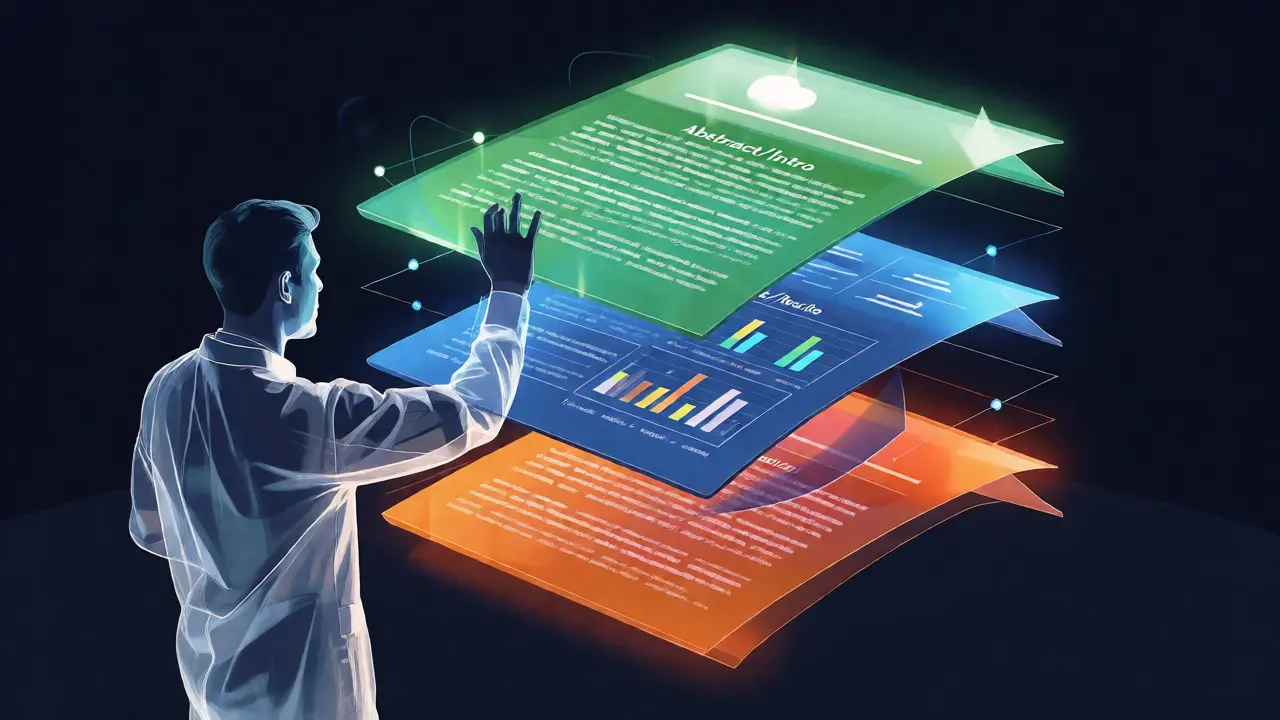
In the first pass, you are not trying to learn the content. You are building a mental map. Spend no more than five minutes. Read the title, abstract, and introduction. Then, skim the section headings. Finally, read the conclusion and glance at the reference list. Ask yourself: What type of paper is this? Is it a survey, a case study, or an experimental result? Do I need to read this fully, or just cite it? If it’s irrelevant, stop there. You just saved 45 minutes.
The second pass is where actual comprehension begins. Now you read the body, but skip the proofs and detailed technical sections initially. Focus on the figures, tables, and graphs. In many STEM fields, the data tells the story better than the text. Mark up the paper (or use digital highlights) for terms you don’t know. At the end of this pass, you should be able to summarize the paper’s main contribution in three sentences. If you can’t, you haven’t understood it yet.
The third pass is virtual re-creation. Only do this if the paper is critical to your thesis or major project. Here, you attempt to reimplement the work or challenge its logic. If it’s a math paper, derive the equations yourself. If it’s a social science study, critique the methodology. This pass transforms you from a passive consumer into an active critic.
Anatomy of a Journal Article: Know Where to Look
Academic writing follows a rigid structure known as IMRaD (Introduction, Methods, Results, and Discussion), a standard format used across scientific disciplines to organize research findings logically. Knowing this structure allows you to jump directly to what matters for your specific goal.
| Section | Purpose | What to Extract | Time Allocation |
|---|---|---|---|
| Abstract | Summary of the entire paper | Main claim, key results, relevance check | 2-3 minutes |
| Introduction | Context and problem statement | Research gap, hypothesis, background | 5-10 minutes |
| Methods | How the study was conducted | Sample size, tools, limitations (skip details unless replicating) | 5-15 minutes |
| Results | Factual findings | Data trends, statistical significance, charts | 10-20 minutes |
| Discussion | Interpretation of results | Implications, comparisons to other studies, future work | 10-15 minutes |
| Conclusion | Final takeaways | Core message, actionable insights | 2-3 minutes |
Notice the time allocation. Most students spend too much time on the Introduction, which is often repetitive marketing for the paper. Skim it for context, then move to the Results. If the Results don’t support the claims in the Abstract, the rest of the paper might not be worth your time.
Active Reading Techniques That Stick
Passive highlighting is useless. If you highlight every sentence, you’ve highlighted nothing. Instead, engage in Active Recall, a learning technique where you retrieve information from memory rather than simply reviewing notes, proven to enhance long-term retention. After each section, close the document and write down what you remember on a blank sheet of paper. Struggling to remember strengthens the neural pathways associated with that information.
Another powerful tool is the Q&A margin note system. In the margins (or comment bubbles in PDFs), ask questions rather than making statements. Instead of writing "Interesting," write "Why did they choose this sample size?" or "How does this contradict Smith et al. (2020)?" This forces your brain to process the material critically. When you return to the paper later, these questions act as prompts for deeper analysis.
Consider using the SQ3R method (Survey, Question, Read, Recite, Review) for particularly difficult texts. Before reading, turn headings into questions. If the heading is "Impact of Sleep on Memory," ask yourself, "What is the impact of sleep on memory?" Then read specifically to answer that question. This gives your reading a purpose and filters out noise.
Digital Tools for Managing Information Overload
University libraries provide access to massive databases, but finding the right tools to manage them is crucial. Zotero and Mendeley are reference management software tools that help users collect, organize, cite, and share their research sources. These tools integrate directly with your browser, allowing you to save papers with one click.
However, saving is not reading. Use these tools to tag papers immediately upon saving. Create tags like "To Read," "Methodology Flaw," or "Key Theory." This prevents the "digital hoarding" syndrome where you have 500 saved PDFs but haven’t opened any of them. Some students find success with spaced repetition apps like Anki for memorizing key definitions found in journals, turning vocabulary acquisition into a game.
For heavy reading, consider text-to-speech features. Listening to a paper at 1.5x speed while following along visually can improve focus for auditory learners. Just ensure you’re still pausing to reflect, not just letting words wash over you.
Overcoming Common Pitfalls
The biggest trap is perfectionism. You do not need to understand every word. Academic language is often intentionally precise, sometimes to the point of obscurity. If a sentence is confusing, check the glossary or look up the term, but don’t get stuck for ten minutes. Move on. Context clues often clarify meaning later in the paper.
Another pitfall is ignoring the references. The bibliography is a treasure map. If a paper cites a source repeatedly, that source is foundational. Add it to your reading list. Conversely, if a paper only cites outdated studies (e.g., nothing after 2015 in a fast-moving field like AI), proceed with caution.
Finally, watch out for confirmation bias. We tend to favor papers that agree with our existing beliefs. Actively seek out counter-arguments. If you’re writing a literature review, include at least one paper that challenges your central thesis. This makes your final argument stronger and more nuanced.
Building a Sustainable Reading Routine
Consistency beats intensity. Reading one paper deeply per week is better than skimming ten in a panic before a deadline. Schedule "journal time" in your calendar just like a lecture. Treat it as non-negotiable.
Start small. Choose shorter articles (under 10 pages) when you’re building the habit. As your confidence grows, tackle longer reviews. Keep a reading log-a simple spreadsheet with columns for Title, Key Takeaway, Relevance Score (1-5), and Status. This log becomes invaluable when you’re writing your thesis and can’t remember which paper had that perfect statistic.
Remember, efficiency isn’t about rushing. It’s about intentionality. Every minute spent reading should have a clear objective. Whether you’re verifying a fact, critiquing a method, or exploring a new concept, know why you’re opening that PDF. Once you master the art of selective, active reading, academic journals stop being obstacles and start becoming tools.
Do I really need to read the whole journal article?
No. For most assignments, you only need the Abstract, Introduction, and Conclusion to understand the scope and outcome. Read the full text only if you are critiquing the methodology or replicating the experiment. The Three-Pass Method helps you decide how deep to go.
How do I handle complex jargon without getting frustrated?
Create a personal glossary. When you encounter a new term, define it in your own words in a dedicated notebook or digital doc. Don’t let one unknown term stop your progress; often, the general idea is clear from context. Review your glossary weekly to reinforce retention.
What is the best way to take notes on academic papers?
Avoid copying large blocks of text. Use a template that includes: Citation, Main Argument, Evidence Used, Limitations, and How It Relates to Your Work. Handwriting notes can boost retention, but digital notes are easier to search. Whichever you choose, ensure you paraphrase rather than quote directly.
Is it okay to read summaries instead of original papers?
Summaries are great for initial screening, but relying on them exclusively is risky. Summaries may misinterpret nuance or omit critical limitations. Always verify key claims against the original text, especially if those claims form the basis of your own arguments.
How can I stay focused while reading dry academic text?
Use the Pomodoro Technique: 25 minutes of focused reading followed by a 5-minute break. During breaks, step away from screens. Additionally, vary your environment; some students focus better in libraries, others in quiet cafes. Physical activity before reading can also prime your brain for concentration.