
Key Strategies for Prioritizing Your Revision
To do this right, you need to stop treating every module as equal. A 10-credit module that counts for 20% of your degree cannot be treated the same as a small elective. You should start by mapping out your credit weighting. If you're at a university like University of Manchester or UCL, your module handbooks will explicitly state how much each exam contributes to your overall mark. Start there. The higher the weight, the higher the priority.
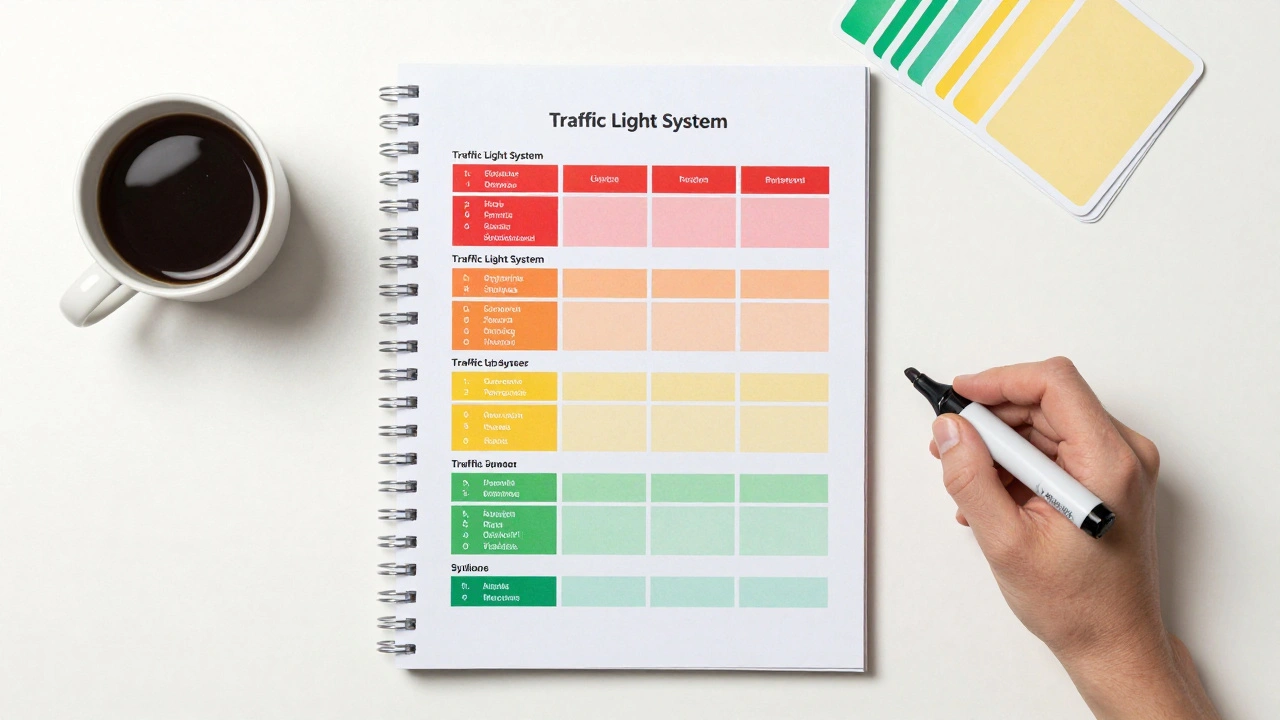
Once you have the weights, apply the Traffic Light System. It sounds simple, but it works because it removes the guesswork. Go through your module list and mark every single topic in Syllabus documents with a color:
- Red: You have no idea what this is, or you've completely forgotten the lecture.
- Amber: You understand the concept but can't explain it clearly or solve a complex problem without notes.
- Green: You could teach this to a classmate right now.
The mistake most students make is spending time in the 'Green' zone because it feels good to be right. Flip that. Your priority should be Red $\rightarrow$ Amber $\rightarrow$ Green. If you spend your energy turning Reds into Ambers, you gain more marks than if you turn Greens into "Perfect Greens."
Managing High-Volume Content with the Pareto Principle
Ever notice how one or two themes always seem to pop up in every single past paper? That's the Pareto Principle in action-the idea that 80% of your results come from 20% of your efforts. In the context of UK exams, this means 80% of the marks usually come from 20% of the core concepts.
To find that 20%, you need to dive into Past Papers. Don't just do them to test yourself; analyze them as a data scientist would. Look for patterns. If "The Industrial Revolution" has appeared in every history paper for the last five years, it is a high-yield topic. Whether you like it or not, that topic becomes your priority. If a specific niche detail has appeared once in ten years, it's a low-yield topic. Treat it as a "bonus" to study only after the high-yield ones are locked in.
| Topic Status | Exam Weight | Priority Level | Study Approach |
|---|---|---|---|
| Red (Unknown) | High | Critical | Intensive focus / Tutor help |
| Amber (Shaky) | High | High | Practice questions / Active recall |
| Red (Unknown) | Low | Medium | Basic understanding / Summary notes |
| Green (Confident) | High | Maintenance | Quick review / One past paper |
Overcoming the "Study Paralysis" Phase
When you have too many modules, you often hit a wall called decision fatigue. You spend an hour deciding what to study, and by the time you pick a topic, you're too tired to actually do the work. To stop this, you need a rigid Study Timetable that isn't based on "hours," but on "tasks."
Instead of writing "Study Biology from 9 am to 12 pm," write "Master the Krebs Cycle and complete 3 past paper questions on cellular respiration." This is a shift toward objective-based planning. When the task is specific, your brain doesn't have to work to figure out *how* to start; it just starts.
Combine this with Interleaving. This is a technique where you mix different subjects in one day rather than focusing on one module for 10 hours. For example, spend two hours on a 'Red' topic in Economics, then switch to an 'Amber' topic in Politics. This prevents burnout and forces your brain to retrieve information more actively, which is exactly what happens during a real exam when you flip through different sections of a paper.

Leveraging Active Recall and Spaced Repetition
Prioritizing what to study is only half the battle; you also need to prioritize how you retain it. Reading your highlighting notes over and over is the least effective way to study-it creates an "illusion of competence." You feel like you know the material because it looks familiar, but you can't produce it from scratch in an exam hall.
Instead, use Active Recall. Close the book and write down everything you remember about a topic on a blank sheet of paper. Only then open the book to see what you missed. The gap between what you remembered and what was actually there is where the real learning happens.
To make sure your 'Green' topics don't slide back into 'Amber,' use Spaced Repetition. Don't review a topic every day. Review it today, then in three days, then in a week. Tools like Anki or simple flashcard decks automate this process. This allows you to spend the vast majority of your time on your 'Red' and 'Amber' zones without losing the progress you've already made.

Dealing with Unexpected Course Changes
Sometimes, a lecturer will drop a hint in the final seminar that completely changes your priorities. "Make sure you're all very familiar with X," is code for "X will definitely be on the exam." When this happens, don't panic and scrap your whole plan. Simply move that specific topic to the top of your priority list, regardless of its previous color.
If you find yourself running out of time entirely, move into "Survival Mode." In this phase, you stop trying to learn everything. You focus exclusively on high-weight, high-yield topics. It is better to know 60% of the syllabus perfectly than to know 100% of the syllabus vaguely. In the UK marking system, depth of understanding often earns more marks than a superficial breadth of knowledge.
What should I do if all my modules are marked 'Red'?
Start with the module that has the highest credit weighting. Use a "bottom-up" approach: read the summary sections of your textbook or lecture slides first to get the big picture, then dive into past papers. Seeing the questions first helps you identify exactly which parts of the 'Red' zone are actually testable, so you don't waste time on fluff.
How do I balance multiple exams happening in the same week?
Use a reverse-calendar method. Start from the date of your first exam and work backward. Give the most time to the exam that happens first, but dedicate a "maintenance block" (1-2 hours) every few days to your later exams. This prevents you from totally forgetting the second and third modules while you're obsessing over the first one.
Are flashcards better than writing summaries?
Generally, yes. Summarizing is a passive process that often involves just rewriting the textbook. Flashcards force active recall. However, for complex essays or long-form UK university exams, you should combine flashcards for facts with "essay skeletons" (bullet-point outlines) to practice the structure of your arguments.
How much time should I spend on 'Green' topics?
Very little. The goal is simply to keep them green. A quick 15-minute review once a week or one practice question every few days is usually enough. If you spend more than 10% of your total study time on things you already know, you are procrastinating under the guise of productivity.
What is the best way to handle a topic I simply cannot understand?
If a topic is a total brick wall, don't spend five hours staring at the same page. Set a timer for 45 minutes. If you still don't get it, move it to a "help list" and send an email to your tutor or ask a classmate. Then, move to a different topic. Often, understanding a different part of the module will provide the missing context that makes the difficult topic suddenly click.
Next Steps for Your Revision Journey
Now that you've mapped your priorities, your next move is to execute. If you're feeling overwhelmed, start with a "Quick Win"-pick one 'Amber' topic that you almost understand and turn it 'Green' in one hour. This builds the momentum you need to tackle the 'Red' zones.
If you're a first-year student, focus on building a library of these prioritized notes now so that next year's season is less chaotic. For final-year students, prioritize the modules that contribute most to your degree classification. Remember, the goal isn't to read everything; it's to be able to answer the questions on the paper.