Every semester, students shell out hundreds-sometimes thousands-on textbooks, gear, subscriptions, and food. But what if you could cut those costs by 50% or more just by using discounts you already qualify for? The secret isn’t just getting one student discount. It’s stacking them. And it’s easier than you think.
You’ve probably used UNiDAYS or Student Beans to get 10% off Amazon or 15% off Spotify. But what if you could combine that with a cashback app, a coupon code, and a credit card reward? That’s not fantasy. That’s how smart students save $300+ a month without lifting a finger.
How Student Discount Stacking Actually Works
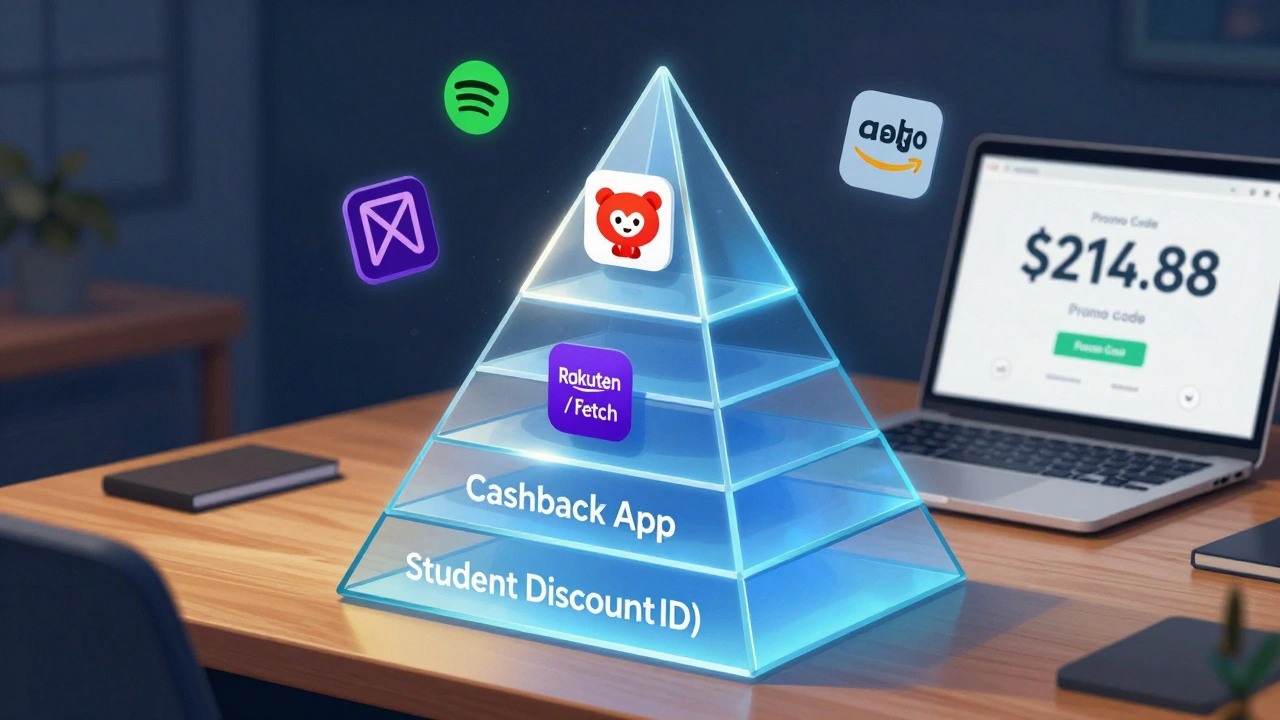
Stacking isn’t about using five discounts on one item. That rarely works. Instead, it’s about layering savings across different parts of your spending. Think of it like building a savings pyramid:
- Bottom layer: Student discounts (verified through ID)
- Middle layer: Cashback apps (earn money back on purchases)
- Top layer: Vouchers and promo codes (site-specific deals)
Each layer reduces the price further. For example:
- You buy a $120 pair of Nike shoes using your student discount: $120 → $102 (15% off)
- You pay with a cashback card that gives 3% back: $102 → $98.94 (after $3.06 cashback)
- You apply a 10% off promo code from a Reddit thread: $98.94 → $89.05
That’s $30.95 saved on one purchase. Do this every month for 12 months? You’ve saved nearly $400. And that’s just shoes.
Where to Find Student Discounts (And How to Verify Them)
Most retailers offer student discounts, but you need to know where to look-and how to prove you’re eligible.
- UNiDAYS: Verified through your .edu email. Covers Apple, Adobe, Spotify, Nike, ASOS, and 200+ brands.
- Student Beans: Works with fashion, tech, and food brands like Zara, Uber Eats, and Adobe.
- SheerID: Used by big names like Microsoft, Adobe, and HP. Often requires uploading your student ID or enrollment letter.
- ISIC Card: The global student ID. Works internationally. Costs $15 one-time, but pays for itself in a single flight or hostel booking.
Pro tip: Always check if your school has its own discount portal. Many universities partner with local businesses-like coffee shops, gyms, or bookstores-that offer extra deals not listed on national platforms.
Best Cashback Apps for Students (2026)
Cashback isn’t just for Amazon shoppers. The best apps for students give you money back on everyday spending.
- Rakuten: 1-10% back on Amazon, Target, Walmart, and Apple. Payouts via PayPal or check. No minimum threshold.
- Fetch Rewards: Scan receipts from grocery stores, pharmacies, and gas stations. Earn points redeemable for gift cards. Works with student discount purchases too.
- Swagbucks: Earn points for online shopping, surveys, and watching videos. Good for small, recurring savings.
- TopCashback: High cashback rates on tech retailers like Best Buy, Newegg, and Microsoft. Often has exclusive student offers.
Use one app for groceries, another for tech, and a third for clothing. Don’t spread yourself thin-just pick the ones that align with your spending habits.
How to Find Voucher Codes That Actually Work
Google “Nike student discount code” and you’ll get spam. But real codes? They live in specific places.
- Reddit: Subreddits like r/StudentDiscounts and r/coupons have active users posting verified codes daily.
- Student Reddit groups: Many universities have their own subreddits. Search “[Your School] student deals”.
- Twitter/X: Follow accounts like @StudentDealsNow or @DiscountsByStudent. They post real-time codes.
- Browser extensions: Honey and Capital One Shopping automatically test codes at checkout. They don’t replace manual searching, but they help catch missed deals.
Always test codes before buying. Some expire after 24 hours. Others only work on first-time purchases. And never assume a code works on sale items-most student discounts exclude already-discounted products.
How to Stack Without Getting Denied
Not all stores allow stacking. Some block promo codes if you’re already using a student discount. Here’s how to beat the system.
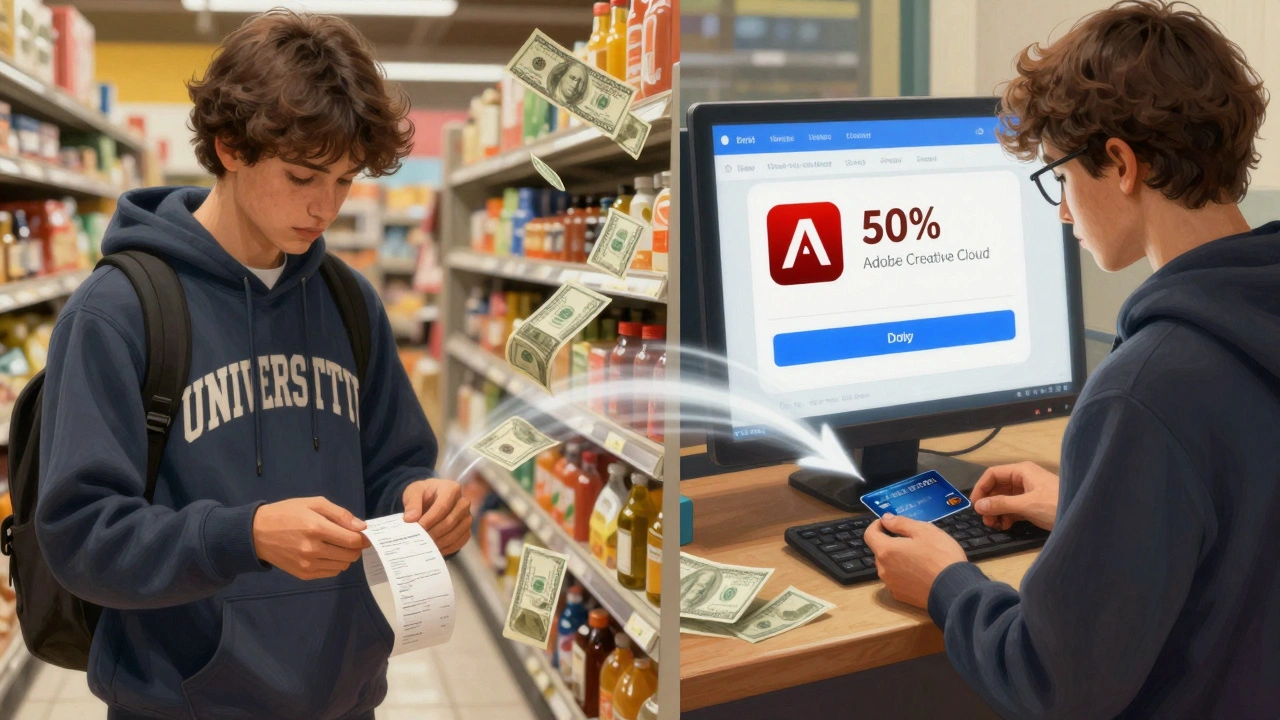
- Order in two steps: Buy the discounted item with your student discount. Then, if you’re eligible for cashback on that purchase (like with a credit card), use a separate card to pay. Cashback doesn’t care how you paid-only that you spent.
- Use different payment methods: Apply the student discount at checkout. Then pay with a cashback credit card (like the Chase Freedom Flex). The discount reduces the price, the card gives you back a percentage.
- Buy gift cards with cashback: Use Rakuten to get 5% back on Amazon gift cards. Then use those gift cards to buy items with your student discount. You’re stacking cashback on the purchase of the discount itself.
Example: You buy a $100 Adobe Creative Cloud subscription with your student discount ($50). You pay with a credit card that gives 2% cashback. You get $1 back. Total savings: $51. Then, you buy a $25 Amazon gift card with 5% cashback from Rakuten. You spend $23.75 and get $1.25 back. Use that gift card to buy your next software license. You just saved $52.25 on $75 of spending.
Tools That Make Stacking Automatic
You don’t have to remember every code or track every cashback offer. These tools do it for you.
- Brave Browser: Built-in crypto rewards for browsing. Also blocks ads that slow down checkout.
- Microsoft Rewards: Earn points for searching with Bing. Redeem for gift cards. Students get bonus points for completing monthly challenges.
- Google Scholar + Amazon: If you’re buying textbooks, search on Google Scholar. Many publishers list direct student pricing. Then use your student discount on Amazon to buy the same book cheaper than the publisher’s site.
Set up email alerts. Many student discount platforms send weekly deals. Turn them on. Ignore the spam. Keep the ones that matter.
Real Student Savings Breakdown (2026)
Here’s what one student in Asheville saved in a single month by stacking:
| Item | Original Price | Student Discount | Cashback | Promo Code | Final Price | Total Saved |
|---|---|---|---|---|---|---|
| Spotify Premium | $10.99 | $5.49 (50%) | $0.16 (3%) | - | $5.33 | $5.66 |
| Adobe Creative Cloud | $19.99 | $9.99 (50%) | $0.30 (3%) | 10% off ($0.93) | $8.76 | $11.23 |
| Amazon Prime | $139/year | $69.50 (50%) | $2.09 (3%) | - | $67.41 | $71.59 |
| Uber Eats (monthly) | $40 | $20 (50%) | $0.60 (3%) | $5 off coupon | $14.60 | $25.40 |
| Total | $310.98 | $145.48 | $3.15 | $5.93 | $96.10 | $214.88 |
That’s $215 saved in one month. On essentials. No side hustle. No debt. Just smart stacking.
Common Mistakes That Cost You Money
- Using the same card for discount and cashback: Some cards block cashback on discounted items. Use a separate card for cashback.
- Assuming all sites allow stacking: Apple and Microsoft often block promo codes during student discounts. Stick to retailers like Nike, ASOS, and Adobe.
- Forgetting expiration dates: Student discounts last until graduation. Cashback offers expire in 30 days. Promo codes? Sometimes 24 hours.
- Not checking your school’s portal: Your university might have a $50 gift card for the campus bookstore you never knew about.
What to Do Next
Start small. Pick one category-say, tech or food. Pick one discount platform. Pick one cashback app. Try stacking just once. See how much you save. Then repeat.
By the end of this semester, you’ll be saving hundreds. Not because you’re rich. But because you know how to use the tools everyone else ignores.
Can I stack student discounts with military or teacher discounts?
Generally, no. Most retailers only allow one discount per transaction. But if you’re a student AND a teacher (like a grad student working part-time), you can sometimes use one discount for one purchase and another for a different one. Always check the fine print.
Do student discounts work on sale items?
Usually not. Most student discounts exclude items already on sale or clearance. But some brands like Nike and ASOS let you combine them. Always test at checkout. If the discount doesn’t apply, it’s blocked.
Is it worth paying for an ISIC card?
Yes-if you travel, eat out, or use public transport. A single flight discount or hostel booking can cover the $15 fee. In the U.S., it’s less useful unless you’re using international brands like Hostelworld or Ryanair.
Can I use student discounts on subscription renewals?
It depends. Spotify and Apple allow renewals at student rates. Adobe and Microsoft require re-verification each year. Amazon Prime student is only for new sign-ups. Always check the renewal policy before canceling.
What if my school doesn’t have a .edu email?
Many non-U.S. schools and online programs use alternatives like .ac.uk or .edu.au. If you’re in the U.S. and don’t have one, try SheerID. You can upload your enrollment letter or transcript. Most platforms accept those as proof.