
Working while studying at a UK university isn’t just common-it’s necessary for many students. With tuition fees, rent, and rising living costs, nearly 60% of undergraduates in the UK take on part-time jobs. But juggling shifts, lectures, assignments, and exams without crashing into burnout? That’s the real challenge. It’s not about working more hours. It’s about working smarter.
Know Your Limits Before You Say Yes
Most students think they can handle 20 hours a week on top of a full course load. The truth? For most people, anything over 15 hours starts eating into sleep, grades, and mental health. A 2023 study from the University of Manchester found that students working more than 16 hours a week were 40% more likely to report chronic stress and falling grades. That doesn’t mean you can’t work-it means you need to pick the right amount.
Ask yourself: How many contact hours do you have? If you’re doing a 30-credit course, that’s about 12-15 hours of lectures and seminars per week. Add in 10 hours of independent study (reading, writing, revising), and you’re already at 25-30 hours. That leaves 10-15 hours for work, meals, travel, and rest. Push past that, and you’re running on fumes.
Build a Realistic Weekly Schedule
Forget those fancy planners with glitter. What works is a simple, color-coded calendar you update every Sunday. Block out every fixed commitment: lectures, labs, library sessions, meal times, and sleep. Then, slot in work shifts. Leave at least two full days free each week-not for "catching up," but for real rest.
Example: A biology student with Monday-Wednesday lectures (10am-3pm) and Thursday lab (9am-1pm) might schedule work on Friday (2pm-6pm) and Saturday (10am-2pm). That’s 14 hours. Sunday is off. No studying. No emails. Just walks, music, or naps. This isn’t laziness-it’s recovery.
Use free tools like Google Calendar or Notion. Set reminders for deadlines and shift changes. If you’re not seeing your week clearly on paper, you’re flying blind.
Work Smart, Not Just Long
Not all part-time jobs are equal. A campus library assistant, student ambassador, or university café worker often has more flexibility than a retail job in town. Look for employers who understand academic calendars. Many universities have dedicated student job boards that list roles with built-in flexibility-like no shifts during exam weeks or automatic time off during semester breaks.
Also, avoid jobs that require you to be on your feet all day, like waitressing or warehouse work. Physical fatigue adds up fast. Mental fatigue from long shifts in customer service? Even worse. Choose roles that let you study during quiet moments-like a library desk job where you can read between customers, or a research assistant role that connects to your degree.
Turn Dead Time Into Study Time
Waiting for a bus? Listen to lecture recordings. Walking to campus? Review flashcards on your phone. Eating lunch? Skim a chapter on your tablet. These aren’t hacks-they’re survival tactics.
Use apps like Anki for spaced repetition flashcards or Audible for audiobooks of your textbooks. Break big reading tasks into 15-minute chunks. You’d be surprised how much you can cover if you use 10-15 minutes of downtime 4-5 times a day. That’s 75-100 minutes of focused study without touching your desk.
One student I spoke to at Leeds University finished her entire sociology reading list in 3 weeks by listening to recorded lectures during her 2-hour shifts at the campus bookshop. She didn’t work more hours-she just used them better.

Protect Your Sleep Like It’s a Final Exam
Sleep isn’t optional. It’s the foundation. Pulling all-nighters to finish essays or cover extra shifts doesn’t make you productive-it makes you slower, forgetful, and more prone to mistakes. Research from the University of Oxford shows students who get less than 6 hours of sleep five nights a week have a 35% drop in memory retention.
Set a hard bedtime. Even if you have a shift tomorrow, don’t stay up past midnight. Use blue light blockers after 9pm. Keep your room cool and dark. If you’re constantly tired, no amount of coffee or willpower will fix it. Sleep is non-negotiable.
Learn to Say No-Politely
You’re not being lazy if you turn down extra shifts, social events, or group projects that aren’t essential. Your priority right now is your degree and your mental health. That’s not selfish-it’s strategic.
Practice this script: "Thanks for thinking of me, but I’ve got a heavy workload this term and need to focus on my studies. I’ll be back next semester." Most people will understand. If they don’t? They’re not your real support system.
And don’t feel guilty for skipping parties, club meetings, or weekend trips. You’re not missing out-you’re investing in your future. The people who matter will respect that.
Use University Support Before You Hit Breaking Point
UK universities offer free, confidential support for students struggling with stress, finances, or time management. But most don’t use it until it’s too late. Don’t wait until you’re crying in the library.
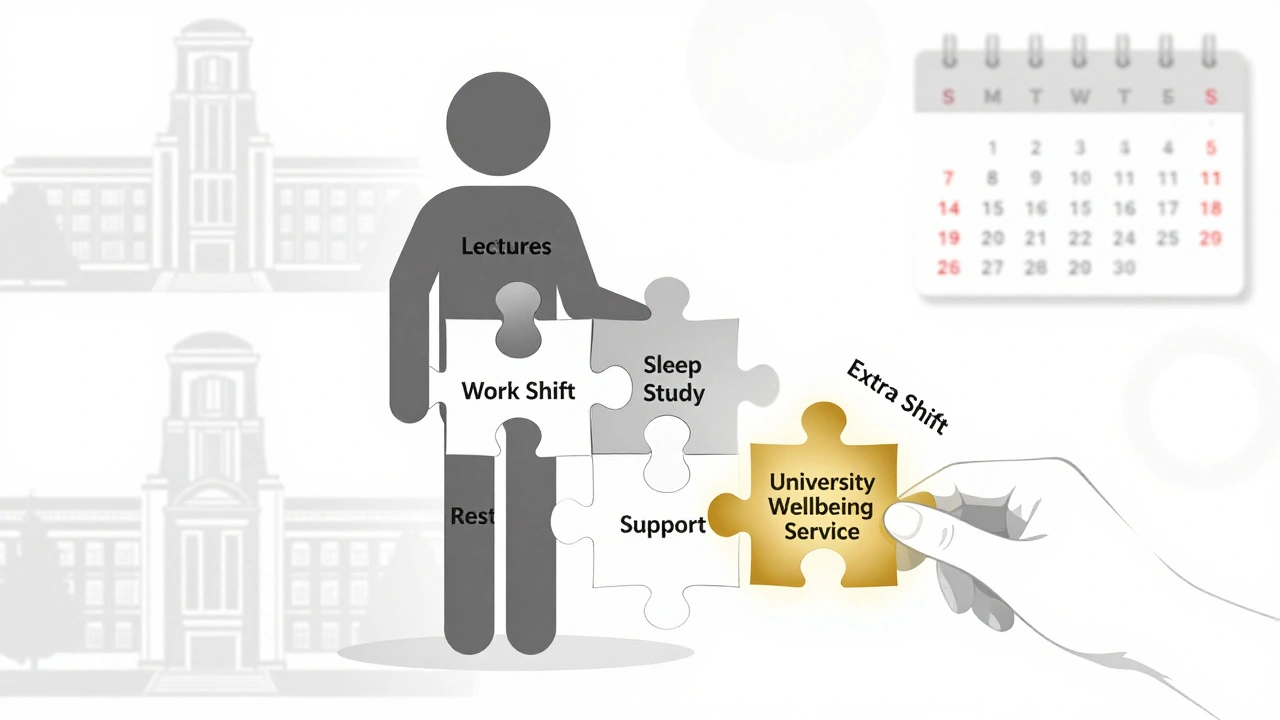
Book a session with your student wellbeing advisor. They can help you negotiate flexible work hours with your employer, apply for emergency funds, or adjust deadlines if you’re overwhelmed. Many universities have emergency grants of up to £500 for students facing sudden financial pressure.
Also, check if your uni has a peer mentoring program. Talking to someone who’s been there-someone who worked 15 hours a week while getting a 2:1-can change everything. You’re not alone.
Track Your Energy, Not Just Your Hours
Not all days are the same. Some days you’re sharp. Others, you’re drained. Instead of tracking hours worked, track your energy levels. Use a simple 1-10 scale each evening: "Today, I felt like a 3/10. Why?"
Patterns emerge fast. Maybe you crash after Friday night shifts. Maybe you’re fine after morning work but useless after lunch. Adjust your schedule based on this data. Move shifts. Swap days. Redesign your week around your body, not a rigid timetable.
What to Do When You Feel Overwhelmed
If you’re snapping at friends, forgetting deadlines, or crying over small things, you’re not failing-you’re signaling. Here’s what to do immediately:
- Stop adding new tasks. Cancel one thing this week-anything.
- Text a friend: "I’m struggling. Can we talk?" Don’t wait to be "ready."
- Visit your GP. They can refer you to free counseling through the NHS.
- Call Student Minds (UK student mental health charity). Their helpline is open 24/7.
There’s no shame in pausing. Taking a term off to reset is better than dropping out from exhaustion.
Final Thought: This Isn’t Permanent
Remember: You’re not building a career as a part-time worker. You’re building a future as a graduate. Every shift, every late night, every skipped meal is temporary. The degree you earn will open doors that no part-time job ever could.
Stay consistent. Stay kind to yourself. And when you look back in two years? You won’t remember how many hours you worked. You’ll remember how you kept going-and that’s the real win.
Can I work more than 20 hours a week on a student visa in the UK?
No. International students on a Tier 4 or Student visa are legally limited to 20 hours of work per week during term time. Exceeding this can lead to visa cancellation and deportation. Some universities offer exceptions for work placements required by your course, but these must be approved in advance. Always check with your university’s international office before taking on extra hours.
What’s the best part-time job for a UK university student?
The best jobs are those that offer flexibility, minimal physical strain, and relevance to your studies. Campus roles like library assistant, research helper, or student ambassador are ideal. They often align with academic calendars, pay above minimum wage, and let you study during quiet periods. Remote roles like virtual tutoring, transcription, or content writing also work well if you have the skills. Avoid jobs with rigid hours, late shifts, or high physical demands.
How do I ask my employer for fewer hours without losing my job?
Be honest and professional. Say something like: "I’m currently balancing my studies and work, and I need to reduce my hours temporarily to maintain my academic performance. I’m still committed to this role and would love to continue working part-time-just at a reduced schedule. Could we adjust my shifts to [X] hours per week?" Most employers respect students who prioritize their education. Many even offer flexible scheduling if you give them notice.
Is it worth it to work if my grades are dropping?
If your grades are slipping because of work, then the answer is probably no-not right now. Your degree is the long-term investment. A lower grade can affect scholarships, job offers, and postgraduate opportunities. Consider cutting hours to 10-12 per week, applying for emergency financial aid, or switching to a higher-paying job that requires fewer hours. Sometimes, working less is the smarter path to success.
How can I avoid burnout if I’m working and studying full-time?
Burnout doesn’t happen overnight. It builds from ignoring small signs: skipping meals, canceling sleep, saying yes to everything. To prevent it, schedule rest like a class. Take one full day off each week. Eat regularly. Move your body-even a 20-minute walk helps. Talk to someone every day, even if it’s just a text. And if you feel numb, exhausted, or hopeless, reach out to your university’s wellbeing team immediately. You don’t have to power through this alone.