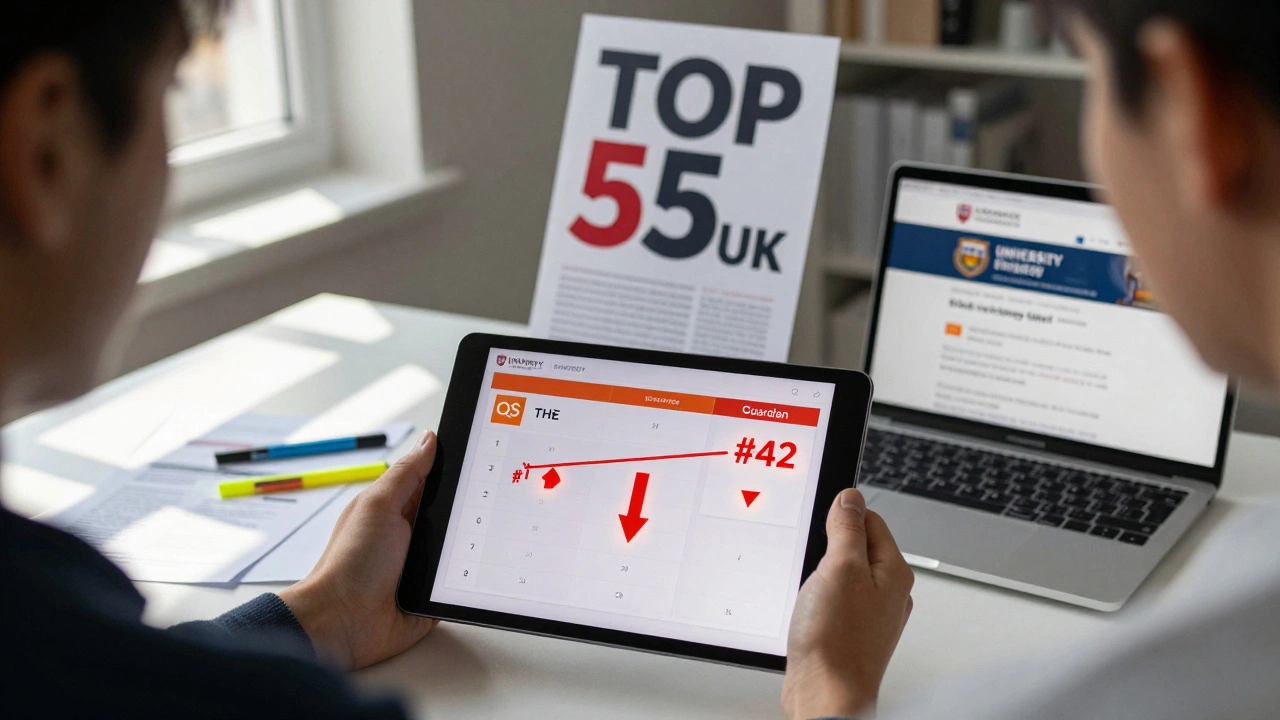
Every year, UK universities flood social media, brochures, and websites with bold claims: "#1 in the UK for employability," "Top 10 globally for engineering," "95% graduate satisfaction." But how many of these claims are real? And how do you tell the difference between a legitimate ranking and a marketing trick? The truth is, rankings aren’t magic numbers-they’re data snapshots with rules, biases, and sometimes outright manipulation. If you’re choosing a university based on these claims, you need to know how to dig past the hype.
Where UK University Rankings Come From
The three main ranking systems used by UK universities are QS World University Rankings, a global ranking that weights academic reputation and employer surveys heavily, Times Higher Education (THE), which focuses on teaching, research, and industry income, and Guardian University Guide, a UK-only ranking built around student experience and outcomes like drop-out rates and career prospects. Each uses different metrics, so a university might be ranked 5th in one and 42nd in another. That’s not a contradiction-it’s how the systems work.
For example, in 2025, the QS World Rankings gave Imperial College London the #1 spot in the UK for engineering because of its massive industry partnerships and global employer reputation scores. But the Guardian ranked it 18th because of lower student satisfaction scores in teaching quality. Neither is wrong. Both are measuring different things.
How Universities Twist the Numbers
Marketing teams don’t just report rankings-they cherry-pick them. You’ll see a university claim "Top 5 in the UK" when it’s actually ranked 12th in THE, 7th in QS, and 15th in the Guardian. They pick the one that looks best. Sometimes they even use outdated rankings. A university might still be advertising a "#1 in the UK" claim from 2021, even though it dropped to 6th in 2025.
Another trick? They use subject-specific rankings to imply overall excellence. If a university is ranked 8th in the UK for psychology, they’ll say "Top 10 UK University" as if that applies to everything. But what about engineering? Business? Computer science? Those might be in the bottom half. Always check which subject the ranking refers to.
Then there’s the "national ranking" loophole. Some universities say they’re "ranked #3 in the UK"-but they’re only ranking themselves against other universities in England, not Scotland, Wales, or Northern Ireland. That’s misleading. The UK has 160+ universities. If you’re comparing just 80 of them, you’re not getting the full picture.
What to Look for in a Real Ranking
Not all rankings are created equal. Here’s how to spot the real ones:
- Check the date. Rankings are published annually. Anything older than 12 months is outdated. If a website says "Consistently ranked in the top 10," ask: When was the last time?
- Find the source link. Legitimate claims always link to the original ranking. If you click it and it leads to a general homepage instead of a specific ranking table, it’s fake.
- Look at the methodology. QS weights employer reputation at 20%. THE uses research citations at 30%. The Guardian uses student-to-staff ratio and teaching time. If the university doesn’t explain how they got their ranking, they’re hiding something.
- Compare across systems. If a university is top 5 in one system but bottom 30 in another, ask why. It’s not a red flag-but it should make you curious.
Use the Official Sources
Don’t trust university websites alone. Go straight to the ranking providers:
- QS World University Rankings: Visit qs.com and search by subject and country. Filter for UK universities. Look at the full table-not just the top 10.
- Times Higher Education: Go to timeshighereducation.com and use their "Rankings" tab. Download the Excel sheet for UK institutions. You’ll see exact scores for teaching, research, and industry income.
- The Guardian University Guide: Go to theguardian.com/university-guide. Type in the university name. You’ll see detailed breakdowns of student satisfaction, career outcomes, and drop-out rates. This is the most honest ranking for student experience.
For example, if you’re looking at the University of Birmingham, check its 2025 Guardian ranking: 52nd overall. But its engineering program is ranked 11th. That’s useful context. Don’t take the "52nd" as a reason to dismiss it-take it as a reason to dig deeper into what matters to you.
What Rankings Don’t Tell You
Rankings are useful-but they’re not the whole story. They don’t tell you:
- How big your class sizes will be in your specific course
- Whether your professors actually care about teaching
- If the campus is safe, walkable, or has decent housing
- How much student support is available for mental health or disabilities
- What the job market looks like for your degree in your chosen city
Take the University of St Andrews. It often ranks #1 in the UK for student satisfaction. But it’s in a small coastal town with limited nightlife, expensive rent, and few internship opportunities. If you’re studying medicine or business, that might hurt your career prospects more than a high ranking helps.
On the flip side, the University of Salford ranks 118th overall in the Guardian. But its media and film program has 98% graduate employment. Why? Because it’s right next to Manchester’s creative industry hubs. Rankings don’t capture that.

How to Verify Claims Yourself
Here’s a simple 3-step process:
- Write down the claim. Example: "We’re ranked #1 in the UK for Computer Science."
- Go to the official ranking. Search "Guardian University Guide 2025 Computer Science" or "QS World Rankings 2025 Computer Science UK."
- Check the position. If it’s not in the top 3, the claim is misleading. If it’s 5th, they’re still stretching the truth by saying "#1."
Try this with the University of Manchester. They claim "Top 3 in the UK for Engineering." Check the Guardian 2025: they’re 19th. Check THE: 11th. Check QS: 8th. So they’re not lying-but they’re not being fully honest either. They’re picking the highest number they can find.
What to Do Instead
Instead of chasing rankings, ask:
- What’s the graduate employment rate for my exact course? (Find it on the university’s own graduate outcomes page-usually under "Prospective Students" or "Careers")
- What’s the student-to-staff ratio in my department? (This matters more than overall rankings)
- Where do past students work? Look up LinkedIn profiles of alumni from your course.
- Can I talk to a current student? Email the student union. Most will reply.
- Does the university have strong industry ties in my field? Check for named labs, sponsored projects, or company partnerships.
For example, if you want to study journalism, don’t care about a university’s global research score. Care about whether it has a working newsroom, partnerships with BBC or ITV, and internship placements. That’s what matters.
Final Rule: Trust Data, Not Buzzwords
Marketing says "world-class." Data says "17% of students in this program got a job within 3 months." Marketing says "leading institution." Data says "average teaching time per week: 10.3 hours." One tells you how to feel. The other tells you what to expect.
Use rankings as a starting point-not a finish line. Verify every claim. Compare across sources. Look at the numbers behind the headlines. And remember: the best university for you isn’t the one at the top of a list. It’s the one that gives you the skills, support, and opportunities you actually need.
Can UK university rankings be trusted at all?
Yes-but only if you understand how they’re made. The top three systems (QS, THE, Guardian) are reliable sources of data. But universities often misrepresent them by cherry-picking rankings, using outdated data, or hiding the subject-specific context. Always check the original source and the year.
Why do some universities rank higher in QS than in the Guardian?
QS focuses on academic reputation and employer surveys, which favor research-heavy, globally recognized universities. The Guardian focuses on student experience: teaching quality, drop-out rates, and career outcomes. A university like Oxford might rank #1 in both, but a school like Leeds might rank 20th in QS and 10th in the Guardian because students there report better teaching and lower stress.
Is it possible for a university to fake its ranking?
No, the ranking systems themselves are rigorous and audited. But universities can manipulate how they present the results. They might say "Top 10" when they’re 12th, or use a 2021 ranking in 2025. They can’t change the data-but they can lie about what it means.
Should I choose a university based on rankings?
Rankings can help you narrow your options, but they shouldn’t be your only factor. Look at graduate employment rates in your specific course, class sizes, location, cost of living, and student support services. A university ranked 50th might give you better career outcomes than one ranked 5th.
How often are UK university rankings updated?
QS and THE release new rankings annually in September. The Guardian updates its guide in June. Any claim using a ranking older than 12 months is outdated. Always check the publication date before trusting a ranking.