
You sit in a lecture hall, pen flying across paper, trying to capture every word the professor says. You leave feeling productive. Two days later, you open your notebook and realize it’s just a transcript of someone else’s thoughts, not a map of your own understanding. This is the most common trap students fall into: confusing recording with learning.
Effective study notes are not archives; they are tools for retrieval. The goal isn’t to have a perfect record of what was said, but to create material that forces your brain to engage when you review it. If your notes don’t help you answer questions without looking at the source, they’re just decoration.
The Myth of Passive Transcription
Most students write notes passively. They listen, transcribe, and move on. Research in cognitive psychology consistently shows that this approach yields poor retention. Why? Because transcription requires almost no mental effort beyond motor skills. Your brain goes on autopilot.
To fix this, you need to shift from being a stenographer to being an editor. During the lecture, your job is to filter information. Ask yourself: Is this key concept? Is this an example I can use? Is this something the professor emphasized? If the answer is no, skip it. If the answer is yes, write it down-but in your own words. Paraphrasing forces your brain to process meaning rather than just sound.
Consider the difference between these two note entries for a biology lecture on photosynthesis:
- Passive: "Photosynthesis occurs in chloroplasts using light energy to convert CO2 and H2O into glucose and O2."
- Active: "Chloroplasts = power plants. Input: Light + CO2 + Water. Output: Sugar (food) + Oxygen (waste)."
The second version is shorter, uses analogies, and highlights the inputs and outputs clearly. It’s easier to remember because it’s structured around logic, not just syntax.
Choosing a Note-Taking System That Fits Your Brain
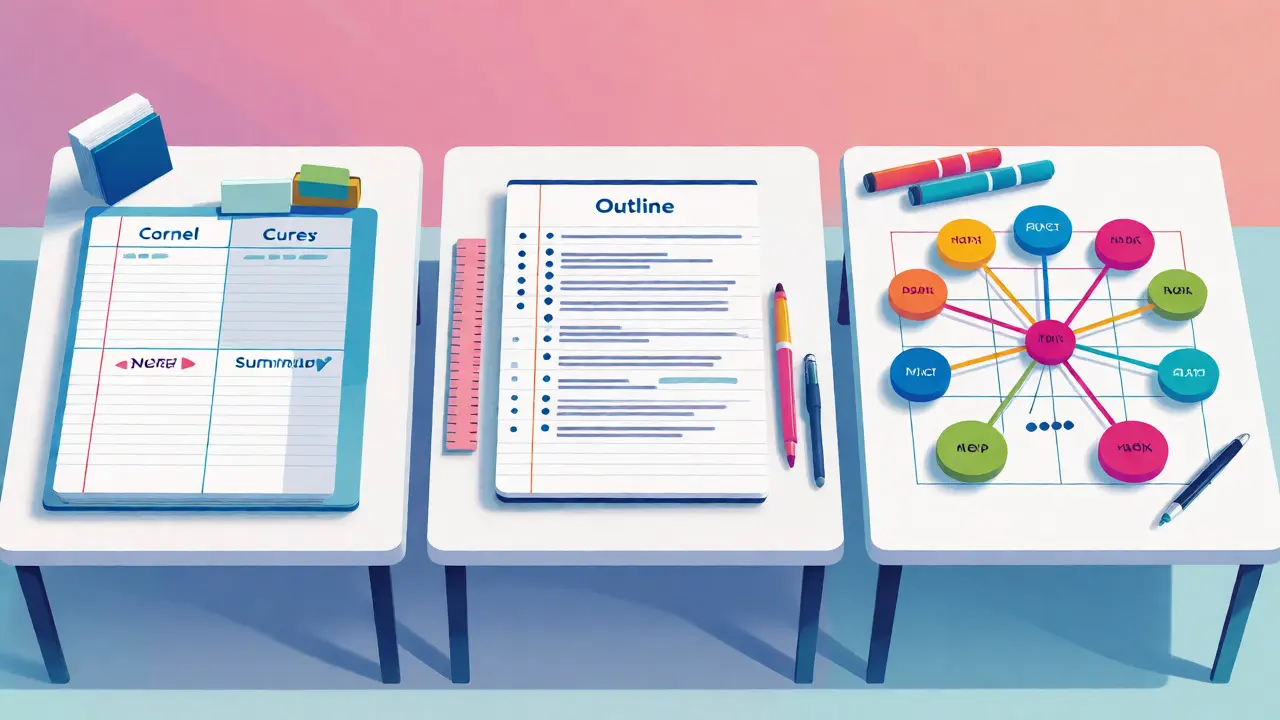
There is no single "best" way to take notes. The right system depends on your subject, your memory style, and how much structure you need. Here are three proven methods, each with specific strengths.
| Method | Best For | Key Feature | Review Effort |
|---|---|---|---|
| Cornell Method | Lecture-heavy courses, STEM subjects | Cue column for self-quizzing | Moderate |
| Outline Method | Structured lectures, history, literature | Hierarchical indentation | Low |
| Mind Mapping | Brainstorming, connecting ideas, visual learners | Non-linear, radial structure | High (initial setup) |
The Cornell Method is arguably the most powerful for exam prep because it builds in a testing mechanism. You divide your page into three sections: a narrow left column for cues/questions, a wide right column for notes, and a bottom section for a summary. After class, you cover the notes column and try to answer the questions in the cue column. This turns your notes into flashcards instantly.
The Outline Method works well if the lecturer follows a clear logical flow. Use bullet points and indents to show relationships between main ideas and supporting details. It’s fast and clean, but it doesn’t force you to think about connections as deeply as Cornell or Mind Mapping does.
Mind Mapping starts with a central idea and branches out. It’s fantastic for seeing the big picture and how topics interconnect. However, it can get messy quickly if you’re not careful. Use it for reviewing complex systems or preparing for essay-based exams where linking concepts matters more than memorizing isolated facts.
From Lecture to First Draft: The Immediate Cleanup
Taking notes during class is only step one. The magic happens in the cleanup phase, ideally within 24 hours of the lecture. Memory decays rapidly-the Ebbinghaus Forgetting Curve suggests we lose about 50% of new information within an hour if we don’t reinforce it. Waiting until the night before the exam to organize notes means you’re relearning everything from scratch.
Here’s your immediate cleanup checklist:
- Fill in gaps: Did you miss a definition? Check the textbook or ask a peer immediately.
- Clarify abbreviations: Write out any shorthand you invented so future-you isn’t confused.
- Add context: If you wrote "Important!" next to a date, add why it’s important. Was it a turning point? A law passed?
- Create cues: If you didn’t use the Cornell method, write questions in the margins that your notes answer.
This step transforms raw data into usable knowledge. It takes 15-20 minutes per lecture but saves hours of cramming later.
Transforming Notes into Active Recall Tools
Reading your notes over and over is passive. To make them exam-ready, you must convert them into prompts for active recall. Active recall is the practice of retrieving information from memory without looking at the source. It strengthens neural pathways far more effectively than re-reading.
How do you do this with existing notes?
Turn headings into questions. If your note says "Causes of the French Revolution," change the heading to "What were the three main causes of the French Revolution?" When you review, look at the question and try to recite the answer before checking the text.
Use the blank sheet method. Take a fresh piece of paper. Write down everything you remember about a topic from your notes. Then compare it to your actual notes. What did you miss? What did you get wrong? These gaps are exactly what you need to focus on.
Create a 'mistake log'. As you practice recalling, keep a list of things you consistently forget. Are you mixing up dates? Confusing similar terms like mitosis and meiosis? Target these specifically. General review wastes time; targeted review fixes weaknesses.

Digital vs. Analog: Which Should You Choose?
A common debate among students is whether to use laptops/tablets or pen and paper. Studies, including those by Mueller and Oppenheimer, suggest that handwriting often leads to better conceptual understanding because it’s slower, forcing you to summarize and synthesize rather than transcribe verbatim. Typing allows you to capture more words, but often less meaning.
However, digital tools offer advantages for organization and searchability. If you choose digital, be disciplined. Avoid the temptation to copy-paste entire paragraphs. Type summaries, not transcripts. Use apps like Notion, OneNote, or Obsidian that allow you to link notes together, creating a web of knowledge rather than isolated files.
If you prefer analog, consider using a scanner app to digitize your handwritten notes after cleanup. This gives you the best of both worlds: the cognitive benefits of writing and the convenience of searchable, backup-friendly digital files.
Exam-Ready: The Final Polish
Your notes aren’t truly exam-ready until you’ve tested them under pressure. Simulate exam conditions. Can you explain the concept out loud in two minutes? Can you draw the diagram from memory? Can you solve the problem without peeking at the formula sheet?
Refine your notes based on these tests. If a section feels shaky, rewrite it more simply. Add mnemonics, acronyms, or vivid images to sticky spots. For example, to remember the order of taxonomic ranks (Domain, Kingdom, Phylum, Class, Order, Family, Genus, Species), use "Dear King Philip Came Over For Good Soup." Embedding these tricks directly into your notes makes them self-contained study guides.
Finally, prune ruthlessly. Before the exam, you don’t need every detail. You need the core framework. Highlight the top 20% of content that likely covers 80% of the exam questions. Mark these clearly. When you’re short on time, go straight to these highlighted sections.
Creating effective study notes is a skill, not a talent. It requires shifting your mindset from collecting information to processing it. Start small. Pick one lecture and try the Cornell method. Clean up your notes the same day. Test yourself with active recall. Within a few weeks, you’ll notice you spend less time studying and retain more. That’s the real win.
Is it better to type or handwrite my study notes?
Handwriting generally promotes better conceptual understanding because it forces you to paraphrase and summarize due to slower speed. Typing allows for faster capture and easier editing/searching. Choose handwriting for complex theoretical subjects and typing for factual, data-heavy subjects, or combine both by handwriting first and digitizing later.
How soon should I review my lecture notes?
You should review and clean up your notes within 24 hours of the lecture. According to the Ebbinghaus Forgetting Curve, memory retention drops significantly after this period. Early review reinforces neural connections and prevents the need to relearn material from scratch before exams.
What is the Cornell Method and why is it recommended?
The Cornell Method divides the page into three sections: notes, cues/questions, and a summary. It is recommended because it integrates note-taking with active recall. By covering the notes and answering the cues, you transform passive records into an interactive self-testing tool, which significantly improves long-term retention.
Do mind maps work for all types of exams?
Mind maps are excellent for subjects requiring synthesis and connection of ideas, such as essays or case studies. They are less effective for rote memorization of isolated facts or strict procedural steps unless combined with other techniques like flashcards. Use them to see the big picture, then drill down into specifics.
How do I know if my notes are actually effective?
Your notes are effective if you can teach the material to someone else using only your notes, or if you can answer potential exam questions without looking at the textbook. If you find yourself constantly referring back to the original source while studying, your notes are likely too passive or incomplete.