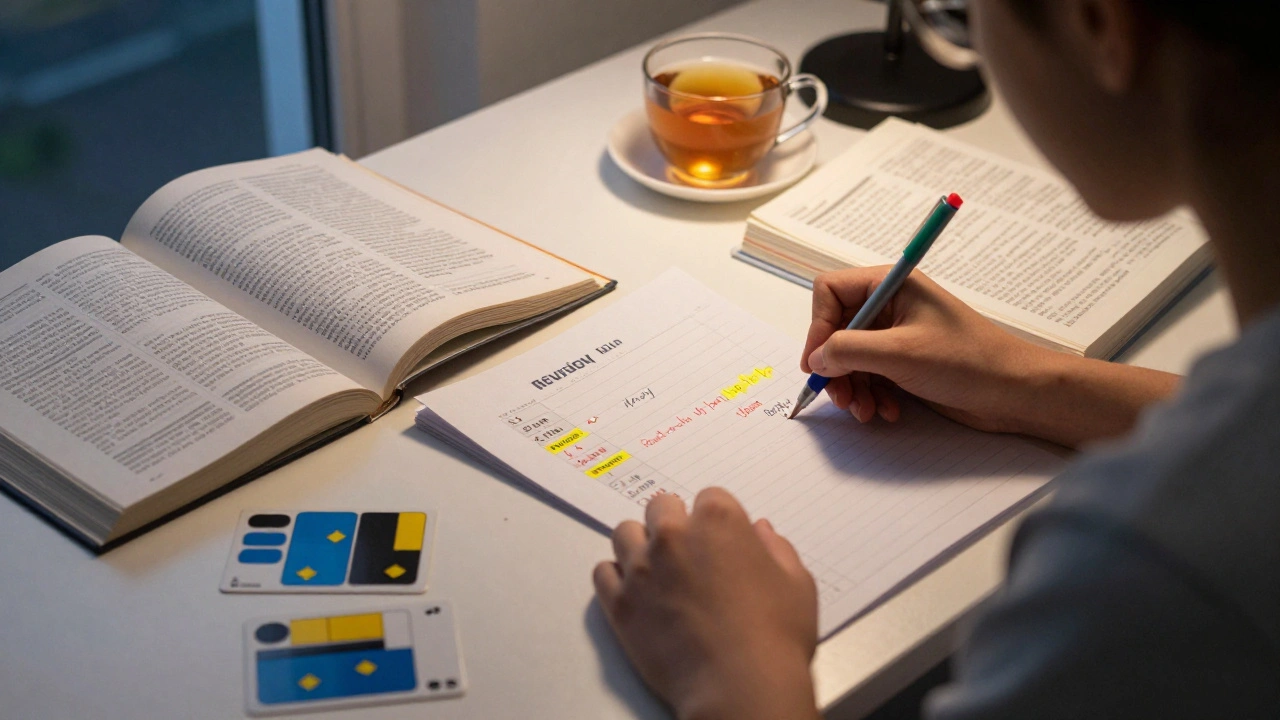
Staring at a pile of textbooks and not knowing where to start? You’re not alone. Most students waste weeks cramming at the last minute because they never built a real plan. A good revision timetable isn’t about filling every hour with study-it’s about working smarter so you remember more, stress less, and walk into the exam room confident.
Start by knowing what you’re up against
Before you open a planner, list every subject and topic you need to cover. Don’t guess. Open your syllabus, past papers, or class notes. Write down each topic like it’s a grocery list: Algebra: quadratic equations, inequalities, word problems, Biology: photosynthesis, cellular respiration, DNA replication. Be specific. Vague goals like study chemistry won’t cut it. You need to know exactly what’s on the table.Now, estimate how long each topic will take. This isn’t about being perfect-it’s about being realistic. If you’ve struggled with trigonometry before, give it 3 hours, not 1. If you aced last year’s essay on Shakespeare, maybe it only needs 45 minutes. Use past exams or teacher feedback to guide you. Most students underestimate how long things take. Add 20% extra time to each topic just to be safe.
Map your available time
Look at your calendar. Mark off everything that’s fixed: school, work, meals, sleep, extracurriculars, family time. Then find the gaps. You might have 90 minutes after school on weekdays, 4 hours on Saturday mornings, and 3 hours on Sunday afternoons. That’s your study window.Don’t try to study 8 hours a day. Your brain isn’t a machine. Research from the University of California shows that most people retain information best in 45-50 minute blocks, followed by a 10-15 minute break. That’s it. Trying to force longer sessions leads to burnout and zero retention.
Build your timetable around these blocks. For example:
- Monday: 4:30-5:20 PM - Algebra (quadratic equations)
- Wednesday: 4:30-5:20 PM - Biology (photosynthesis)
- Saturday: 9:00-10:30 AM - Chemistry (periodic table trends)
Leave one day a week completely free. Not for studying. Just to rest, recharge, or handle surprises. Life happens. If you don’t build in breathing room, you’ll quit.
Use the spacing effect
Cramming doesn’t work. Your brain forgets fast. But if you revisit something after 1 day, then 3 days, then a week, you lock it in. That’s called spaced repetition.Here’s how to use it: When you study a topic, schedule a quick review 2 days later, then again 5 days after that. For example:
- Day 1: Study algebra - quadratic equations
- Day 3: Quick 15-minute quiz on the same topic
- Day 8: Do 3 practice problems
You don’t need to re-learn everything. Just trigger your memory. This is why flashcards work. Apps like Anki automate this, but you can do it with paper too. Write the question on one side, the answer on the other. Shuffle them. Test yourself. If you get it right, move it to the back of the pile. If you get it wrong, put it at the front.

Match your energy, not your schedule
You’re not the same all day. Some people focus best in the morning. Others hit their stride after dinner. Track your energy for three days. When do you feel alert? When do you zone out? Use that data.Put hard topics-like calculus or organic chemistry-when you’re sharpest. Save easier stuff-reviewing notes, flashcards, or rewriting summaries-for when you’re tired. Don’t waste your peak hours on busywork. Save them for the stuff that actually makes you think.
Build in active recall and practice tests
Reading notes over and over feels productive. It’s not. You’re just re-familiarizing yourself. Real learning happens when you force your brain to retrieve information without help.Switch from passive reading to active testing:
- After studying a topic, close your book and write down everything you remember.
- Use past exam papers. Time yourself. Treat them like real tests.
- Explain a concept out loud like you’re teaching it to someone who’s never heard of it.
Studies from Washington University show students who tested themselves regularly scored 20-30% higher than those who just reread. It’s not magic. It’s how memory works. You strengthen recall by using it.
Review and adjust every week
Your timetable isn’t set in stone. At the end of every week, ask yourself:- Did I stick to the plan?
- Which topics took longer than expected?
- What felt pointless or exhausting?
Then tweak it. Maybe you need to swap Friday’s slot to Thursday because you’re always too tired on Fridays. Maybe you realized you overestimated how fast you’d learn genetics. That’s okay. Adjusting is part of the process.
Don’t wait until the last week to fix things. Small weekly tweaks prevent big meltdowns later.

What to avoid
Here are the three biggest mistakes students make:- Trying to do everything at once. You can’t study 10 subjects in 3 days. Focus on one or two per day. Depth beats breadth.
- Waiting until you feel ready. You’ll never feel 100% ready. Start before you’re sure. Action builds confidence, not the other way around.
- Ignoring sleep and food. Pulling all-nighters doesn’t help. Your brain consolidates memory during sleep. Skip sleep, and you forget what you learned. Eat regular meals. Sugar crashes kill focus.
Sample timetable (10-day revision plan)
Here’s a real example for a student with 5 subjects and 10 days before exams:| Day | Time | Subject & Topic | Activity |
|---|---|---|---|
| Day 1 | 4:30-5:20 PM | Math: Quadratic Equations | Study + 5 practice problems |
| Day 2 | 4:30-5:20 PM | Biology: Photosynthesis | Draw process, explain aloud |
| Day 3 | 4:30-5:20 PM | Math: Quadratic Equations (review) | Flashcards + 3 timed problems |
| Day 4 | 9:00-10:30 AM | Chemistry: Periodic Trends | Practice questions + summary sheet |
| Day 5 | 4:30-5:20 PM | Biology: Photosynthesis (review) | Write 5 key facts from memory |
| Day 6 | 4:30-5:20 PM | History: WW2 Causes | Timeline + essay outline |
| Day 7 | 9:00-10:30 AM | Chemistry: Periodic Trends (review) | Quiz yourself with flashcards |
| Day 8 | 4:30-5:20 PM | History: WW2 Causes (review) | Teach it to a friend or mirror |
| Day 9 | 9:00-10:30 AM | Full practice paper (Math + Biology) | Timed, no notes |
| Day 10 | 11:00 AM-12:00 PM | Light review + rest | Review flashcards, no new material |
Notice how each topic is reviewed twice. Notice how hard topics are done when energy is high. Notice how the last day is light. That’s the pattern.
What happens next
Stick to this for two weeks. You’ll notice things change. You’ll stop panicking before tests. You’ll feel calm walking into the exam hall because you know you covered everything-no guessing, no last-minute panic.The goal isn’t to study more. It’s to study in a way your brain actually remembers. A good timetable doesn’t just organize your time-it organizes your confidence.
What if I fall behind on my revision timetable?
Falling behind is normal. Don’t panic. Look at what’s left and prioritize. Focus on high-weight topics first-those that appear in past papers or are worth the most marks. Skip low-yield topics if you’re running out of time. It’s better to master 70% well than scramble through 100% poorly. Adjust the rest of your plan, not your self-worth.
Should I use an app or paper for my timetable?
Use whatever keeps you consistent. Apps like Notion, Google Calendar, or Anki are great for reminders and spaced repetition. But if you’re the type who forgets digital alerts, write it on paper. The act of writing by hand improves memory. The tool doesn’t matter-what matters is that you follow it.
How many hours should I study each day?
Aim for 2-4 focused hours a day, split into 45-50 minute blocks. More than that leads to diminishing returns. One student in a 2024 study who studied 3 hours a day with breaks scored higher than another who studied 6 hours without rest. Quality beats quantity every time.
What if I get distracted while studying?
Distractions are normal. Try the Pomodoro method: 25 minutes of focused work, then 5 minutes of total distraction (phone, snack, walk). After four cycles, take a 20-minute break. This trains your brain to focus in short bursts. Turn off notifications. Put your phone in another room. You don’t need to be ‘in the zone’-you just need to show up.
Is it okay to take days off during revision?
Yes. In fact, you should. Your brain needs downtime to process what you’ve learned. A full day off every 5-7 days improves retention and reduces burnout. Use it to sleep, walk, watch something light, or hang out with friends. Coming back refreshed is better than grinding into exhaustion.
How do I know if my timetable is working?
Check two things: Can you recall topics without notes? Do you feel less anxious as the exam nears? If yes, you’re on track. If you’re still guessing or feeling overwhelmed, go back and adjust. Maybe you’re not doing enough active recall. Maybe you’re skipping reviews. Fix the method, not the schedule.