
It’s 11:45 PM on a Tuesday. You’re staring at your laptop, surrounded by cold coffee and three open tabs of lecture notes you haven’t read yet. The panic isn’t because you’re lazy; it’s because your plan was built on fantasy. You assumed you’d study for four hours straight every night, but life happened-part-time shifts, social plans, and the simple fact that human brains need breaks. For UK students is a demographic facing specific academic pressures including intensive term structures and high-stakes assessment cycles., creating a study schedule that actually sticks is less about discipline and more about design.
The goal here isn’t to turn your week into a military operation. It’s to build a system that accounts for your energy levels, your university’s calendar, and your actual capacity. A good schedule feels like a safety net, not a cage. When you know exactly what needs to be done and when, the mental load drops significantly. You stop worrying about *if* you’ll get things done and start focusing on *how* to do them well.
Understand Your Academic Calendar First
Before you pick up a pen or open a digital planner, you need to map out the fixed points in your week. Most UK universities operate on a term system, typically spanning 10 to 12 weeks per term. These terms are dense. Lectures, seminars, labs, and library hours are non-negotiable blocks of time. If you try to fit study sessions around these without accounting for travel time or setup, your schedule will collapse within two days.
Start by listing every committed hour. This includes:
- Lectures and seminars (including commute time if you don’t live on campus).
- Part-time work or internships.
- Social commitments that you genuinely want to keep (don’t cut all fun; burnout is real).
- Self-care basics: meals, sleep, and hygiene.
Once these are marked, look at the remaining white space. That’s where your study happens. But here’s the catch: not all white space is equal. A Saturday morning might feel free, but if you’re exhausted from Friday night, it’s not a productive slot. Be honest about your energy peaks. Do you think best before breakfast? Or do you come alive after a walk in the afternoon? Align your hardest tasks with your highest energy windows.
The Power of Time Blocking vs. To-Do Lists
A to-do list is just a wish. “Read Chapter 4” doesn’t tell you *when* you’ll do it. Time blocking does. Instead of writing “Study History,” you write “14:00-15:30: Read Chapter 4 and take active notes.” This technique forces you to acknowledge that studying takes time. It also prevents the “task creep” where one small assignment eats up your entire evening.
For UK students, this is particularly useful during revision periods. When exams loom, the temptation is to cram. But spaced repetition-the practice of reviewing material over increasing intervals-is far more effective for long-term retention. By blocking specific times for review rather than leaving it to chance, you ensure consistency. Try using the Pomodoro Technique within these blocks: 25 minutes of focused work followed by a 5-minute break. After four cycles, take a longer break. This keeps your brain fresh without requiring massive willpower.
Designing Your Weekly Template
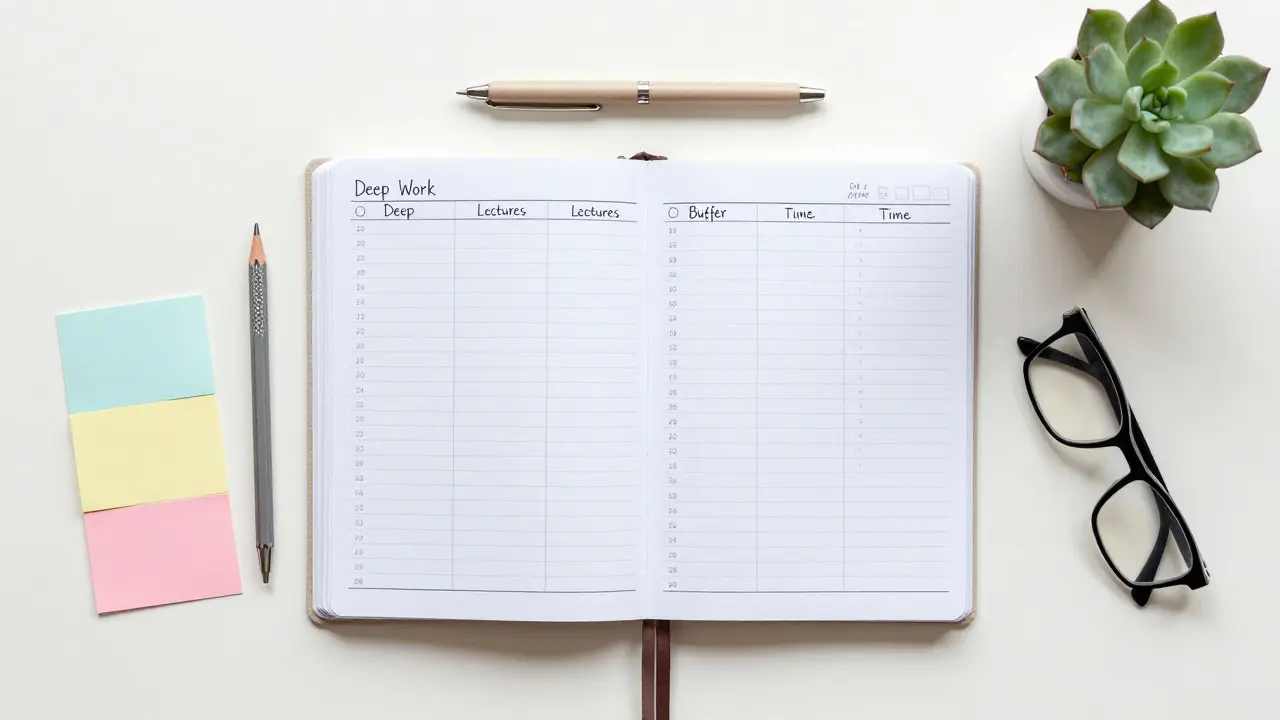
You don’t need a unique schedule for every single day. Create a template that repeats weekly, with slight variations for lighter or heavier days. Here’s a practical example for a student with lectures Monday, Wednesday, and Friday:
| Day | Morning (8 AM - 12 PM) | Afternoon (1 PM - 5 PM) | Evening (6 PM - 9 PM) |
|---|---|---|---|
| Monday | Review previous week's notes | Lectures/Seminars | Light reading / Relaxation |
| Tuesday | Deep Work Block (Hardest Subject) | Library Session / Group Study | Admin tasks / Email |
| Wednesday | Lectures/Seminars | Break / Social Time | Short Revision Session (30 mins) |
| Thursday | Deep Work Block (Second Hardest Subject) | Practicals / Labs | Meal Prep / Chores |
| Friday | Lectures/Seminars | Catch-up / Buffer Time | Social Evening |
| Saturday | Long Study Block (3 hours max) | Hobby / Exercise | Free Time |
| Sunday | Weekly Review & Planning | Rest / Light Reading | Prep for next week |
Notice the buffer time on Friday. Life is unpredictable. Assignments pop up, friends cancel plans, or you get sick. Having a designated “catch-up” slot prevents one missed task from derailing your whole week. Also, notice Sunday. This is crucial. Spend 30 minutes reviewing what you accomplished and planning the upcoming week. This ritual reduces anxiety because you enter Monday with clarity, not chaos.
Managing Stress Through Structure
Stress often comes from uncertainty. When you have a clear plan, stress transforms into manageable pressure. However, structure can become rigid if you don’t allow for flexibility. If you miss a block, don’t beat yourself up. Just move it to the next available slot or use your buffer time. Perfectionism is the enemy of progress.
Also, consider the difference between active and passive studying. Reading a textbook is passive. Testing yourself, explaining concepts to a peer, or summarizing notes in your own words is active. Active studying requires more cognitive effort but yields better results. Schedule active sessions for your peak energy times. Save passive review for lower-energy moments, like commuting or waiting for lab equipment to finish running.
Tools and Environment Setup
Your environment dictates your focus. If you study in your bedroom, your bed becomes associated with rest, making it harder to concentrate. Try to establish a dedicated study space, even if it’s just a specific corner of the kitchen table. Keep your phone in another room or use apps like Forest or Freedom to block distractions. Digital minimalism isn’t about banning technology; it’s about controlling it so it serves you, not the other way around.
Use tools that fit your workflow. Some students prefer paper planners for tactile satisfaction, while others thrive with digital apps like Notion or Todoist. The best tool is the one you’ll actually use. Don’t spend hours customizing a complex dashboard if a simple spreadsheet works better. Simplicity wins when motivation dips.

Common Pitfalls to Avoid
Even with the best intentions, schedules fail. Here are the most common reasons why, and how to fix them:
- Overestimating Capacity: We think we can study for six hours straight. In reality, deep focus lasts about 90 minutes. Plan for breaks. If you skip them, you’ll hit a wall by hour two.
- Ignoring Admin Tasks: Filing references, updating CVs, or answering emails seem trivial, but they eat time. Block 30 minutes twice a week for admin work.
- No Rest Days: Studying seven days a week leads to diminishing returns. Your brain consolidates memory during sleep and rest. Protect at least one full day off per week.
- One-Size-Fits-All Approach: What worked last semester might not work now. Reassess your schedule monthly. If a block consistently feels too hard or too easy, adjust it.
Remember, a study schedule is a living document. It should evolve as your course progresses, your workload changes, and you learn more about your own habits. The aim isn’t to be perfect; it’s to be consistent. Consistency beats intensity every time. When you show up regularly, even for short sessions, the cumulative effect is powerful.
Frequently Asked Questions
How many hours should UK students study per week?
There is no single number, but a common guideline is 10-15 hours of independent study for every hour of contact time (lectures/seminars). For a typical undergraduate with 15 hours of contact time, that means 150-225 hours per term spread over 10-12 weeks, or roughly 15-20 hours per week. Adjust based on your course intensity and personal pace.
Is it better to study early morning or late night?
It depends on your chronotype. Morning people (larks) tend to perform better on complex tasks before noon. Night owls may find late evenings more productive. Experiment for two weeks. Track your focus levels and energy. Stick to the pattern that gives you the most consistent output, and protect your sleep schedule accordingly.
What if I fall behind on my schedule?
Don’t abandon the schedule. Use your buffer slots to catch up. If you’re significantly behind, reassess your priorities. Are all tasks equally urgent? Drop low-value activities temporarily. Remember, finishing an assignment at 80% quality on time is often better than aiming for 100% and missing the deadline. Communicate with lecturers if needed; they appreciate proactive communication.
How do I balance part-time work with studies?
Treat your job like a fixed appointment. Schedule study blocks around your shifts, not the other way around. If you work weekends, use weekdays for deep work. Ensure you have at least one full day off both work and heavy study to recharge. Many UK students find that limiting part-time work to 15-20 hours per week maintains a healthy balance.
Which study method is most effective for retention?
Active recall and spaced repetition are widely considered the most effective methods. Instead of re-reading notes, close the book and try to remember key concepts. Then check your answers. Space these reviews out over days and weeks. This forces your brain to retrieve information, strengthening neural pathways far more effectively than passive review.