
The problem is that most students treat UK university rankings is a hierarchical list of higher education institutions based on metrics like research output, student satisfaction, and entry requirements. as a definitive leaderboard. They aren't. A ranking is just a snapshot of specific data. To actually use them to your advantage, you need to stop looking at the overall score and start looking at the components. We're talking about the difference between a school that's great for prestige and one that's actually great for the specific course you want to study.
The Core Strategy: The Three-Tier Approach
When you're filling out your UCAS (Universities and Colleges Admissions Service) application, you have five slots. If you waste all five on "Top 10" schools, you're ignoring the reality of admission rates. Instead, divide your list into three tiers based on your predicted grades and the rankings data.
- Reach Schools (1-2 slots): These are the institutions where your predicted grades meet the minimum, but the actual entry requirements often soar during the offer stage. Think of the University of Oxford or University of Cambridge. They are ranked highly for almost everything, but they reject thousands of perfectly qualified students every year.
- Target Schools (2 slots): These are the "sweet spot." Your grades are comfortably within the typical offer range, and the university is ranked well for your specific subject. You're a strong candidate here, and these schools provide a high probability of an offer.
- Safety Schools (1-2 slots): These are the universities where your grades are well above the typical entry requirement. Even if the rankings are slightly lower than your targets, these schools ensure you aren't left without a place to study in September.
Why bother with safety schools if you're a high achiever? Because rankings can fluctuate, and admission trends shift. In 2024, we saw a spike in applications for Computer Science across the UK, meaning schools that were previously "targets" suddenly became "reaches" overnight.
Decoding the Different Ranking Tables
Not all rankings are created equal. Depending on which list you're looking at, a university might jump ten places or drop twenty. You have to know which tool to use for which job.
| Ranking Body | Primary Focus | Best For... | Potential Bias |
|---|---|---|---|
| The Complete University Guide | Student Experience & Value | Overall feel and quality of life | Heavily weights student surveys |
| The Guardian | Teaching Quality & Satisfaction | Undergraduate experience | Ignores research output |
| QS World University Rankings | Global Reputation & Research | International prestige/Post-grad | Heavily favors old, wealthy institutions |
| Times Higher Education | Academic Influence | Research-heavy courses | Favors large, research-centric hubs |
If you're looking for a degree in a practical field like Nursing or Primary Education, the The Guardian rankings are often more useful because they focus on student satisfaction and teaching quality rather than how many papers the professors published in a niche journal. Conversely, if you're aiming for a career in global finance or high-level academia, the QS World University Rankings give you a better idea of how a degree from that school is perceived in New York or Tokyo.

Prioritize Subject Rankings Over Overall Rankings
This is the biggest mistake students make. A university can be ranked 50th overall but be 2nd in the country for Architecture or Geology. If you want to be a world-class geologist, you don't go to a top-10 general university that's mediocre at geology; you go to the specialized powerhouse.
When you dig into subject-specific rankings, look for the "Student Satisfaction" and "Graduate Prospects" metrics. If a course is ranked high for research but low for graduate prospects, it means the professors are brilliant at their own work, but they aren't necessarily great at getting students into jobs. You want to see a balance where both teaching quality and employment rates are high.
Consider a scenario where you're choosing between a Russell Group university and a modern university. The Russell Group-a collection of 24 prestigious, research-intensive universities-usually dominates the overall rankings. However, for vocational degrees, a post-1992 university might have better industry links, more modern facilities, and a higher ranking for "Employer Satisfaction." Don't let the "prestige' label blind you to the practical utility of the degree.
Factoring in the "Hidden" Metrics
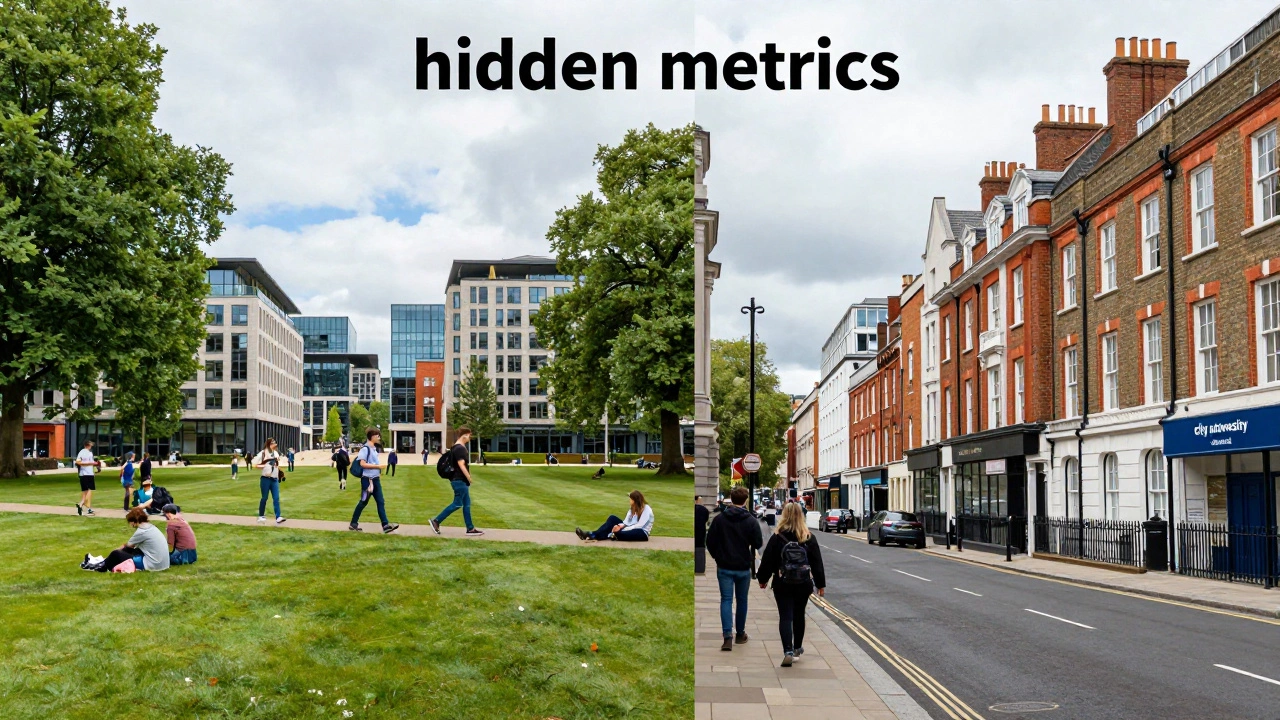
Rankings tell you what a university is, but they don't tell you if you'll actually like being there. Once you've used the rankings to create your three-tier list, you need to apply a set of human filters to narrow it down.
First, look at the campus layout. Is it a "campus university' like University of Warwick, where everything is in one place? Or is it a "city university' like University College London (UCL), where the campus is integrated into the streets of the city? This changes your entire daily experience.
Second, check the module list. Two universities might both be ranked in the top 10 for Psychology, but one might focus on Clinical Psychology while the other focuses on Cognitive Neuroscience. A high ranking in a subject is meaningless if the actual modules don't align with your interests. Read the course handbook, not just the ranking summary.
Avoiding the Ranking Trap
It's easy to fall into the trap of thinking a lower-ranked school is a "failure." In reality, the gap between a university ranked 15th and one ranked 35th is often negligible in terms of actual teaching quality. The difference usually comes down to how much money they spend on research or how many international students they attract.
If you find a school that's ranked moderately but has an incredible partnership with the industry you want to enter-say, a university with direct pipelines into the NHS or major engineering firms-that is worth more than a five-place jump in a generic league table. The goal isn't to get into the highest-ranked school; the goal is to get into the school that provides the best bridge to your next step.
Finalizing Your Five Choices
Now that you've filtered your options, it's time to lock in your UCAS application. Your final list should look something like this: one "Dream" (Reach), two "Solid' (Target), and two "Safe" (Safety) options. This distribution protects you against the unpredictability of the admissions process while still giving you a chance to aim high.
Before you hit submit, do one last check: are these universities too similar? If you pick five schools that are all in the same ranking bracket and the same city, you're creating a bottleneck. Diversify your geography and your tiers. By blending the quantitative data of rankings with qualitative research on course content and campus life, you create a strategy that maximizes your chances of success.
Do universities actually care about these rankings?
Universities definitely care about rankings because it affects their ability to attract international students and secure research funding. However, they don't base their admission decisions on these lists. They use their own internal criteria, looking at your personal statement and grades, regardless of where they sit in the Guardian or QS tables.
Which ranking is the most accurate for undergraduates?
No single ranking is 100% accurate because they all use different formulas. For undergraduates, The Guardian and The Complete University Guide are generally better because they emphasize student satisfaction and teaching quality. QS and Times Higher Education are better for those looking at global research prestige.
Is it a mistake to apply to a university ranked lower than my predicted grades?
Not at all. This is essentially what a "safety school" is. Having a university on your list where you exceed the entry requirements ensures that you will have a place to go even if the more competitive schools have a surprising year of high application volumes.
How often do these rankings change?
Most major UK rankings are updated annually. While the top few spots rarely shift drastically, universities in the 20-60 range can move up or down several places each year based on new student survey data or research breakthroughs.
What if two universities are ranked the same for my subject?
When rankings are identical, stop looking at the numbers. Look at the specific modules, the location, the cost of living in that city, and the university's facilities. At that point, the decision becomes about "fit" rather than "rank."