
You’ve been staring at that essay for three hours. Your eyes are dry, your brain feels like mush, and you’re pretty sure the words on the screen have started to swim. You keep telling yourself to "push through," but honestly? You aren’t getting anywhere. In fact, you’re probably making more mistakes than before.
This is a trap most UK university students fall into every semester. We treat sleep and downtime like enemies of success. But science says the opposite is true. Taking healthy breaks isn’t just about feeling good; it’s a biological requirement for keeping your brain sharp. If you want to retain information and produce high-quality work, you need to stop working.
The Science Behind Study Fatigue
Your brain is not a machine that runs indefinitely on coffee and willpower. It’s an organ that consumes energy. When you focus intensely on complex tasks-like solving math problems or writing code-you deplete glucose in specific regions of your brain. This leads to cognitive fatigue.
When you hit this wall, your prefrontal cortex-the part responsible for decision-making and focus-starts to underperform. You might feel like you’re still working, but your output quality drops significantly. Studies from institutions like University College London show that sustained attention without breaks leads to a sharp decline in accuracy after just 45 minutes.
Think of your brain like a muscle. If you lift weights for four hours straight without stopping, you won’t get stronger; you’ll injure yourself. The same applies to studying. Rest allows your brain to consolidate memories and clear out metabolic waste products. Without those pauses, you’re essentially cramming information into a full hard drive. Nothing new can stick until you clear some space.
Why Passive Scrolling Isn’t a Break
Here’s the big mistake: many students think checking their phone counts as resting. It doesn’t. Scrolling through social media floods your brain with dopamine hits and new information. Your brain never actually switches off. Instead, it stays in a state of low-level alertness.
A true healthy break requires active recovery. This means doing something that engages different parts of your brain or body while giving your cognitive centers a rest. If you’ve been sitting and reading, standing up and moving is better. If you’ve been looking at screens, closing your eyes or looking at distant objects helps.
The goal is to lower your cortisol levels (the stress hormone) and reset your attention span. A five-minute walk outside beats thirty minutes of scrolling because it physically changes your environment and reduces mental clutter. You return to your desk feeling refreshed, not just distracted by a new notification.
Effective Break Techniques for Students
Not all breaks are created equal. Here are three proven methods that fit easily into a busy student schedule in the UK:
- The 20-20-20 Rule: Every 20 minutes, look at something 20 feet away for 20 seconds. This reduces eye strain and gives your visual processing centers a quick reset. It’s perfect for library sessions where you can’t leave your seat.
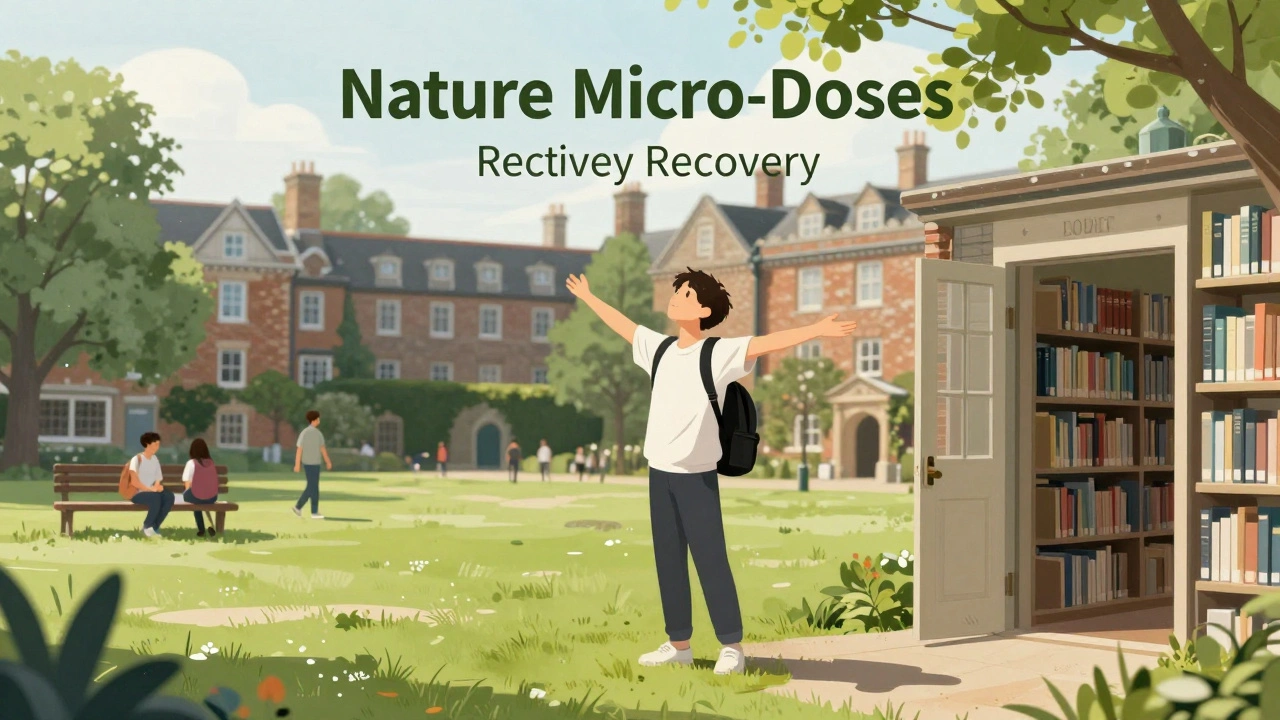
- Nature Micro-Doses: Step outside for 10 minutes. Even if it’s just sitting on a bench in the campus quad. Research shows that exposure to natural light and greenery lowers stress markers faster than indoor environments. In the UK, where grey skies are common, even overcast outdoor air helps reset your circadian rhythm.
- Physical Movement: Do 50 jumping jacks, stretch, or take a brisk walk around the block. Physical activity increases blood flow to the brain, delivering oxygen and nutrients needed for concentration. It also burns off the restless energy that builds up during long study sessions.
Avoid heavy meals or intense social interactions during short breaks. Digestion takes energy, and complex conversations require cognitive load. Keep breaks simple and restorative.
Structuring Your Day with the Pomodoro Technique
If you struggle to know when to stop, try the Pomodoro Technique. It’s a time management method that uses a timer to break work into intervals, traditionally 25 minutes in length, separated by short breaks.
- Choose a task.
- Set a timer for 25 minutes.
- Work on the task until the timer rings.
- Take a short break (5 minutes).
- After four cycles, take a longer break (15-30 minutes).
This structure forces you to accept that stopping is part of the process. The short breaks prevent burnout, while the longer breaks allow for deeper recovery. Many students find that they accomplish more in four focused 25-minute blocks than in six hours of distracted grinding.
The key is consistency. Don’t skip the break because you’re "in the zone." Your brain needs the pause to maintain that zone. If you push past the limit, you’ll pay for it later with errors and frustration.

Sleep: The Ultimate Productivity Tool
No amount of caffeine or power napping replaces proper sleep. Sleep is when your brain processes what you learned during the day. It moves information from short-term memory to long-term storage. Without this consolidation, studying is largely pointless.
Most UK students aim for less than seven hours of sleep per night, especially during exam season. This is a critical error. Lack of sleep impairs executive function, creativity, and emotional regulation. You become slower, irritable, and less able to solve problems.
Prioritize seven to nine hours of sleep. Treat it as non-negotiable. If you have to choose between pulling an all-nighter and sleeping, choose sleep. You’ll likely perform better on the assignment after a good night’s rest than if you try to force your exhausted brain to work.
Common Pitfalls to Avoid
Even with good intentions, students often sabotage their own productivity. Watch out for these traps:
- Guilt Tripping: Feeling guilty for taking a break makes the break stressful. Accept that rest is productive. It’s part of the job.
- Over-Scheduling: Trying to fill every minute with study time leaves no room for unexpected delays or mental recovery. Build buffer zones into your timetable.
- Ignoring Hunger Signals: Studying on an empty tank drains your energy. Eat regular, balanced meals. Low blood sugar mimics anxiety and fatigue.
Remember, productivity isn’t about how many hours you sit at a desk. It’s about how much effective work you complete. Quality beats quantity every time.
How long should a healthy break be?
Short breaks should last 5-10 minutes for every 45-60 minutes of study. Longer breaks of 20-30 minutes are recommended after several study sessions to allow for deeper mental recovery.
Is scrolling social media a good way to relax?
No. Social media keeps your brain engaged and stimulated, preventing true rest. Opt for physical movement, nature exposure, or mindfulness exercises instead.
What happens if I don't take breaks while studying?
You will experience cognitive fatigue, leading to decreased focus, more errors, and poorer memory retention. Your brain needs downtime to consolidate information.
Can I use the Pomodoro Technique for all types of assignments?
Yes, but you may need to adjust the intervals. For deep creative work, some students prefer 50-minute focus blocks with 10-minute breaks to maintain flow.
How does sleep affect my ability to learn?
Sleep is crucial for memory consolidation. During sleep, your brain processes and stores information learned during the day, making it easier to recall later.