
Ever sat down to study and felt completely lost? You open your book, stare at the same paragraph for ten minutes, and wonder if you’re even learning anything. Then you remember your friend who studies in a group and swears it’s the only way they pass exams. Meanwhile, your roommate crushes every test studying alone in silence. So which one works better-group study or solo study? The truth isn’t black and white. It depends on what you’re studying, how you learn, and when you’re studying.
Why Solo Study Works for Deep Focus
Some subjects demand total concentration. Think calculus, coding, or memorizing chemical reactions. These aren’t topics you can bounce around with a group. They need quiet, uninterrupted time. When you study alone, you control the pace. No one rushes you. No one drags the conversation off track. You can pause, rewind, and re-read until it clicks.
Research from Stanford’s Learning Sciences Lab shows that students who studied complex material alone retained 37% more information after one week compared to those who studied in groups. Why? Because group settings often create a false sense of understanding. Someone explains a concept, you nod along, and suddenly you think you get it-when you really just heard someone else’s version.
Solo study is also your best friend when you’re preparing for exams with heavy recall demands. Flashcards, spaced repetition, and self-quizzing work best when you’re alone. Apps like Anki or Quizlet thrive in this environment. You test yourself. You fail. You try again. No one’s watching. No one’s judging. That’s where real learning happens.
When Group Study Actually Helps
But here’s the catch: group study isn’t useless. It’s powerful-for the right kind of learning. If you’re tackling abstract concepts like philosophy, essay writing, or case studies, talking them out changes everything. Explaining an idea to someone else forces your brain to organize it. It’s called the protégé effect. Studies from the University of Washington found that students who taught a concept to peers scored 20% higher on follow-up tests than those who just reviewed quietly.
Group study also helps when you’re stuck. You hit a wall on a physics problem. You’ve tried three different approaches. Your friend looks at it and says, “Oh, you forgot to factor in friction.” That one moment saves you an hour of frustration. Groups bring different perspectives. Someone’s good at visuals. Another remembers formulas. One can connect ideas across chapters. Together, you fill each other’s gaps.
And let’s not ignore motivation. If you’re the kind of person who procrastinates when alone, a study group can be your anchor. Knowing others are counting on you to show up makes you show up. It’s not about peer pressure-it’s about accountability. A 2023 survey of 1,200 college students found that 68% of those who attended regular study groups reported higher consistency in their study habits than those who studied alone.
What Kind of Learner Are You?
Before you pick a side, ask yourself: How do you learn best?
- Do you remember things better after writing them down? → Solo study.
- Do you need to talk through ideas to understand them? → Group study.
- Do you get distracted easily in groups? → Solo study.
- Do you feel lost without someone to check your work? → Group study.
There’s no shame in being either type. Most people are a mix. The key is matching your method to the task. You wouldn’t use a hammer to screw in a lightbulb. Don’t use group study for memorizing formulas, and don’t use solo study for debating ethical theories.
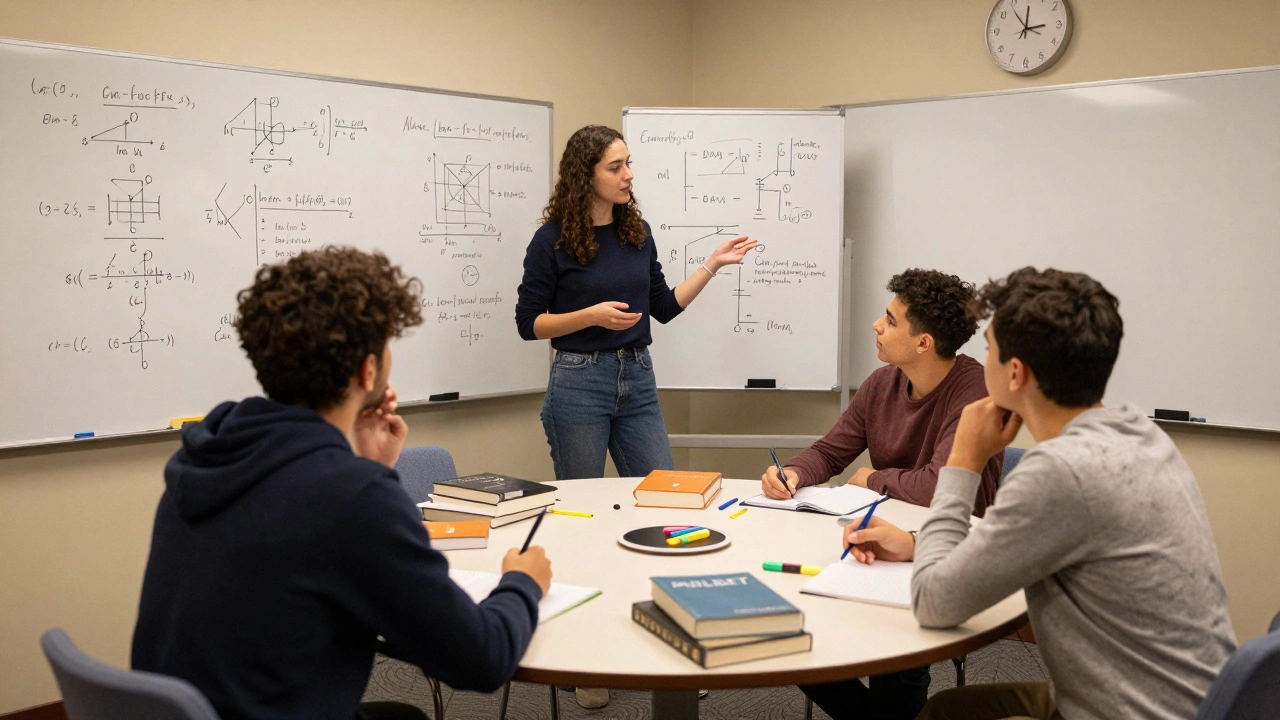
How to Make Group Study Actually Work
Not all group study sessions are created equal. Many fail because they turn into social hours with books. Here’s how to fix that:
- Set a clear goal: “Today we’re solving 5 practice problems from Chapter 7.”
- Assign roles: One person leads, one takes notes, one times the session.
- Limit size: 3-4 people max. More than that, and someone gets quiet.
- Start with solo work: Everyone reviews the material alone first, then meets to discuss.
- End with a quiz: Test each other. No notes. No phones.
Groups that follow this structure are 5x more likely to improve grades than those that just “study together.”
How to Maximize Solo Study Time
If you’re going solo, don’t just sit there with a textbook. Structure matters.
- Use the Pomodoro Technique: 25 minutes focused, 5 minutes break. Repeat.
- Write summaries in your own words-no copying.
- Teach the material out loud to an empty room. Your brain treats it like a real audience.
- Track progress: Keep a simple log: “Today: Understood trig identities. Struggled with derivatives.”
- Eliminate distractions: Put your phone in another room. Use apps like Forest or Focus To-Do.
One student from UNC Asheville tracked her study habits for a semester. She doubled her GPA by switching from passive reading to active recall and self-testing. She didn’t change her schedule. She changed her method.

Hybrid Approach: The Best of Both Worlds
The smartest students don’t choose one. They switch based on the material. Here’s a simple rule:
- Start solo: Learn the basics alone. Build your foundation.
- Then group: Once you have a grip, meet with others to test your understanding.
- End solo: Before the exam, go back to solo review. Test yourself. Drill weak spots.
This method combines the focus of solo study with the clarity of group discussion. It’s how top performers in medical school, law school, and engineering programs study. They don’t rely on one method. They use rhythm.
Common Mistakes to Avoid
Both group and solo study have traps.
In group study: Don’t let one person dominate. Don’t let the group become a lecture hall. Don’t skip the prep. Showing up unprepared wastes everyone’s time.
In solo study: Don’t just reread. Don’t highlight everything. Don’t assume you know it because it looks familiar. Active recall is the only real test of learning.
And avoid the myth that “more hours = better results.” A focused 90-minute solo session beats 3 hours of distracted scrolling. A 45-minute group session with clear goals beats a 2-hour chat with textbooks open.
Final Rule: Match the Method to the Task
Here’s your cheat sheet:
| Task | Best Method | Why |
|---|---|---|
| Memorizing facts or formulas | Solo | Self-testing works best alone |
| Solving complex problems | Solo first, then group | Work alone to build logic, then compare approaches |
| Writing essays or analyzing texts | Group | Discussion reveals new angles |
| Preparing for oral exams | Group | Practice explaining aloud |
| Learning new software or coding | Solo | Hands-on practice requires focus |
| Reviewing for final exams | Solo | Identify personal weaknesses |
There’s no single best way to study. But there is a best way for you-right now, with this subject. Try both. Track what works. Adjust. The goal isn’t to be the person who studies the longest. It’s to be the person who learns the most.
Is group study better than solo study?
Neither is universally better. Group study helps with discussion, clarification, and motivation, especially for abstract topics. Solo study is better for deep focus, memorization, and self-testing. The best approach depends on what you’re learning and how you learn best.
Can I combine group and solo study?
Yes, and most high-performing students do. A proven method is to study alone first to build understanding, then meet in a group to test and explain concepts, and finally return to solo review before exams. This hybrid approach uses the strengths of both.
How many people should be in a study group?
Three to four people is ideal. Smaller groups keep focus. Larger groups often lead to one person doing all the talking, while others stay quiet. If the group grows beyond four, split into two smaller groups.
What if I’m shy and hate talking in groups?
You don’t need to dominate. Just listen, ask one question, and try explaining one concept in your own words. Many shy students find that once they start speaking-even once-they feel more comfortable. You can also start with a two-person study partner instead of a larger group.
How do I know if I’m just pretending to understand in a group?
If you nod along but can’t explain the concept later without notes, you’re pretending. Test yourself after the session. Try teaching it to an empty room or writing a summary from memory. If you struggle, go back and study that part alone.
Should I study alone if I’m falling behind?
Yes. When you’re behind, you need to rebuild your foundation. Group study can help later, but first, you need to understand the basics on your own. Use solo time to identify exactly where you’re stuck, then bring those questions to a group.
Study smarter, not harder. Your brain doesn’t care how long you sit at a desk. It cares whether you’re actively engaging with the material. Whether you’re alone or with others, the goal is the same: make your brain work.