
When a student dies on campus, or a close friend or family member passes away, university life doesn’t pause. Lectures keep going. Deadlines don’t move. And for the grieving student, the world feels like it’s spinning faster while they’re stuck in slow motion.
It’s not just sadness-it’s shock, guilt, and isolation
Most people think grief looks like crying. In reality, it often looks like showing up to class with no memory of what was said, skipping meals, or sleeping 14 hours a day. At UK universities, where students often live far from home, the absence of family support can make grief feel heavier. A 2024 study by the University of Manchester found that 68% of students who experienced a sudden loss reported feeling completely alone in the first month. Many didn’t tell anyone-afraid of being seen as weak, or worse, a burden.
It’s not just about losing someone. It’s about losing the future you imagined with them. The birthday texts you’ll never send. The graduation photo you won’t get to take together. The quiet voice that used to say, “I’ll see you at dinner.” That’s the real weight.
What universities actually offer (and what they don’t
Most UK universities have a student support service. But the gap between policy and practice is wide. You might find a webpage titled “Bereavement Support,” but it often just links to a generic counselling form. There’s no one waiting to say, “I’m sorry for your loss.” No one who knows what it means to sit in a lecture hall where everyone else is talking about weekend plans while you’re trying not to fall apart.
Some universities-like Oxford, King’s College London, and the University of Edinburgh-have dedicated bereavement coordinators. These are trained staff members who can help you pause assignments, extend deadlines, or connect you with peer support groups. But these roles are rare. In 2025, only 19% of UK universities had a named person assigned to handle student bereavement. The rest expect you to navigate the system alone.
And then there’s the bureaucracy. To get an extension, you might need a death certificate. To see a counsellor, you might need to wait six weeks. To get financial help for travel home, you need to fill out three forms and wait for approval. In grief, paperwork feels like a second loss.
What works: Real strategies students actually use
There’s no one right way to grieve. But some things consistently help students who’ve been through it.
- Find one person you trust-a roommate, a tutor, a barista who remembers your order. Just one person who knows what happened and doesn’t ask you to “be strong.”
- Use the university’s quiet spaces. Many campuses have prayer rooms, meditation corners, or even just empty lecture halls you can sit in after hours. Silence is often more healing than talking.
- Write it down. Not for anyone else. Just for you. A letter to the person you lost. A list of things you miss. A single sentence each day: “Today, I remembered their laugh.”
- Take one day at a time. If you can get out of bed, eat something, and go to one class-that’s enough. You don’t have to be productive. You don’t have to “move on.”
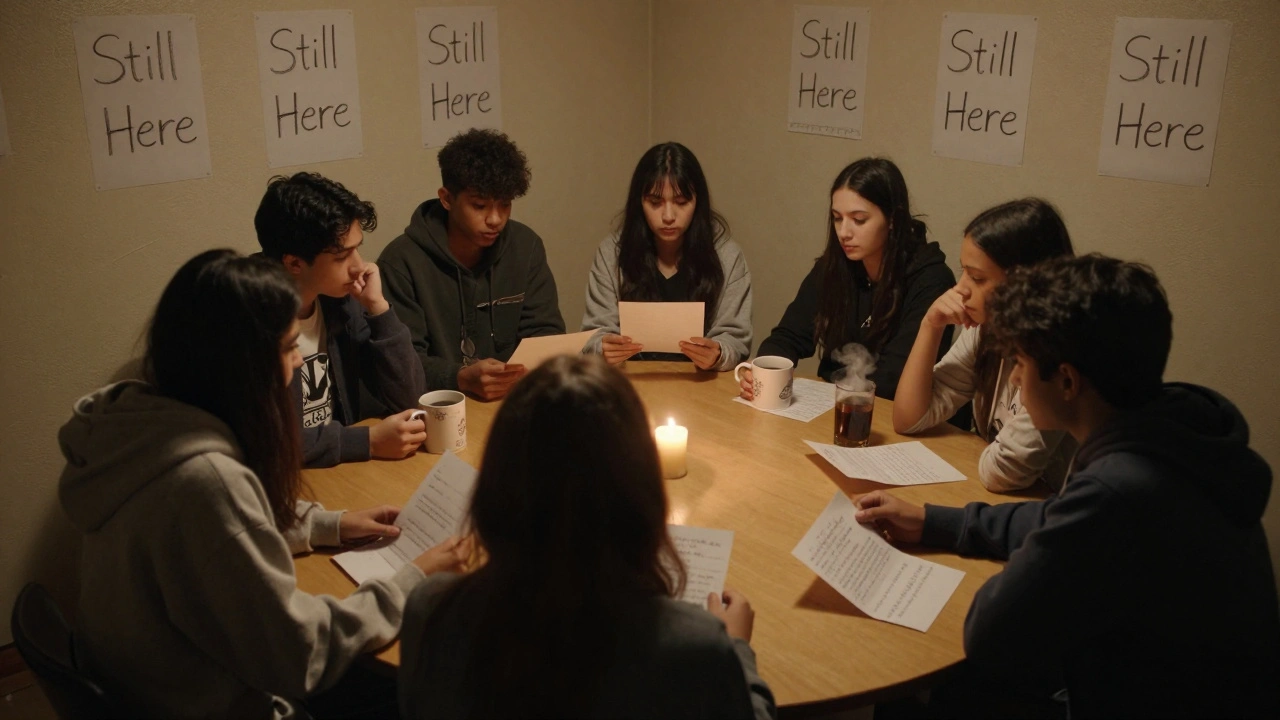
Some students join peer-led support groups. At the University of Glasgow, a student started a group called “Still Here” after losing her brother. It meets every Thursday at 6 PM in the student union basement. No agenda. No facilitator. Just people who get it. That’s the kind of support that sticks.
What to say (and what not to say)
If you’re the friend, flatmate, or lecturer watching someone grieve, your words matter. But what you say often makes things worse.
Don’t say:
- “They’re in a better place.”
- “At least they didn’t suffer.”
- “You’ll get over it.”
- “I know how you feel.”
These phrases aren’t malicious. They come from a place of trying to help. But they shut down grief. They make the person feel like their pain is too much to hold.
Instead, try:
- “I’m so sorry. I can’t imagine what this is like.”
- “I’m here. You don’t have to talk.”
- “Would you like me to pick up your groceries this week?”
- “I’m thinking of them today.”
Actions speak louder than words. Bring soup. Do their laundry. Send a text that just says “I remember their smile.”
The long road: Grief doesn’t end-it changes
People talk about “moving on” from grief. That’s not how it works. Grief doesn’t disappear. It becomes part of you. A year later, you might still cry when you hear their favorite song. You might avoid the café where you used to meet. You might feel guilty for laughing again.
That’s not failure. That’s love.
Many students who’ve lost someone close find themselves changed in ways they didn’t expect. Some drop out. Some switch courses. Some start volunteering with hospices. Some become student mental health advocates. One student at Cardiff University, after losing her mother, created a peer-led bereavement guide that’s now used across 12 UK campuses.
There’s no timeline. There’s no right way. But there is hope-not in forgetting, but in carrying them with you.

Where to turn: UK-specific support resources
If you’re a student in the UK and you’re grieving, you’re not alone. Here are real, working resources:
- Cruse Bereavement Care-Free, confidential support by phone or online. They have a dedicated student line: 0808 808 1677.
- The Compassionate Friends-Support for families who’ve lost a child. They run online groups specifically for university students.
- University of London Student Union Bereavement Network-A student-led group that connects grieving students across all UoL colleges.
- Student Minds-Offers downloadable guides on coping with loss while studying. Free and downloadable.
- The Good Grief Trust-Publishes a “Student Bereavement Toolkit” used by 80+ UK universities. Check their website for downloadable PDFs.
Most universities also have chaplaincies or faith-based support services-even if you’re not religious, chaplains are trained to sit with grief. No judgment. No pressure. Just presence.
Final thought: You’re allowed to be broken
University doesn’t care if you’re grieving. But you do. And that’s what matters.
You don’t have to be okay. You don’t have to be strong. You don’t have to pretend.
It’s okay to miss class. It’s okay to cry in the library. It’s okay to not know what to say next.
What you’re feeling is real. What you’ve lost matters. And you are not alone-even if it feels like you are.
There are people who’ve been here. There are places you can go. There are words that will help. And there is a way forward-not by forgetting, but by remembering.
How long do university extensions last after a death?
There’s no fixed rule. Most UK universities offer extensions of 7 to 28 days depending on the circumstances. You’ll usually need to provide a death certificate or official confirmation. Some institutions allow extensions up to 6 weeks if the loss was sudden or traumatic. Contact your student support office directly-they can often override standard policies if you explain the situation.
Can I take a break from university after a bereavement?
Yes. Most universities have a “leave of absence” or “suspension” option for personal or medical reasons, including bereavement. You won’t lose your place, and you can usually return the next term without reapplying. Some even allow you to freeze fees during the break. Talk to your student advisor-they’ll guide you through the form. You don’t need to explain in detail.
Do I have to tell my lecturers about the death?
No, you don’t have to. But if you want extensions, deadline changes, or accommodations, you’ll need to inform someone-usually your personal tutor or student support team. You can ask them to keep it private from your lecturers. Many students choose to say only, “I’m going through a difficult personal time,” and leave it at that.
What if I’m grieving but I’m not close to the person who died?
Grief isn’t a competition. Losing a classmate, a neighbor, a campus worker, or even a distant relative can be deeply painful, especially in a close-knit university environment. Your feelings are valid. You don’t need to justify your grief. Universities should support anyone affected by a loss on campus, regardless of how close you were.
Can I get financial help if I need to travel home?
Some universities offer emergency hardship funds that can cover travel costs after a bereavement. Others have bursaries specifically for students in crisis. Apply through your student finance office-they’re used to helping in these situations. You may need to provide proof of the death and your travel plans, but you don’t need to share private details.