
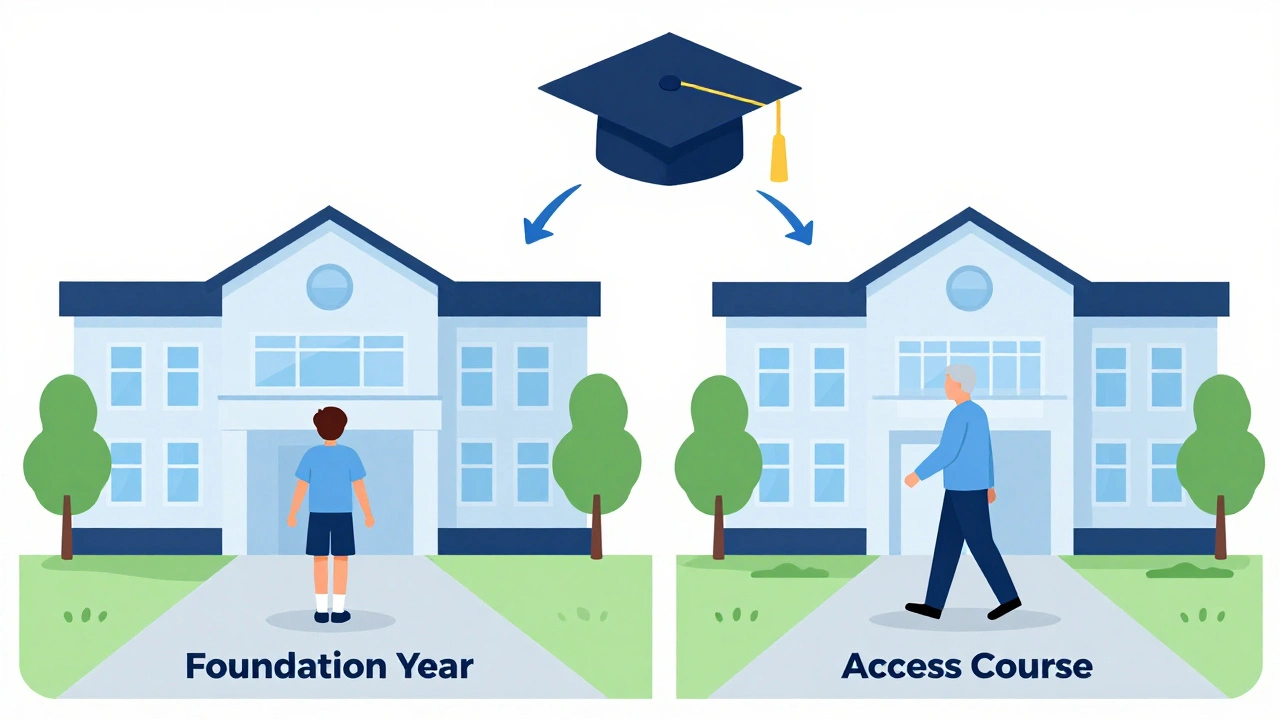
Not everyone follows the traditional path to university in the UK. If you didn’t take A-levels, left school early, or come from a country with a different education system, you might feel like university is out of reach. But it’s not. Two clear, well-established alternatives exist: foundation years and access courses. Both are designed to get you into university - even if your background doesn’t match the usual profile.
What Is a Foundation Year?
A foundation year is a one-year course offered by universities as the first step of a full undergraduate degree. It’s built into the degree program, so if you pass, you automatically move into Year 1 of your chosen degree - no separate application needed. These are common for students who didn’t take the right A-level subjects, got lower grades than required, or are returning to education after a break.
For example, if you want to study engineering but only have a BTEC in business, a foundation year in engineering will cover the math, physics, and technical skills you missed. It’s not a prep course - it’s the first year of your degree, just slower and more supported. Universities like Manchester, Birmingham, and Newcastle offer foundation years in nearly every subject area.
Foundation years are also popular with international students. If you’re from a country where high school ends at 12th grade but doesn’t match UK standards, a foundation year bridges that gap. It includes English language training, study skills, and subject-specific content tailored to UK university expectations.
What Is an Access to Higher Education Course?
An Access course is different. It’s not tied to one university. Instead, it’s offered by colleges, adult education centers, and some sixth forms. It’s designed for adults over 19 who don’t have traditional qualifications. You might be a single parent, a worker returning after years in retail, or someone who left school at 16. The course lasts one year and prepares you specifically for university entry.
Access courses come in different flavors: Science, Health Professions, Social Sciences, Humanities, and more. Each one focuses on the subjects you’ll need for your future degree. A Health Access course, for instance, covers biology, chemistry, psychology, and academic writing - all aligned with nursing or midwifery degree requirements.
Unlike foundation years, Access courses are usually free for UK residents over 19. You might even qualify for a loan to cover materials or childcare. And because they’re nationally recognized, universities accept them as equivalent to A-levels. In fact, over 25,000 people in the UK complete Access courses each year - and nearly 80% go on to university.
Foundation Year vs. Access Course: Key Differences
It’s easy to confuse the two. Here’s how they really differ:
| Feature | Foundation Year | Access Course |
|---|---|---|
| Who it’s for | 18-19 year olds, international students, those with non-standard qualifications | Adults over 19, career changers, those without A-levels |
| Where it’s offered | At universities | At colleges, adult education centers |
| Duration | One year | One year (full-time) |
| Cost | £9,250 (same as tuition fee) | Usually free for UK residents over 19 |
| Progression | Guaranteed entry to the same university’s degree | Accepted by most UK universities, but you apply separately |
| Entry requirements | Often just GCSEs in English and Math | Usually no formal qualifications needed |
If you’re under 19 and still in the school system, a foundation year is your most direct path. If you’re older and need flexibility, an Access course is more likely to fit your life.

Who Should Choose Which Path?
Let’s say you’re 17, finished your GCSEs, and got a C in Maths and a D in Chemistry. You want to study pharmacy. Your school counselor says you need A-levels in Chemistry and Biology. But you didn’t take them. A foundation year in Life Sciences is your answer. It’ll give you the science background you need, and you’ll enter the pharmacy degree at the same university.
Now imagine you’re 32, worked as a care assistant for 10 years, and want to become a nurse. You left school at 16 with two GCSEs. You can’t afford to quit your job for a full-time degree. An Access to Nursing course at your local college fits perfectly. You study two evenings a week, finish in 10 months, and apply to universities like Birmingham or Sheffield. They accept your Access certificate just like A-levels.
International students from Nigeria or India often choose foundation years because their high school diplomas aren’t seen as equivalent to A-levels. Foundation years help them adjust to UK teaching styles and academic expectations.
How to Apply
Applying for a foundation year is done through UCAS - the same system used for regular degrees. You pick a university, find their foundation year option, and apply like you would for any course. You’ll need a personal statement and references. Some universities require an interview.
Applying for an Access course is simpler. You contact your local college directly. No UCAS. No application fee. You might need to attend an information session or complete a short written task. Once you finish the course, you apply to university through UCAS like any other applicant.
Deadlines matter. Foundation year applications open in October and close in late June. Access courses often have rolling admissions - you can start in September or January.
Support and Funding
Funding is a big concern. Foundation years cost £9,250 - the same as a full degree. But you can get a student loan for tuition and maintenance. The loan is repaid only after you earn over £25,000 a year.
Access courses are different. If you’re a UK resident over 19 and studying full-time, you usually don’t pay tuition. The government covers it. You can also apply for a 24+ Advanced Learning Loan to cover course materials, transport, or childcare. This loan is written off if you complete your degree.
Many colleges offer extra support: free childcare, mental health counseling, or study skills workshops. Don’t assume you’re on your own - help is built in.
What Happens After?
Success rates are high. Students who complete foundation years have the same graduation rates as those who entered directly. Access course graduates perform just as well in their degrees - and often outperform peers because they’re more focused and motivated.
Universities don’t treat you differently. Your degree certificate won’t say “foundation year” or “Access course.” It just says “BSc in Psychology” or “BA in History.” Employers don’t ask. They care about the final qualification.
Some students even use these routes to switch careers. A teacher with 15 years of experience took an Access course in Psychology and now works as a clinical psychologist. A warehouse worker completed a foundation year in Computer Science and now codes for Google. These aren’t rare stories - they’re everyday outcomes.
Common Myths Debunked
- Myth: Foundation years are for “less capable” students. Truth: They’re for students with different backgrounds. Many top universities offer them to high-achieving international applicants.
- Myth: Access courses are only for older people. Truth: While most students are over 19, some 18-year-olds with non-traditional education take them too.
- Myth: You can’t get into Russell Group universities. Truth: Universities like UCL, Edinburgh, and Durham accept Access course graduates every year.
- Myth: Foundation years are too hard. Truth: They’re designed to be manageable. You get more support, smaller classes, and weekly feedback.
Next Steps: What to Do Now
If you’re considering one of these routes, start here:
- Decide what subject you want to study at university.
- Search for “[your subject] foundation year” on university websites.
- Check local colleges for “Access to [your subject]” courses.
- Compare entry requirements, costs, and start dates.
- Contact admissions teams - they’ll answer your questions honestly.
- Apply early. Spaces fill up.
You don’t need perfect grades or a straight path. You just need the determination to start. Foundation years and Access courses exist because universities know talent comes in many forms. Your background doesn’t define your future - your effort does.
Can I do a foundation year if I already have a degree?
Yes, but it’s rare. Foundation years are designed for people entering university for the first time. If you have a degree and want to switch fields, you’re better off applying directly to a second degree or a postgraduate course. Some universities offer conversion courses instead.
Do international students need a foundation year?
Many do. If your high school diploma isn’t recognized as equivalent to UK A-levels, a foundation year is the most reliable way to meet entry requirements. It also helps you adapt to British teaching styles and improve your English for academic use.
Can I apply to multiple universities with an Access course?
Yes. Unlike foundation years, which are tied to one university, Access courses are nationally recognized. You can apply to any university that accepts them. Most do - including top-ranked institutions.
Are Access courses harder than A-levels?
They’re different, not harder. Access courses are intense because they cover a year’s worth of content in 10 months. But they’re taught with adult learners in mind - more support, more flexibility, and practical focus. Many students find them easier than A-levels because they’re motivated and focused on their goal.
What if I fail my foundation year or Access course?
Failing isn’t common - most students pass. But if you do, you can often retake the year or resit specific modules. Some colleges offer support to help you improve. You can also apply to a different university or course with a lower entry requirement. It’s not the end - it’s a detour.
These routes exist because education isn’t one-size-fits-all. Whether you’re 17 with shaky GCSEs or 35 with a full-time job, there’s a way in. You just have to take the first step.