
Quick Summary: Which one should you choose?
- Use In-Text Citations for APA, MLA, or Harvard styles; best for science, psychology, and business essays.
- Use Footnotes for Oxford, OSCOLA, or Chicago styles; best for law, history, and theology.
- Check your handbook: Your university's specific style guide always overrides general rules.
- Consistency is key: Never mix two different systems in the same paper.
When to reach for footnotes
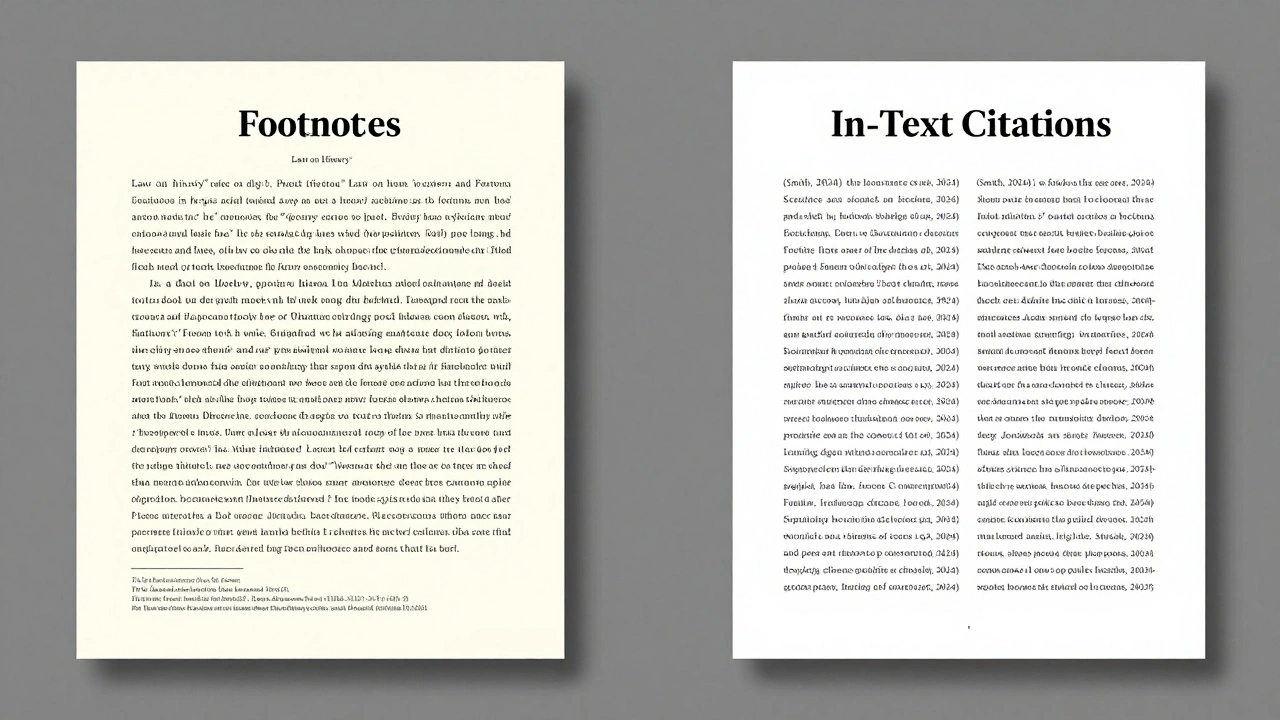
Footnotes are a lifesaver when you have a lot to say but don't want to clutter your main argument. Imagine you're writing a history essay on the Industrial Revolution. You might mention a specific piece of legislation. While the main text focuses on the economic impact, you might want to explain the legal nuance of that act. A footnote lets you provide that extra context without derailing your paragraph. In UK universities, if you are studying Law, you'll almost certainly use OSCOLA (Oxford Standard for the Citation of Legal Authorities). It relies heavily on footnotes because legal citations-like case names and statute numbers-are long and clunky. Putting "R v Brown [1993] UKHL 19" in the middle of a sentence would be a nightmare for the reader. By pushing it to the bottom of the page, the argument stays sharp. Footnotes also allow for "discursive" comments. This is where you tell the reader, "Actually, another author argues the opposite here, and here is why they are wrong." Doing this in the main text can make your writing feel fragmented. In a footnote, it shows the examiner that you've read widely and are thinking critically, all while keeping your primary thesis front and center.The power of in-text citations
If you're writing for a sociology or biology module, you're likely using Harvard Referencing or APA Style. These systems prioritize the date of the research. In science, a study from 1974 is viewed very differently than one from 2024. By placing the year right next to the author's name in the text-e.g., (Smith, 2024)-the reader immediately knows how current your evidence is. In-text citations are faster to write and easier for the reader to scan. When a lecturer is skimming your work, they can see at a glance which heavyweights in the field you're citing. If they see (Foucault, 1975) or (Butler, 1990) peppered through your paragraphs, they know you've hit the core theoretical requirements of the module. However, the downside is the "bracket clutter." If you have a sentence supported by five different sources, you end up with a massive block of parentheses that can break the reader's concentration. This is why many students struggle with UK academic writing when they first transition from A-levels to university; they either over-cite or under-cite because they're afraid of making the page look ugly.Comparing the two systems at a glance
| Feature | Footnotes (e.g., Oxford/OSCOLA) | In-Text (e.g., Harvard/APA) |
|---|---|---|
| Visual Flow | Clean pages, references at bottom | Interrupted by brackets |
| Primary Focus | Source precision and nuance | Recency of data (Publication date) |
| Common Subjects | Law, History, Classics, Theology | Psychology, Business, Science, Sociology |
| Extra Comments | Easy to add side-notes/critiques | Difficult; requires separate paragraphs |
| Page Layout | Varies based on number of notes | Consistent text blocks |
How to actually implement them
If you've decided (or been told) to use footnotes, don't do it manually. Typing numbers and drawing lines at the bottom of the page is a recipe for disaster. Use the "Insert Footnote" function in Microsoft Word or Google Docs. These tools automatically renumber your citations if you decide to move a paragraph from page 10 to page 2. If you do it manually and add one new citation at the start, you'll have to change every single number in the entire essay. For in-text citations, the rule of thumb is the "Author-Date" system. If you're quoting directly, you must include the page number: (Jones, 2022, p. 45). If you're just paraphrasing an idea, the page number is often optional but still encouraged in high-level UK essays to show you've actually read the book rather than just the abstract. One common pitfall is the "double-up." Some students think they need to do both. They put a citation in the text and then a footnote at the bottom. Unless you are writing a PhD thesis with very specific requirements, avoid this. It's redundant and makes your work look like you're trying to inflate your word count.Avoiding the most common mistakes
One of the biggest traps is the "orphan footnote." This happens when you place a superscript number at the end of a paragraph, but the actual footnote appears on the next page. While technically allowed, it's a pain for the marker. Try to ensure your citations are placed logically. If a sentence contains three different ideas from three different books, put the footnote number immediately after the specific phrase, not just at the very end of the sentence. Another issue is the "citation dump." This is when a student puts ten in-text citations in one paragraph to look impressive. It usually has the opposite effect. It suggests you are relying too much on other people's words and not providing enough of your own analysis. The goal of a UK essay is to use sources to support *your* argument, not to let the sources *be* the argument. Finally, watch out for the "ibid" trap in footnotes. Ibid. (short for *ibidem*, meaning "in the same place") is used when you cite the same source twice in a row. However, many modern UK style guides are moving away from it because it's confusing for digital readers. Check if your university prefers "Shortened Citations" (Author, Short Title) instead of ibid.
Practical steps for your next essay
First, open your module handbook. Look for the section titled "Assessment" or "Referencing." If it says "Harvard," go in-text. If it says "OSCOLA" or "Oxford," go footnotes. If it doesn't specify, email your tutor immediately. Nothing is worse than rewriting 50 citations the night before the deadline. Second, set up a referencing manager. Tools like Zotero or Mendeley can switch your entire paper from Harvard to Oxford style with one click. This removes the mechanical stress of formatting and lets you focus on the actual writing. Third, create a "citation log." As you read, copy the full bibliographic details into a separate document. Whether you use footnotes or in-text citations, you still need a full bibliography or reference list at the end. Trying to find that one specific journal article from three weeks ago in a sea of 50 open browser tabs is a waste of your mental energy.Can I use both footnotes and in-text citations in the same essay?
Generally, no. Mixing styles is considered poor academic practice in UK universities. You should commit to one system. The only exception is if you use in-text citations for your sources and footnotes specifically for "content notes" (providing extra information that doesn't fit in the text), but this is rare and should be cleared with your tutor first.
Do footnotes count towards the final word count?
It depends entirely on the university and the department. In some Law courses, footnotes are excluded from the count. In History, they might be included. Always check your specific assignment brief; if you're tight on words, using footnotes for discursive comments can sometimes be a way to add depth without hitting the limit.
Which is "better" for getting a higher grade?
Neither is inherently "better." A first-class grade comes from the quality of your analysis and the accuracy of your referencing, not the system you use. However, using the *correct* system for your subject shows a level of professional competence. A Law essay using APA in-text citations looks amateur and may be penalized.
What happens if I forget a citation?
Missing a citation can lead to accusations of plagiarism, even if it was an honest mistake. If you realize you've missed one after submitting, contact your tutor immediately. It's much better to admit a mistake and ask to submit a corrected version than to have a plagiarism software report flag your work.
Do I need a bibliography if I use footnotes?
Yes. Footnotes tell the reader where a specific quote came from on a specific page, but a bibliography provides a complete, alphabetized list of every source you consulted. Think of footnotes as the "map" for the essay and the bibliography as the "directory" for the research.