
UK students are under more pressure than ever. Between deadlines, exams, part-time jobs, and social expectations, many are running on empty. But there’s one simple, free, and proven tool they’re often ignoring: movement. Not intense gym sessions or marathon runs. Just regular, consistent movement - walking, stretching, dancing, cycling - that actually changes how the brain handles stress.
Why Sitting All Day Makes Stress Worse
Most UK students spend 6 to 10 hours a day sitting - at desks, in lecture halls, on sofas scrolling through feeds. This isn’t just bad for posture. It’s bad for mental health. When you sit for long periods, your body stays stuck in a low-grade stress response. Cortisol, the stress hormone, keeps building up. Your muscles tense. Your breathing gets shallow. And your brain starts to feel like it’s stuck in slow motion.
A 2024 study from University College London tracked 1,200 university students over six months. Those who sat more than 8 hours a day reported 47% higher anxiety levels than those who moved for at least 30 minutes daily. The difference wasn’t about how much they exercised - it was about whether they broke up sitting. Just standing up every hour made a measurable difference.
How Movement Actually Lowers Stress
Your body and brain are wired to move. When you walk, your heart rate increases slightly. Blood flows better. Oxygen reaches your brain. And here’s the key part: your body releases endorphins and serotonin - natural chemicals that calm your nervous system. You don’t need to break a sweat. A 15-minute walk around campus does more than an hour of scrolling.
One student at the University of Manchester described it like this: "I used to sit at my desk for hours, panicking about my essay. Then I started taking five-minute walks between each section. It wasn’t about getting fresh air. It was about resetting my brain. By the time I sat back down, the panic was gone. I could think again."
Exercise doesn’t just distract you from stress - it rewires how your brain reacts to it. Regular movement lowers baseline cortisol levels. It improves sleep. It gives you a sense of control when everything else feels overwhelming.
What Kind of Movement Works Best?
You don’t need a gym membership. You don’t need fancy equipment. You just need to move in a way that feels good - not punishing.
- Walking - Even 10 minutes between classes. Walk without headphones. Notice the sky, the sounds, your feet hitting the ground.
- Stretching - Try 5 minutes of simple stretches before bed. Neck rolls, shoulder circles, standing forward bends. No need to touch your toes. Just release the tension.
- Dancing - Put on one song. Move however your body wants. No rules. This isn’t about being good. It’s about letting go.
- Cycling - Ride to campus instead of taking the bus. Even 15 minutes each way adds up.
- Yoga or Tai Chi - Many UK universities offer free weekly sessions. These combine movement with breath control - a double hit for stress relief.
None of these require you to be "fit" or "disciplined." They just require you to move for a few minutes - not to burn calories, but to reset your nervous system.
Real Students, Real Results
At the University of Edinburgh, a group of students started a "Move Before You Study" challenge. Every morning before starting work, they walked for 12 minutes. No exceptions. After four weeks, 82% reported feeling calmer. 76% said they finished tasks faster. One student, 21, said: "I used to waste two hours a day staring at my screen, stuck in anxiety. Now I walk. I come back and get things done in 30 minutes."
At King’s College London, a student-led initiative called "Staircase Therapy" encouraged people to take the stairs instead of the elevator. They didn’t promote fitness. They promoted mental reset. Within a term, 60% of participants said they felt less overwhelmed during exam season.
When Movement Feels Impossible
Some days, just getting out of bed feels hard. That’s okay. You don’t need to move for 30 minutes. Move for 60 seconds.
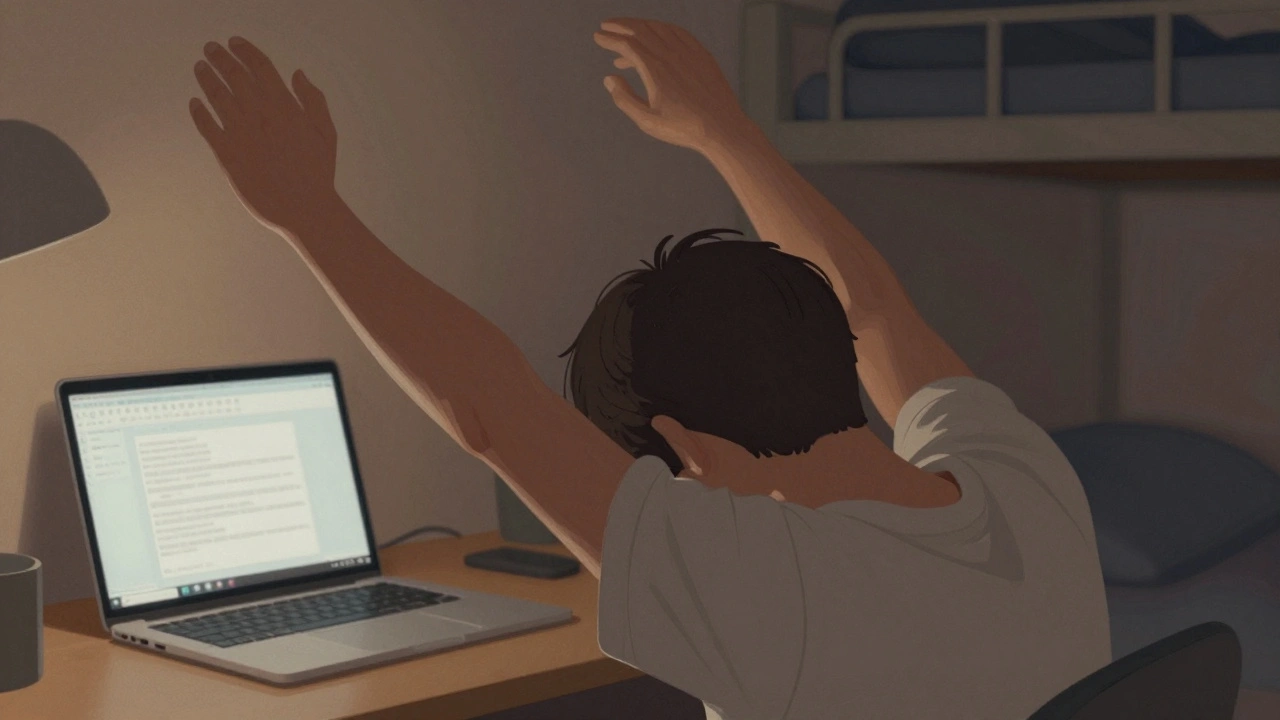
Stand up. Stretch your arms over your head. Take three slow breaths. Then sit back down. That’s it. That’s enough.
Stress doesn’t disappear because you did a full workout. It fades because you broke the cycle of stillness. Even tiny movements signal to your brain: "I’m not trapped. I can shift. I can change."
If you’re feeling too tired, too anxious, or too overwhelmed to move - that’s when you need it most. Start small. Stand. Breathe. Move one joint. Then another. You’re not trying to become an athlete. You’re trying to become calmer.

Make It Stick
Here’s how to build movement into your routine without adding pressure:
- Set one daily trigger - like after breakfast, before checking your phone, or right after class ends.
- Choose one easy movement - walk around your room, stretch your arms, do 5 squats.
- Do it for 7 days straight. No exceptions.
- After a week, notice how you feel. Not better. Just… different.
Don’t aim for consistency. Aim for curiosity. Ask yourself: "What happens if I just stand up?"
Most students think they don’t have time. But time isn’t the problem. It’s the belief that movement has to be "productive" or "hard" to count. It doesn’t. Movement as stress relief isn’t about fitness. It’s about freedom.
It’s Not a Quick Fix - It’s a Daily Reset
Exercise won’t erase your exam stress. It won’t fix your financial worries. It won’t make your workload disappear. But it will give you space - mental space - to handle it all better.
Think of movement like a reset button for your brain. Press it every day. Not because you should. But because you need to.
UK students aren’t failing because they’re lazy. They’re overwhelmed because they’re stuck. Movement is the simplest way to break free - without spending a penny, without waiting for permission, without needing to be perfect.
Stand up. Breathe. Move. Just for a minute. See what happens.
Can walking really help with exam stress?
Yes. A 2023 study from the University of Cambridge found that students who took 10-minute walks before exams scored 12% higher on average than those who sat quietly. The walk didn’t help them remember more - it helped them think clearly. Walking lowers cortisol and increases blood flow to the prefrontal cortex - the part of the brain responsible for focus and decision-making. Even a short walk breaks the cycle of panic.
Do I need to go to the gym to reduce stress?
No. Gyms can help, but they’re not necessary. Many students feel more stressed trying to fit gym sessions into their schedule. Movement for stress relief is about consistency, not intensity. A 15-minute walk, dancing to one song, or even stretching on your bed can be more effective than an hour on a treadmill if you’re dreading it. The goal is to feel better - not to check a box.
What if I don’t have time to move?
You don’t need a lot of time. You need one minute. Stand up. Take three deep breaths. Roll your shoulders. That’s it. Stress builds up in stillness. Movement doesn’t have to be long - it just has to be different from sitting. Try moving for 60 seconds between each task. You’ll be surprised how much calmer you feel.
Is this just for university students?
No. This applies to any student - sixth form, college, or even high school. Stress doesn’t care about age. A 16-year-old with GCSEs feels the same pressure as a 22-year-old with finals. Movement works the same way for everyone. Schools and colleges across the UK are starting to build short movement breaks into timetables because the evidence is clear: active students perform better and feel less anxious.
Can movement replace therapy or medication for anxiety?
Movement is not a replacement for professional mental health support. But it can be a powerful companion. Many students who use therapy or medication say movement helps them feel more grounded between sessions. It doesn’t cure anxiety - but it gives you tools to manage it daily. Think of it as building your mental resilience, not replacing care.