
Writing a strong university essay doesn’t require fancy words or long sentences. It needs a clear essay structure-one that guides the reader through your ideas without confusion. Too many students focus on sounding smart instead of being clear. The result? Confusing, disjointed papers that lose points even when the content is good. The truth is simple: if your essay doesn’t follow a logical shape, your argument won’t stick. Let’s break down exactly how to build an essay that works-starting with the introduction, moving through the body, and ending with a conclusion that actually matters.
Start with a Purposeful Introduction
Your introduction isn’t just a warm-up. It’s your first chance to convince the reader that your essay is worth reading. A weak introduction says: "This essay will talk about climate change." A strong one says: "Climate change isn’t just an environmental issue-it’s reshaping how cities plan housing, water, and emergency response systems, and ignoring this shift puts millions at risk."
The introduction has three jobs:
- Hook the reader with a real-world connection
- Define the specific problem or question you’re answering
- State your main claim (thesis) clearly
Forget the cliché: "Since the beginning of time..." or "In today’s society...". Instead, start with something concrete. A statistic. A surprising fact. A short story from a news article. For example: "In 2024, over 60% of U.S. universities reported a 30% increase in student mental health crises linked to academic pressure." That’s your hook. Then narrow it: "This essay argues that universities must redesign workload policies to prevent burnout, not just offer counseling after damage is done."
And don’t bury your thesis. Put it in the last sentence of the paragraph. Make it bold. Make it clear. If your professor has to hunt for your main point, they’ll assume you don’t know it either.
Build Body Paragraphs Like Building Blocks
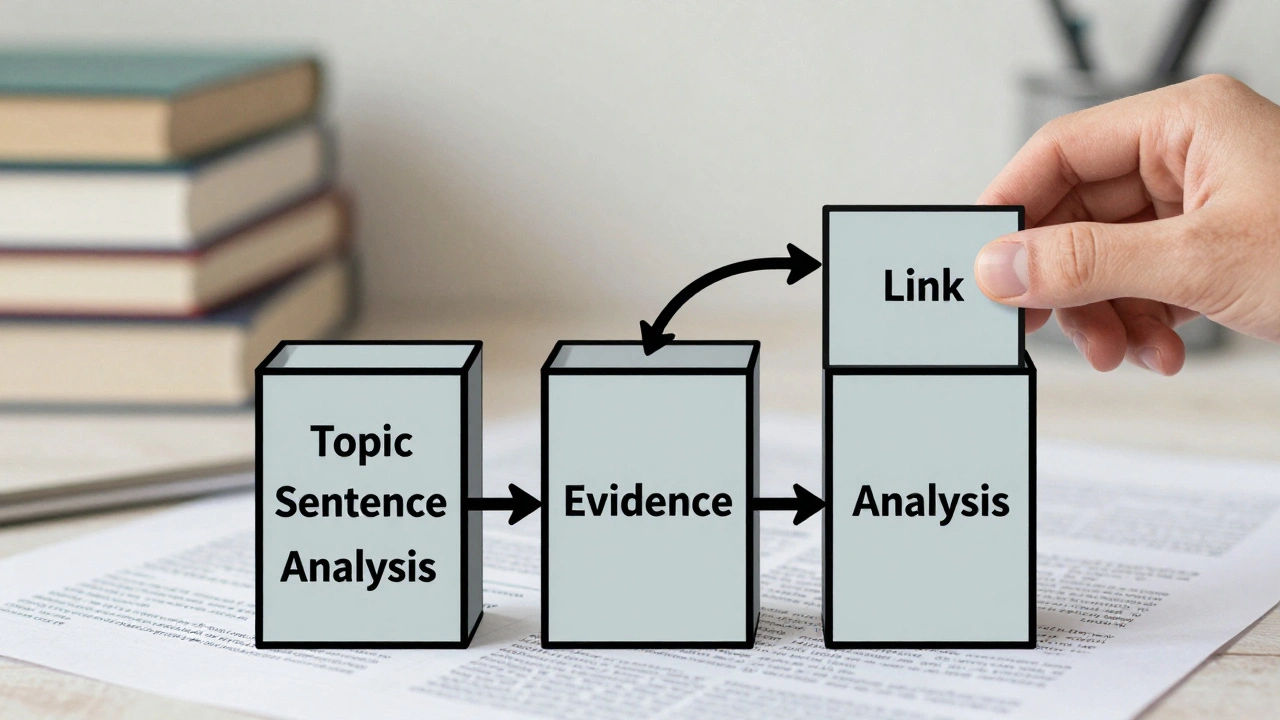
Each body paragraph should feel like a single, solid brick in a wall. No wobbling. No gaps. The classic formula-topic sentence, evidence, analysis, link-isn’t just textbook advice. It’s what separates A papers from C papers.
Start every paragraph with a topic sentence. This isn’t a general statement like "There are many causes of stress." It’s specific: "Overloaded reading lists directly contribute to student burnout by reducing time for sleep and self-care." That sentence tells the reader exactly what this paragraph will prove.
Then comes evidence. Not just quotes. Not just opinions. Real data, examples, or sources. If you’re writing about education policy, cite a 2025 study from the National Center for Education Statistics. If you’re analyzing literature, point to a specific passage. Don’t say "some experts believe." Name them. "According to Dr. Elena Torres, a professor at Stanford who studied workload trends for 12 years..."
Now, the part most students skip: analysis. What does this evidence mean? Why does it matter? Don’t just repeat the source. Explain it. "This means students aren’t just tired-they’re being trained to sacrifice health for grades, which undermines the university’s own mission of holistic development."
End the paragraph with a link to the next one. "This pressure also affects classroom participation, which leads directly to the next issue: how grading systems penalize students who are mentally exhausted." That’s how you keep the flow tight.
And here’s the rule: one idea per paragraph. If you’re trying to make three points in one paragraph, you’re confusing your reader. Split it. Three paragraphs are better than one messy one.
End with a Conclusion That Stays With Them
A conclusion isn’t a summary. It’s not a repeat of your introduction. And it’s definitely not where you say "In conclusion..."
Your conclusion should answer one question: "So what?" Why should anyone care about what you just wrote? A weak conclusion says: "To sum up, stress is bad and universities should change." A strong one says: "If universities continue treating students like machines, they’ll graduate more dropouts than graduates-and the cost won’t just be in tuition refunds. It’ll be in lost innovation, broken mental health systems, and a generation that no longer trusts institutions to care for them."
Here’s how to build it:
- Restate your thesis in new words-not copied.
- Connect your argument to something bigger: a trend, a future, a societal impact.
- End with a thought that lingers. A question. A warning. A call to imagine.
For example, if your essay was about standardized testing: "The SAT was designed in 1926 to sort students, not measure potential. Today, it still sorts-but now it’s sorting children into futures they never chose. What happens when we stop using a tool built for a different century to decide who gets to learn?"
That’s not a closing line. That’s a mirror. It makes the reader think after they’ve finished reading.
Common Mistakes to Avoid
Even experienced writers slip up. Here are the three most common errors-and how to fix them:
- Mistake: Writing a thesis that’s too broad. "People should be kind." Fix: "Universities should require mandatory empathy training for first-year advisors because 72% of students who report feeling isolated in their first semester never seek help later."
- Mistake: Using vague evidence. "Studies show that stress affects grades." Fix: "A 2025 meta-analysis of 47 U.S. universities found that students sleeping fewer than 6 hours per night had GPAs 0.8 points lower on average than peers sleeping 7-8 hours."
- Mistake: Ending with a cliché. "In conclusion, education is important." Fix: "If we want students to lead tomorrow’s breakthroughs, we need to stop testing how long they can survive-and start designing systems that help them thrive."

Putting It All Together: A Real Example
Let’s say your essay is about online learning and attention spans.
Introduction: "In 2023, the average attention span of university students dropped to 47 seconds during online lectures-down from 85 seconds just five years earlier. While digital tools promise access, they’re also reshaping how students learn-and not always for the better. This essay argues that universities must redesign online course design around cognitive limits, not convenience, to restore meaningful learning."
Body Paragraph 1: Topic sentence: "Shortened attention spans reduce comprehension of complex material." Evidence: "A 2024 study at MIT tracked 1,200 students in online biology courses and found that those who watched lectures in 10-minute segments retained 68% more key concepts than those who watched hour-long videos." Analysis: "This isn’t about distraction-it’s about how the brain processes information. Longer videos force cognitive overload, making students skip critical details." Link: "This pattern also affects how students engage with readings and assignments."
Body Paragraph 2: Topic sentence: "Passive video formats discourage critical thinking." Evidence: "Surveys from the University of Michigan show that 63% of students in lecture-based online courses never participated in discussion boards, compared to 29% in hybrid courses with live Q&A." Analysis: "When students aren’t asked to respond, question, or debate, they become consumers, not thinkers." Link: "That shift has consequences for how students approach exams and research."
Conclusion: "Online learning won’t disappear. But if we keep treating it like a broadcast system, we’ll train a generation of students who can watch, but not think. The future of education isn’t about more screens-it’s about designing spaces where attention, curiosity, and critical thought can grow together."
Final Tip: Read It Aloud
Before you submit, read your essay out loud. If you stumble over a sentence, it’s too long. If you can’t tell what the paragraph is about after one listen, the topic sentence is weak. If the ending feels flat, rewrite it. Your ears know when something doesn’t flow. Trust them.
What’s the best length for a university essay introduction?
A strong introduction is usually 10-15% of your total essay length. For a 1,500-word essay, that’s about 150-200 words. The key isn’t length-it’s clarity. If you can state your thesis and context in 120 words, that’s better than a 250-word ramble. Focus on precision, not padding.
Can I use first-person pronouns like 'I' in university essays?
It depends on the discipline. In humanities and social sciences, using 'I' is often acceptable-especially when analyzing your own interpretation or experience. In sciences and formal research papers, it’s usually avoided. Always check your professor’s guidelines. When in doubt, rephrase: instead of 'I believe,' try 'This analysis suggests' or 'The evidence indicates.'
How many body paragraphs should an essay have?
There’s no magic number. Three to five is typical for most undergraduate essays. But the real rule is: one main idea per paragraph. If you have seven points to make, write seven paragraphs. If you have two strong arguments supported by deep evidence, two paragraphs are enough. Quality beats quantity every time.
What if my conclusion feels too short?
A short conclusion isn’t bad if it’s sharp. Don’t pad it with fluff just to make it longer. If your final thought is powerful-like a call to action or a thought-provoking question-it doesn’t need to be long. A 50-word conclusion that sticks with the reader is better than a 200-word one that repeats what was already said.
Should I write the introduction first?
Many students try to, but it often leads to weak openings. Try writing your body paragraphs first. Once you know exactly what you’re arguing and how you’re supporting it, your introduction will write itself. Think of it like building a house: you don’t design the front door before you know the floor plan.
Structure isn’t about rules. It’s about respect-for your reader, for your ideas, and for the work you’ve done. When you give your essay a clear shape, you’re not just following a format. You’re giving your argument the best chance to be heard.