
You have just received an assignment brief. The deadline is three weeks away. You stare at the blinking cursor on your blank Word document, feeling that familiar tightness in your chest. Most students think the hard part is the writing itself. It isn't. The hardest part is knowing what to write before you type a single word. If you skip essay planning, you are essentially building a house without a blueprint. You might get walls up, but they will likely lean, crack, or fall over when the examiner pushes them.
For UK university students, the stakes are high. Unlike American-style multiple-choice exams or open-book tests, UK assessment often relies heavily on long-form essays where structure and argument flow determine your grade. A first-class degree isn't just about having good ideas; it's about organising those ideas so the marker can follow your logic without getting lost. This guide breaks down exactly how to move from a chaotic mind full of thoughts to a structured, persuasive argument, using methods that actually work under pressure.
Why Your Brain Needs a Plan Before It Writes
Writing is a cognitive load nightmare. You are trying to recall facts, check citations, form arguments, check grammar, and maintain a formal tone all at once. When you try to do this simultaneously, your brain bottlenecks. You end up with rambling paragraphs that go nowhere. Planning separates these tasks. By deciding what you want to say before you worry about how to say it, you free up mental bandwidth for clarity and style during the drafting phase.
Think of it like cooking. You wouldn't start heating oil before chopping your vegetables. In academia, the prep work-reading, thinking, structuring-is where the real learning happens. The actual typing is just transcription. If you find yourself stuck mid-paragraph, it’s rarely because you don’t know how to spell "consequently." It’s because you don’t know what point you’re making. A solid plan eliminates that ambiguity.
Decoding the Assignment Brief
Before you brainstorm a single idea, you must understand the question. This sounds obvious, yet it is the number one reason students lose marks. In the UK system, command words matter. There is a massive difference between "discuss," "evaluate," "analyse," and "describe." Misinterpreting these leads to answering the wrong question entirely.
| Command Word | What the Marker Wants | Pitfall to Avoid |
|---|---|---|
| Analyse | Break the topic into parts and examine relationships. Show cause and effect. | Just describing the parts without explaining how they connect. |
| Evaluate | Weigh the strengths and weaknesses. Make a judgment based on evidence. | Listing pros and cons without concluding which side is stronger. |
| Discuss | Present different viewpoints and explore their implications. | Being too biased or ignoring counter-arguments. |
| Critique | Identify faults and merits in a specific theory or text. | Simply summarising the author's view instead of challenging it. |
Spend twenty minutes dissecting the prompt. Circle the key terms. Look up any ambiguous words in the Oxford English Dictionary or your course glossary. If the question asks you to "critically evaluate" a policy, you cannot just describe the policy. You must judge its effectiveness against specific criteria. Write down a one-sentence interpretation of the question. If you can't explain it simply, you don't understand it well enough to answer it.
Broadening Your Thinking: Effective Brainstorming Techniques
Once you know the question, you need raw material. Don't jump straight into linear note-taking. That restricts your thinking. Instead, use divergent thinking techniques to generate as many relevant points as possible. Quantity beats quality at this stage. You can cut bad ideas later; you can't create them if you filter too early.
Try the Mind Mapping technique. Start with the core question in the center of a blank page. Draw branches out for main themes. From each theme, draw sub-branches for specific examples, theories, or authors. This visual approach helps you see connections between disparate ideas. For instance, you might notice that a sociological theory in one branch directly contradicts an economic model in another. That contradiction could be the seed of your thesis statement.
Another powerful method is Freewriting. Set a timer for ten minutes. Write continuously about the topic without stopping, worrying about grammar, or checking sources. Just let your subconscious dump what it knows. Often, the best insights appear in the last two minutes when your brain stops censoring itself. Afterward, highlight the strongest sentences. These become your potential paragraph topics.
If you prefer structure, try Cluster Grouping. Write every random thought on a separate sticky note (or digital equivalent). Then, group them into piles. One pile might be "Historical Context," another "Modern Criticisms," another "Case Studies." Label each pile. This turns chaos into categories, making the next step much easier.

Finding Your Thesis: The Anchor of Your Essay
A common mistake among undergraduates is assuming the essay title is the thesis. It isn't. The title is the topic; the thesis is your specific answer to the question. A strong thesis is arguable, specific, and narrow. It tells the reader exactly what stance you are taking and why.
Consider this weak thesis: "Social media has effects on teenagers." That is a fact, not an argument. No one disagrees. Now look at this stronger version: "While social media provides community support for isolated teens, its algorithm-driven design exacerbates anxiety by prioritising engagement over well-being." This takes a stand. It acknowledges a counter-point (community support) but argues a specific negative outcome (anxiety via algorithms). This gives you a clear roadmap: you will discuss isolation/community, then pivot to algorithms/anxiety.
To craft this, ask yourself: "So what?" Why does my argument matter? What is the nuance I am adding to the existing debate? If your thesis doesn't provoke a "I disagree" or "Interesting perspective" reaction, it’s too broad. Narrow it down until you can prove it within the word count limit.
Structuring the Argument: The Skeleton Outline
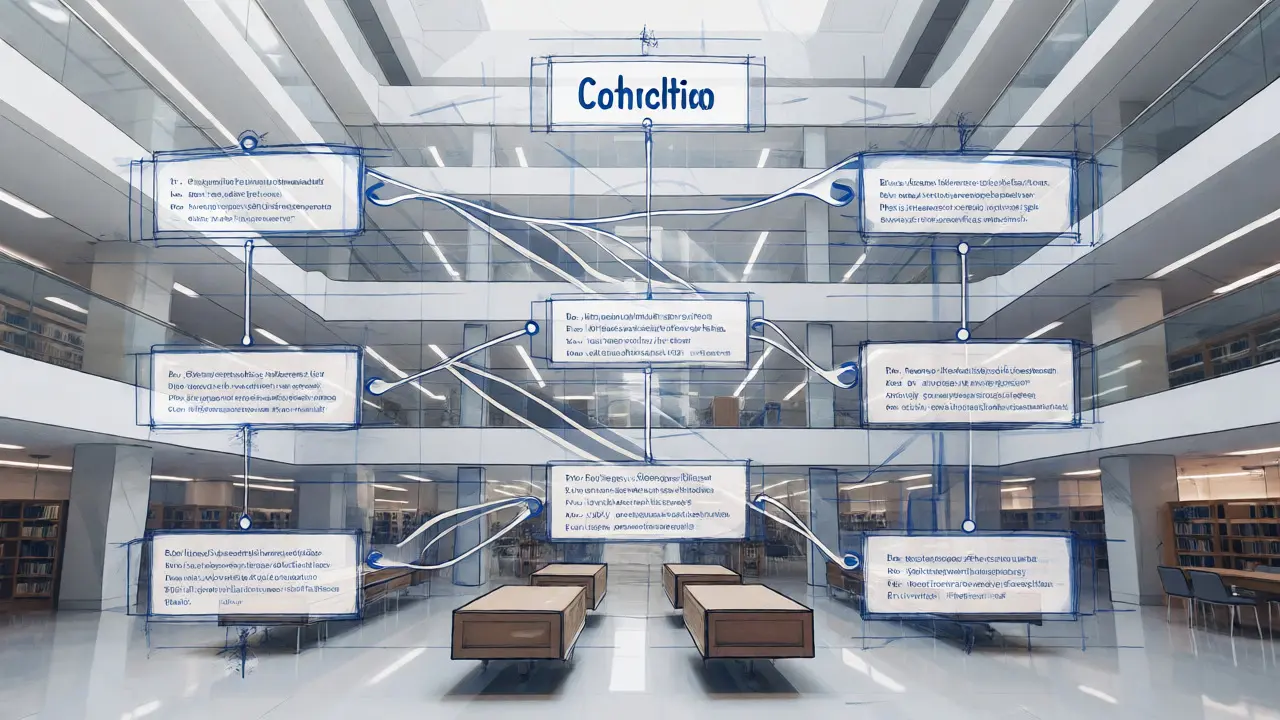
With your clusters grouped and your thesis defined, it is time to build the skeleton. Do not write full sentences yet. Use bullet points. Each bullet point represents one paragraph. A standard UK academic essay follows a logical progression: Introduction, Body Paragraphs, Conclusion. But the magic lies in the order of the body paragraphs.
There are two main structures to consider:
- The Thematic Structure: Organise by themes or concepts. Best for descriptive or analytical essays where you need to cover various aspects of a topic. Example: Theme A, Theme B, Theme C.
- The Dialectical Structure: Organise by argument flow. Present Point A, Counter-Point B, Synthesis C. Best for evaluative essays where you are weighing evidence. Example: Support for X, Evidence against X, Why X still holds true despite Y.
Write your outline in reverse order sometimes. Start with the conclusion. What do you want the reader to remember? Work backward. What evidence supports that final thought? What precedes that evidence? This ensures every paragraph serves the ultimate goal of the essay. If a paragraph doesn't help prove your thesis, cut it. Ruthlessness is a virtue here.
Refining the Flow: Signposting and Cohesion
UK markers value cohesion. They want to glide through your argument without hitting speed bumps. This requires signposting. These are transitional phrases that tell the reader where you are going. "However," "Conversely," "Furthermore," "As a result," "In contrast." But don't just sprinkle them randomly. They must reflect the logical relationship between your ideas.
Check your transitions for logic. If you use "Therefore," ensure the previous sentence actually causes the next one. If you use "Similarly," ensure the examples are truly comparable. Weak transitions reveal weak thinking. During the planning phase, draft the first sentence of each planned paragraph. Read only those sentences in sequence. Does it make sense? Does it flow? If the thread breaks, rearrange the bullets in your outline. Fixing a structural flaw now takes five minutes. Fixing it after writing 3,000 words takes hours.
Practical Checklist for Your Next Essay
Before you close your laptop and walk away from the planning phase, run through this quick audit. It prevents the panic of the night before submission.
- Question Analysis: Have I identified the command word and defined key terms?
- Thesis Clarity: Can I state my argument in one clear, arguable sentence?
- Evidence Map: Do I have at least two credible sources per major point? Are they properly cited in my notes?
- Logical Flow: Does the order of my points build toward the conclusion naturally?
- Word Count Check: Have I allocated roughly equal word counts to each section? (e.g., 10% Intro, 80% Body, 10% Conclusion).
Planning feels like extra work when you are pressed for time. But it saves you from rewriting entire sections because you realised halfway through that your argument was flawed. Treat planning as an investment. The time you spend mapping your thoughts is the time you save fighting writer's block.
How long should I spend planning an essay?
A good rule of thumb is to spend 20-30% of your total working time on planning. For a 3,000-word essay due in two weeks, if you have 15 hours to work on it, spend 3-4 hours on reading, brainstorming, and outlining. This seems like a lot, but it prevents the frantic last-minute scramble where quality drops significantly.
Do I need a thesis statement for every type of essay?
Almost always, yes. Even in reflective or descriptive essays, you need a central focus or "controlling idea." However, the nature of the thesis changes. In an argumentative essay, it is debatable. In a descriptive essay, it might be a specific lens through which you view the topic. Without a controlling idea, the essay becomes a list rather than a coherent piece of writing.
What if I change my mind while writing?
This is normal and often a sign of deeper understanding. If your initial plan no longer fits your developing argument, stop and re-outline. Don't force the old structure onto new ideas. Update your outline, adjust your thesis if necessary, and continue. Flexibility is key to high-quality academic writing.
Is mind mapping better than listing for essay planning?
It depends on your cognitive style. Visual thinkers often prefer mind maps because they show spatial relationships and connections. Linear thinkers may prefer lists or hierarchical outlines because they clearly indicate order. Try both on small assignments to see which reduces your stress and improves your clarity. Many successful students use a hybrid: mind map for brainstorming, list for outlining.
How do I handle complex questions with multiple parts?
Break the question into sub-questions. If the prompt asks you to "Analyse X and Evaluate Y," treat these as two distinct sections of your body paragraphs. Ensure your introduction explicitly states that you will address both components. Your conclusion must synthesise the findings from both parts, showing how they relate to each other, rather than just summarising them separately.