
Choosing a university degree in the UK doesn’t mean you’re stuck with just one subject. Many students are now picking double degrees and joint honours programs to mix their passions - like pairing Psychology with Philosophy, or Computer Science with Economics. These options give you more control over your education and open doors you might not have even known existed.
What’s the Difference Between Double Degrees and Joint Honours?
At first glance, they sound the same. But there’s a real difference in how UK universities structure them.
A double degree means you’re studying two separate degrees at the same time - often from two different departments or even two universities. You’ll earn two distinct qualifications, like a BA in History and a BSc in Mathematics. These programs usually take longer - often four to five years - because you’re covering full course loads for both subjects.
A joint honours degree, on the other hand, combines two subjects into one single degree. You still study both subjects in depth, but you graduate with one certificate that says, for example, “BA (Hons) in English and History.” Most joint honours programs are three years long (or four with a placement year), just like a standard degree.
Think of it this way: double degrees are like running two separate marathons back-to-back. Joint honours is like a relay race where you and another subject share the same track.
Why Do Students Choose These Paths?
It’s not just about having two interests. Students pick these routes because they want more flexibility in their future.
Take someone studying Law and Politics. They’re not just learning how court systems work - they’re also learning how policies are made. That combination makes them stronger candidates for roles in government, NGOs, or international organizations. Or consider a student doing Physics and Philosophy. They’re not just solving equations; they’re asking deep questions about reality, time, and ethics - a mix that’s rare but powerful in tech ethics, AI research, or science communication.
Employers notice this. A 2024 survey by the Higher Education Policy Institute found that 68% of UK employers said they valued graduates with joint degrees more than those with single subjects, especially in fields like consulting, public policy, and media.
How Do These Programs Actually Work?
It’s not as chaotic as it sounds. Universities plan these programs carefully.
In a typical joint honours program, you might split your time 50/50 between subjects. In Year 1, you take introductory modules from both. By Year 2, you start choosing more specialized courses - maybe a module on European Union law in Politics, and another on quantum mechanics in Physics. In Year 3, you often write a final project that connects both subjects - like analyzing how AI ethics are shaped by legal frameworks.
Some programs let you shift the balance. For example, you might take 70% of your credits in Economics and 30% in Statistics. Others require equal weight. It depends on the university and the subjects.
Double degrees are more structured. You’ll often take modules from both programs side by side, sometimes with overlapping deadlines. Time management becomes critical. You might have one week where you’re writing a history essay, preparing for a chemistry lab, and studying for a law exam - all at once.

What Subjects Work Well Together?
Not every combination makes sense. Some pairings create natural synergy. Others feel forced.
Here are combinations that actually work well in UK universities:
- Computer Science + Psychology - for user experience design, behavioral AI, or mental health tech
- Economics + Mathematics - for finance, data analysis, or economic modeling
- Modern Languages + International Relations - for diplomacy, translation, or global business
- Environmental Science + Law - for climate policy, environmental regulation, or sustainability consulting
- Philosophy + Artificial Intelligence - for ethics in automation, algorithmic bias, or human-machine interaction
Some universities even let you design your own combination. The University of Edinburgh, for example, allows students to propose joint degrees if they can show a clear academic rationale.
What Are the Downsides?
It sounds great - but it’s not easy.
First, workload. You’re not just studying two subjects - you’re learning two different ways of thinking. History asks you to analyze context and narrative. Physics asks for precision and formulas. Switching between them can be mentally exhausting.
Second, fewer elective choices. In a single honours program, you might have six modules to pick from in your final year. In a joint degree, you might only have two or three per subject because space is limited.
Third, not all universities offer every combination. Some subjects are only available as joint degrees with specific partners. You can’t always pair what you want. For example, you might want to combine Drama and Engineering - but only a handful of UK universities even offer that option.
And finally, there’s the perception problem. Some employers still don’t understand joint degrees. They might assume you’re “diluting” your focus. That’s changing - but it still happens.
How to Decide If It’s Right for You
Ask yourself these questions:
- Do I genuinely enjoy both subjects, or am I just trying to impress someone?
- Am I comfortable managing heavy workloads and tight deadlines?
- Do I want a career that requires cross-disciplinary thinking - like policy design, tech ethics, or global marketing?
- Have I checked what’s actually offered? Some universities list joint degrees but only allow them in very specific pairs.
- Will I be able to get academic support? Joint degrees sometimes fall between departments - making it harder to find tutors or advisors.
If you answered yes to most of these, you’re probably a good fit.
Where to Find These Programs
Not all UK universities offer joint honours or double degrees equally.
Top schools for flexible degrees include:
- University of Edinburgh - offers over 100 joint degree combinations
- University of Birmingham - strong in social sciences + STEM pairings
- University of Manchester - known for interdisciplinary programs
- University of Warwick - excellent for combining arts and business
- University of Oxford and Cambridge - limited options, but highly respected when available (e.g., PPE - Philosophy, Politics, Economics)
Always check the course page carefully. Some programs are listed under “Combined Honours,” others under “Dual Degree.” The wording matters.
Real Student Stories
Lily, 22, studied Psychology and Linguistics at University College London. She wanted to understand how language shapes thought. Her final project looked at how AI chatbots misinterpret emotional tone in non-native speakers. She now works at a tech startup building inclusive voice assistants.
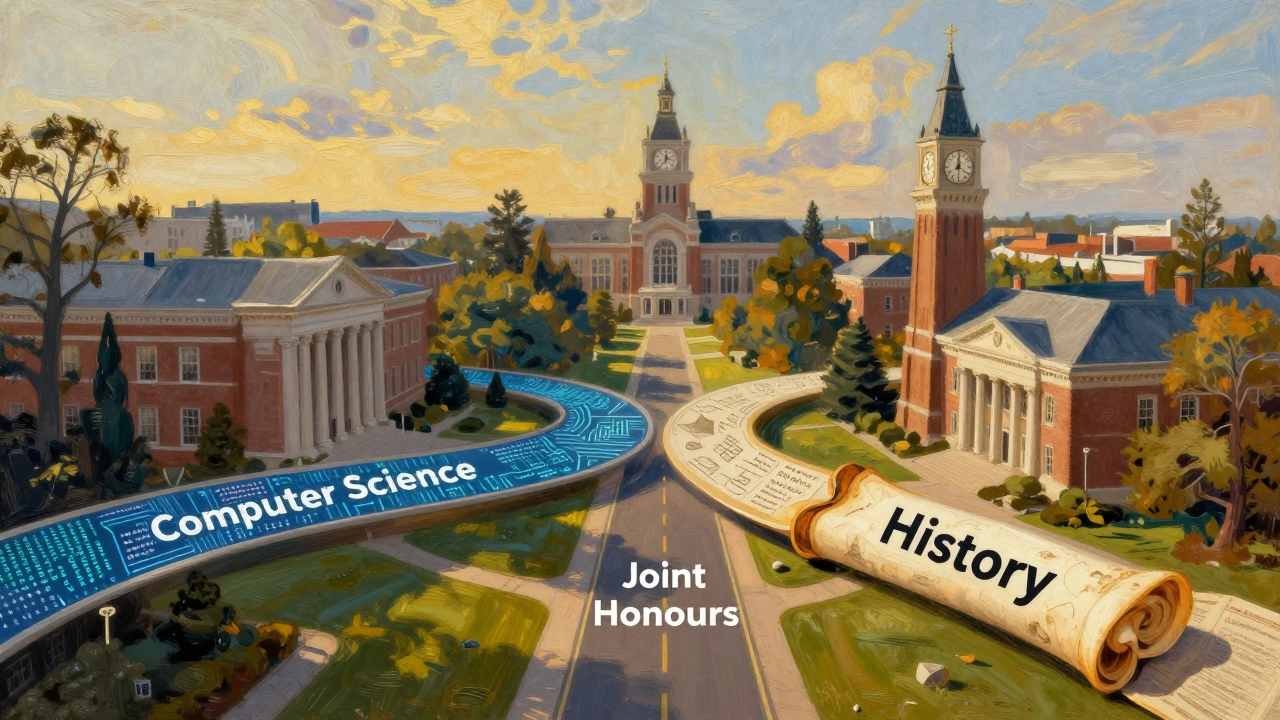
James, 23, did History and Computer Science at the University of Leeds. He built a digital archive of oral histories from WWII veterans using machine learning to tag emotional content. He’s now a data curator at the Imperial War Museum.
These aren’t outliers. They’re becoming more common.
What Comes After?
Graduates from joint degrees often go into roles that require both technical and human skills:
- Policy analysts in government
- UX researchers in tech
- Environmental consultants
- Science communicators
- Human rights advocates with data skills
- Education technology developers
Many also go on to postgraduate study - especially in interdisciplinary fields like cognitive science, digital humanities, or global governance.
One thing’s clear: the future doesn’t fit neatly into one subject box. Employers want people who can connect ideas across disciplines. If you’re ready to work hard and think broadly, a double degree or joint honours program in the UK could be one of the smartest academic choices you ever make.