
When a student with a disability starts university in the UK, they don’t just need textbooks and a dorm room-they need a system that works for them. Too many students still face delays, confusion, or outright gaps in support. The truth is, universities in the UK are legally required to make adjustments, but how those adjustments actually work on the ground? That’s where things get messy. This isn’t about sympathy. It’s about access. And access isn’t automatic-it has to be claimed, negotiated, and sometimes fought for.
What the law says-and what it doesn’t
The Equality Act 2010 is the backbone of disability rights in UK higher education. It says universities must make reasonable adjustments to prevent disabled students from being at a substantial disadvantage. That sounds simple. But what’s ‘reasonable’? It depends on the student, the course, and the institution’s resources. A student with dyslexia might get extra time on exams and screen-reading software. A student with chronic pain might need flexible attendance policies or a desk that accommodates a wheelchair. But if a student needs a personal care assistant during lectures? That’s not always covered. Universities aren’t required to pay for personal support-they only have to adjust the environment or delivery of teaching.
There’s a big gap between legal obligation and real-world practice. Some universities have dedicated disability teams that respond within days. Others take weeks-or ignore requests until the student is already failing. The law doesn’t spell out timelines. It doesn’t say what counts as ‘substantial disadvantage.’ That leaves students in limbo.
How to get support: Step by step
Getting accommodations isn’t something you wait for. You have to start before you even arrive on campus.
- Register with the university’s disability service as soon as you accept your offer. Many students wait until orientation-by then, deadlines for exam adjustments have passed.
- Submit medical evidence. This doesn’t mean a doctor’s note saying ‘they have a condition.’ It needs to explain how the condition affects learning: ‘My chronic fatigue means I can’t sit for more than 90 minutes without a break,’ or ‘My anxiety triggers panic attacks in large groups, making seminars overwhelming.’ Specifics matter.
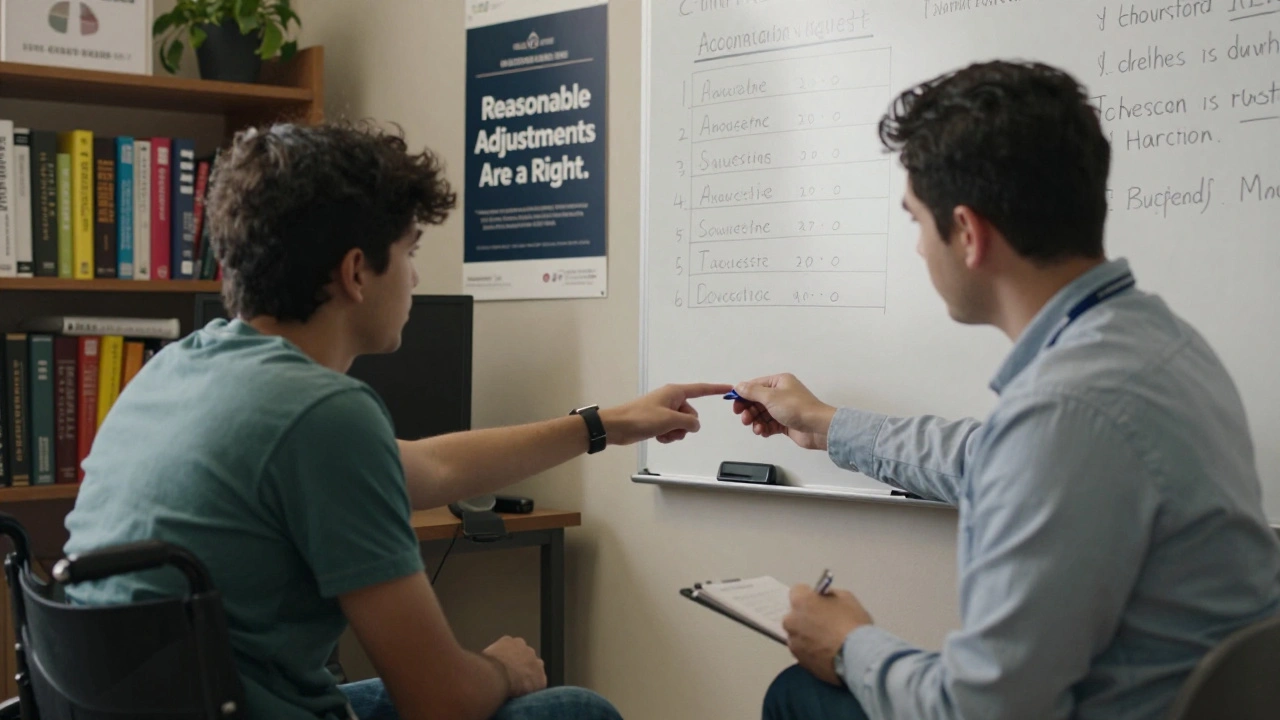
- Attend a needs assessment. This is a one-on-one meeting with a specialist. They’ll recommend adjustments. Don’t just nod along. If they suggest ‘extra time’ but you need a quiet room with a monitor, say so. They can’t guess what you need.
- Get a Student Support Plan (SSP). This is your official document. It lists approved adjustments and is shared with your department. Keep a copy. If a lecturer says ‘no’ to your exam accommodations, show them the SSP.
- Follow up every term. Needs change. A student with depression might need more flexibility after a hospital stay. A student with autism might need help navigating a new lab setup. Don’t assume your plan stays the same.
Common accommodations-and what they really mean
Here’s what most students get-and what they actually look like in practice:
- Extra exam time: Usually 25% extra, but some get 50% or more. It’s not just longer breaks-it means you can take breaks during the exam without losing time. Some students need to leave the room to manage pain or anxiety.
- Alternative formats: Lecture notes in Word instead of PDF, textbooks in audio, slides provided before class. But many lecturers still upload slides the day before the exam. That’s not accommodation-that’s negligence.
- Flexible attendance: If you have a condition that flares up unpredictably, you might be allowed to miss up to 20% of classes without penalty. But you still have to submit work on time. This isn’t a free pass-it’s a trade-off.
- Specialist equipment: Speech-to-text software, ergonomic chairs, screen readers. Universities often lend these out. But if your laptop breaks and you’re waiting for a replacement? You’re on your own. There’s no emergency kit.
- One-to-one note-takers or mentors: These are lifesavers. But they’re not always available. Some courses have 50 students with disabilities and only two note-takers. You might be waiting months.
What universities get wrong
Universities often treat disability support like a box to tick. They’ll say they have a ‘disability office’ and call it done. But that office might be understaffed, underfunded, or disconnected from academic departments.
Here’s what breaks down:
- Lecturers don’t know the rules. A professor might refuse to let a student record lectures because ‘it’s against policy.’ But the policy doesn’t exist-it’s just their preference. The law says recording is a reasonable adjustment.
- Assessments aren’t adapted. A student with dyspraxia might struggle with handwritten exams. They’re offered extra time, but still forced to write by hand. That’s not fair. A laptop should be allowed.
- Online learning ignores accessibility. A lecture video with no captions? A PDF with no alt text? That’s not an accident. It’s a failure. Universities still use outdated platforms that don’t meet WCAG standards.
- Hidden disabilities are ignored. Anxiety, autism, chronic illness-these don’t show up on a cane or a wheelchair. Students are told to ‘just try harder.’ But trying harder doesn’t fix a neurological condition.
Real stories, real barriers
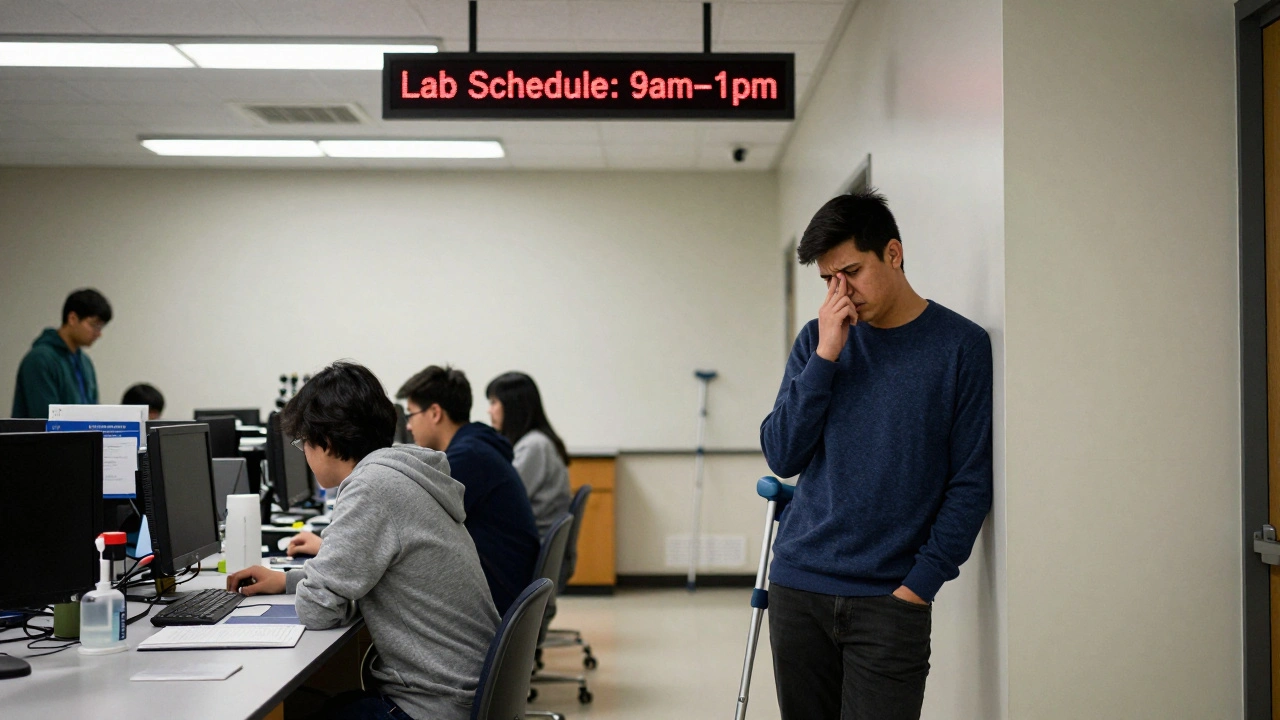
Emma, 21, has Ehlers-Danlos syndrome. She can’t sit for long. Her university approved a flexible attendance policy. But her biology lab runs for 4 hours every week. She asked to split the session into two 2-hour blocks. The department said no-‘the schedule doesn’t allow it.’ She dropped the course.
James, 19, has autism. He needed a quiet room for exams. The university offered a room with a window facing a busy hallway. He asked for a room with no windows. They said, ‘We don’t have one.’ He failed his first exam. He appealed. They gave him a room with a blindfolded window. He passed the retake.
These aren’t outliers. They’re common. And they’re avoidable.
What you can do if support fails
If your university won’t give you what you need:
- File a formal complaint using the university’s internal process. Don’t wait. Deadlines matter.
- Get help from the Students’ Union. They have trained disability officers who can push back on behalf of students.
- Contact the Office for Students (OfS). They oversee universities and can investigate systemic failures.
- If you’re denied reasonable adjustments, you can take legal action under the Equality Act. It’s not easy, but it’s possible. Many students have won cases.
Don’t be afraid to escalate. Universities respond to pressure. And you’re not asking for special treatment-you’re asking for the same chance everyone else has.
What’s changing in 2026
There’s progress, even if it’s slow. In 2025, the UK government launched the Higher Education Accessibility Framework, which requires universities to publish annual reports on disability support. They must now track how many students request accommodations, how long it takes to approve them, and how many complaints are filed.
Some universities are hiring disability liaisons who work directly with departments-not just the disability office. Others are using AI tools to auto-caption lectures or convert PDFs to accessible formats.
But tools don’t fix culture. The real change comes when lecturers stop seeing accommodations as ‘extra work’ and start seeing them as part of teaching.
Final thought: You’re not asking for a favor
Disability support isn’t charity. It’s the law. It’s equity. It’s the difference between dropping out and graduating.
If you’re a disabled student in the UK, you have rights. You have tools. You have people who can help. But you have to speak up. And you have to keep speaking up-even when it’s exhausting.
The system isn’t perfect. But it’s better than it was five years ago. And it will keep getting better-if enough students refuse to stay silent.
What counts as a disability under UK university policy?
Under the Equality Act 2010, a disability is a physical or mental impairment that has a substantial and long-term adverse effect on daily activities. This includes visible conditions like mobility impairments, but also invisible ones like chronic pain, dyslexia, autism, anxiety, depression, epilepsy, and long-term fatigue. The condition must last or be expected to last at least 12 months. You don’t need a formal diagnosis to request support-but medical evidence helps speed up the process.
Can I get financial help for disability-related costs?
Yes. The Disabled Students’ Allowances (DSAs) are non-repayable grants for extra study costs caused by your disability. This can cover specialist equipment like speech software, non-medical helpers like note-takers or mentors, travel costs if you can’t use public transport, and other disability-related expenses. You apply through Student Finance England, Wales, Scotland, or Northern Ireland-depending on where you live. DSAs are separate from tuition fees and maintenance loans.
Do I have to tell my university about my disability?
No, you’re not legally required to disclose. But if you don’t, you won’t get accommodations. You can’t claim adjustments you haven’t requested. Many students wait until they’re struggling to disclose-and by then, they’ve already fallen behind. The sooner you register, the more support you’ll have when you need it.
What if my lecturer refuses to follow my accommodations?
First, show them your official Student Support Plan (SSP). If they still refuse, contact your university’s disability office immediately. They can intervene. If that doesn’t work, escalate to your department head or the Students’ Union. If the issue continues, you can file a formal complaint or contact the Office for Students. Refusing reasonable adjustments is a breach of the Equality Act.
Are accommodations the same for postgraduate students?
Yes. Postgraduate students have the same legal rights as undergraduates. You can still apply for DSAs, request exam adjustments, and get note-takers or flexible deadlines. However, some courses-especially research-based ones-may require different types of support, like extended deadlines for thesis submissions or access to adaptive lab equipment. Make sure your needs are clearly documented and discussed with your supervisor and disability team.