
Imagine sitting down to study for your final exams, but after ten minutes, you’re scrolling through TikTok, checking Instagram, then wondering why your coffee’s gone cold. Sound familiar? You’re not lazy. You’re just fighting a system designed to pull your attention apart. For UK students juggling lectures, deadlines, part-time jobs, and social pressure, deep work isn’t a luxury-it’s the only way to get real results without burning out.
What Deep Work Actually Means (And Why It’s Not Just ‘Studying Harder’)
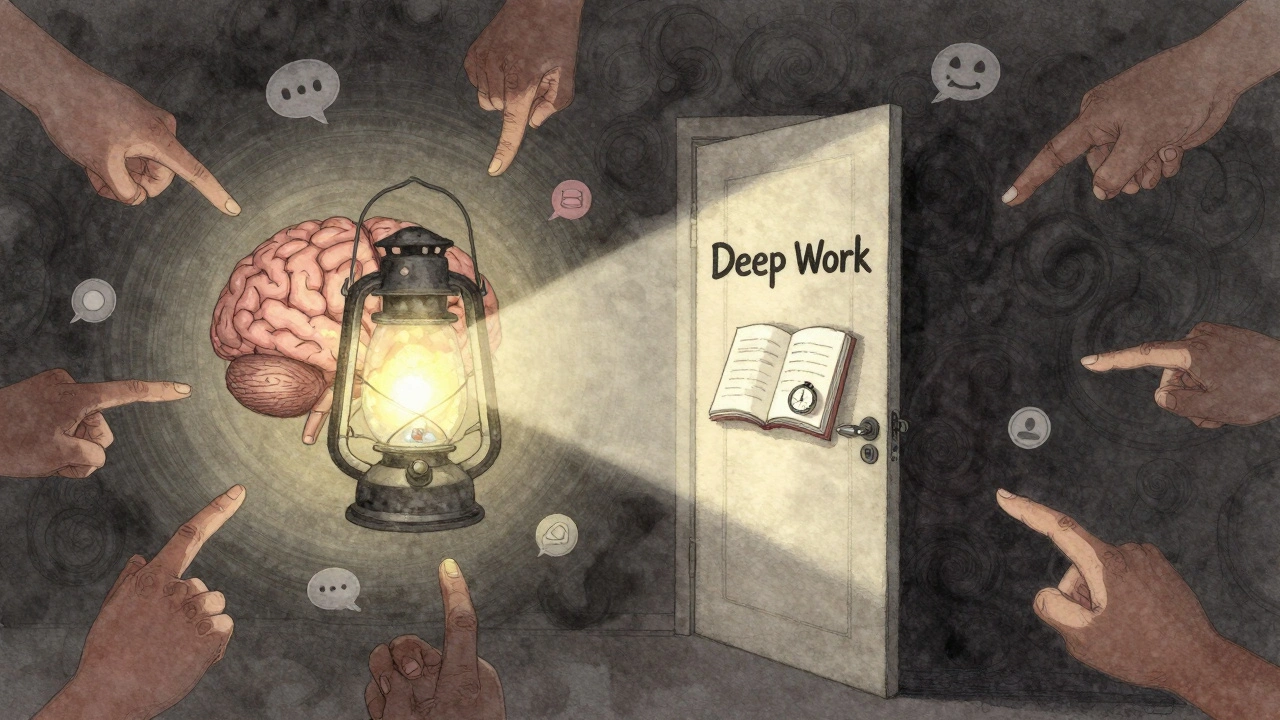
Deep work, a term coined by Cal Newport, isn’t about putting in more hours. It’s about putting your full brainpower into one thing, without interruption, for long stretches. Think of it like this: when you’re writing an essay while texting friends, watching YouTube, and checking emails, your brain is constantly switching lanes. Each switch drains mental energy. Studies from the University of California, Irvine show it takes an average of 23 minutes to fully regain focus after a single distraction.
Deep work means locking your phone in another room, closing every tab except your notes, and staying with one task for 90 minutes or more. It’s not about being perfect-it’s about being present. And for students in the UK, where university deadlines are tight and grading is rigorous, this isn’t optional. It’s survival.
The Real Enemy: Your Phone and the Illusion of Busy
Most students think they’re busy because they’re constantly active. But activity isn’t progress. Scrolling through revision TikToks feels like studying. Opening five tabs for ‘research’ feels productive. But neither builds real understanding.
Your phone isn’t just a distraction-it’s a dopamine machine. Every notification triggers a tiny reward in your brain. Over time, your brain starts preferring these quick hits over the slow, hard work of reading a textbook or writing an essay. The result? You feel tired, unfocused, and guilty-even if you’ve been ‘working’ all day.
Here’s what works better: turn off all non-essential notifications. Use a basic phone (or an old one) during study blocks. Or better yet, use apps like Forest or Focus To-Do that lock your phone for set periods. If you’re studying in your dorm, keep your phone in another room. No exceptions. If you need to use your laptop, close everything except the document you’re working on. Use browser extensions like StayFocusd to block social media during work hours.
How to Build Deep Work Into Your Week (Without Going Crazy)
You don’t need to study 12 hours a day to be productive. You need to study 90 minutes at a time, with total focus, three times a week. That’s it.
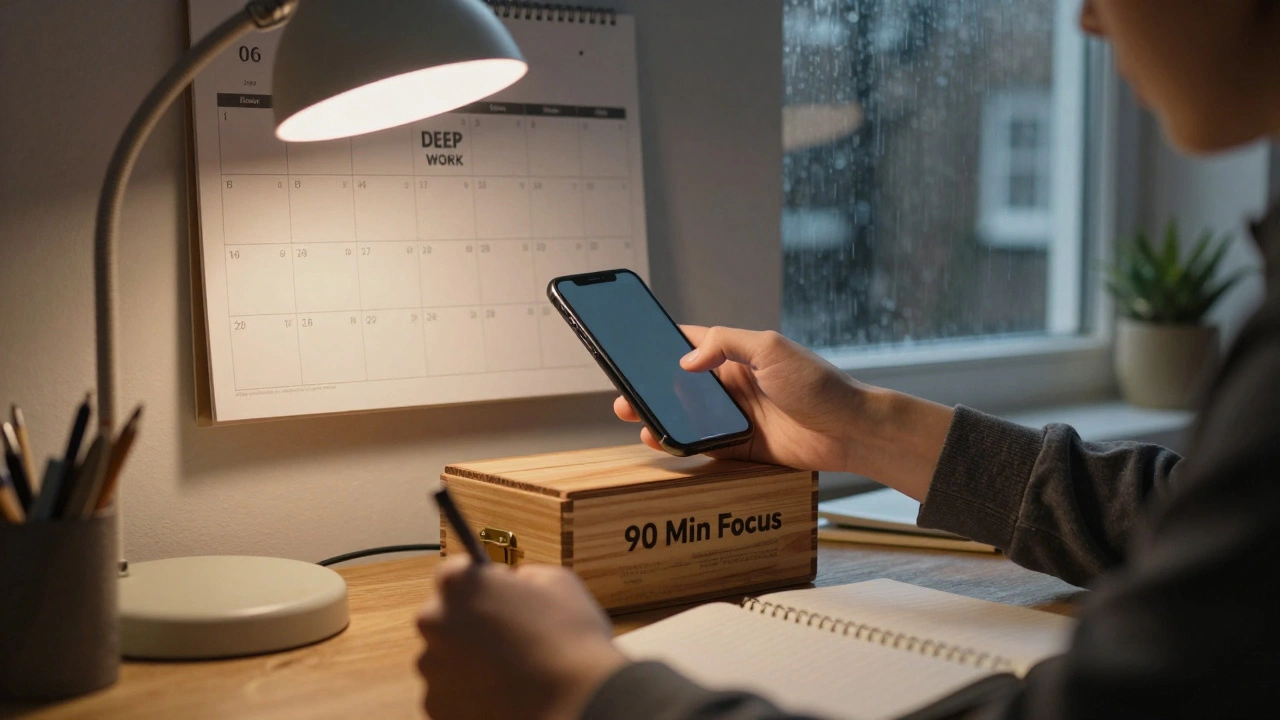
Start by mapping out your week. Find three 90-minute windows where you’re least likely to be interrupted-early morning before class, right after lunch, or late evening if you’re a night owl. Block these out like appointments. Tell your flatmates. Put it in your calendar. Treat it like a lecture you can’t miss.
During each block:
- Write down exactly what you’ll do: ‘Read Chapter 5 of Economics textbook and summarize key arguments’
- Set a timer for 90 minutes
- Put your phone in another room
- Close all browser tabs except your notes
- Start. Don’t stop until the timer goes off
After 90 minutes, take a 15-minute break. Walk outside. Stretch. Don’t check your phone. Then repeat if you’re still energized. Most students find two deep work blocks a day is enough. Three is excellent. More than that? You’re just fatiguing yourself.
Why Your Environment Matters More Than Willpower
Willpower is a myth. You don’t need more discipline-you need a better setup.
Study in the same place every time. If you study at your desk, your brain learns: desk = focus. If you study on your bed, your brain learns: bed = sleep. Don’t mix them. Libraries, quiet study rooms, or even a corner of the campus café with no Wi-Fi can become your deep work zones.
Lighting matters too. Natural light boosts alertness. If you’re studying in a dim room, turn on a bright lamp. Keep your desk clean. A cluttered space = a cluttered mind. One notebook, one pen, one open document. That’s all you need.
And here’s a secret: noise isn’t always bad. Some students work better with background noise-white noise, rain sounds, or lo-fi beats. Use apps like Noisli or Brain.fm. But avoid music with lyrics. Your brain will try to process the words, stealing focus from your work.
The 5-Minute Rule for When You Just Can’t Start
Sometimes, you sit down and your brain just refuses. You stare at the screen. Nothing happens. That’s not laziness. That’s anxiety.
Use the 5-minute rule: tell yourself you’ll work for just five minutes. No pressure. No goal. Just start. Open the document. Read one paragraph. Write one sentence. Often, that’s all it takes. Once you begin, momentum kicks in. Your brain stops resisting.
If after five minutes you still feel stuck, take a 10-minute walk. Drink water. Breathe. Come back. Don’t force it. Deep work isn’t about punishment-it’s about creating the right conditions for your brain to thrive.
What to Do When You’re Overwhelmed (And It’s Not Just ‘Study More’)
UK students are under more pressure than ever. Tuition fees, cost of living, mental health services stretched thin. It’s normal to feel overwhelmed. But pushing harder won’t fix it.
When you’re drowning:
- Write down every task on your plate-big and small
- Circle the one thing that will make the biggest difference if done
- Do only that one thing in your next deep work block
That’s it. You don’t need to do everything. You just need to do the right thing. Focus on quality over quantity. One well-written essay beats three rushed ones. One hour of deep reading beats three hours of skimming.
And if you’re feeling burned out? Take a full day off. No guilt. No studying. Walk in the park. Call a friend. Sleep. Your brain needs recovery to perform. Deep work only works if you rest.
Real Students, Real Results
Emma, a second-year History student at Manchester, used to pull all-nighters before exams. She’d get 6 hours of sleep, drink three coffees, and panic-write essays. Her grades hovered at a 2:2.
Last term, she started doing two 90-minute deep work blocks a day. She turned off her phone. She studied in the library. She wrote one essay per week with full focus. She didn’t study on weekends. By exam season, she was getting firsts. Not because she studied more-but because she studied better.
James, a biomedical science student in London, used to check his phone every 10 minutes. He’d spend hours ‘studying’ but couldn’t remember what he’d read. He started using Forest app during study sessions. He blocked social media. He began writing summaries after each reading session. His exam scores jumped 27% in one term.
You don’t need a perfect schedule. You don’t need to be a genius. You just need to protect your focus like it’s your most valuable resource-because it is.
Final Thought: Focus Is a Skill, Not a Trait
You weren’t born distracted. You were trained to be. Every app, every notification, every algorithm is designed to steal your attention. But you can unlearn it.
Deep work is a muscle. The more you use it, the stronger it gets. Start small. One 90-minute block this week. One day without phone checks. One quiet space where you just think and write.
The world will keep shouting. But you? You can choose to listen to your own mind.
Can I do deep work if I live in a noisy dorm?
Yes. Use noise-canceling headphones with white noise or ambient sounds. Find quiet corners in the library, campus study rooms, or even a parked car during lunch. The key isn’t silence-it’s control. If you can block out interruptions, you can focus. Many students use public libraries or university silent study zones, which are free and designed for this exact purpose.
How long does it take to get good at deep work?
Most people notice a difference within 7-10 days of consistent practice. The first week is the hardest-your brain resists the lack of stimulation. By day 10, you’ll start craving those focused blocks. After 3-4 weeks, deep work becomes automatic. It’s not about天赋-it’s about repetition.
Should I use apps to track my study time?
Only if they help you stay focused, not just track time. Apps like Forest, Focus To-Do, or TomatoTimer work because they enforce boundaries. Don’t use apps that just log hours-those can become another distraction. The goal isn’t to see how long you sat at your desk. It’s to see how much you actually learned in that time.
Is deep work only for exams?
No. Deep work helps with essays, research projects, lab reports, presentations, and even learning new skills like coding or languages. Any task that requires thinking, understanding, or creating benefits from deep focus. It’s not just for exams-it’s for becoming a better thinker overall.
What if I have group projects or team meetings?
Schedule those meetings in blocks of 30-60 minutes, and treat them like appointments. Do your deep work before or after. Don’t let group work eat into your focus time. If your team is constantly messaging, set boundaries: ‘I reply to messages after 6 PM.’ Protect your focus like your grade depends on it-because it does.