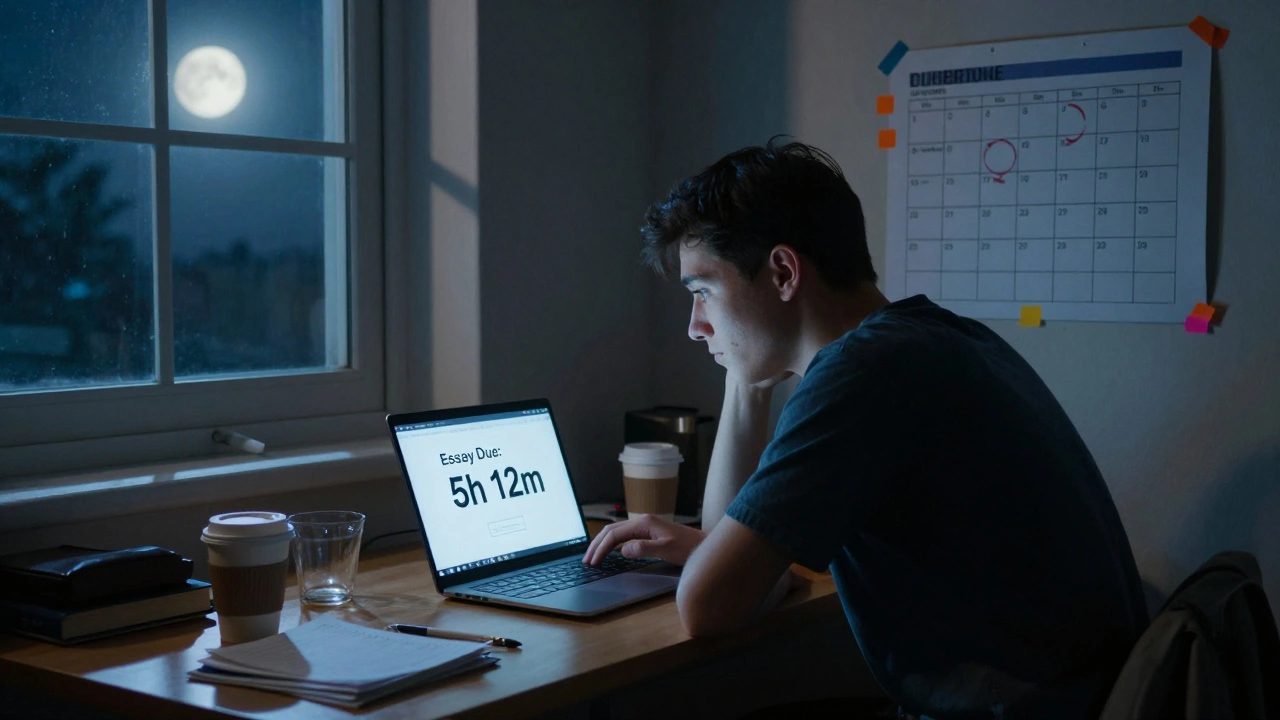
It’s 2 a.m. You’ve been staring at the same paragraph for an hour. Your coffee’s cold. Your phone buzzes with a reminder: essay due in 5 hours. Your chest tightens. Your stomach churns. You know you should’ve started earlier-but you didn’t. And now, the weight of it all is crushing you.
This isn’t just a bad night. It’s a pattern. For UK students, especially those in universities and sixth forms, deadline anxiety isn’t rare-it’s routine. A 2024 study by the UK Student Wellbeing Consortium found that 78% of undergraduates reported severe stress in the two weeks before major deadlines. And it’s not just about grades. It’s about feeling trapped, overwhelmed, and like one missed deadline could unravel everything.
Why Deadlines Feel Like Time Bombs
It’s not that UK students are lazy. It’s that the system sets them up to fail. Most courses pack multiple high-stakes deadlines into tight windows: essays, presentations, lab reports, group projects-all due within days of each other. Add in part-time work, family obligations, and the pressure to maintain a certain GPA, and it’s no wonder stress spikes.
Psychologists call this the deadline paradox: the more time you have, the more you delay. Your brain thinks, “I’ve got weeks,” so it pushes the task into the background. Then, suddenly, the clock starts ticking, and your amygdala-the part of your brain that handles fear-takes over. Your body floods with cortisol. Your focus shatters. You freeze.
And it’s not just you. Everyone around you seems calm. They’re posting about their “productive mornings” on Instagram. But you don’t see their 3 a.m. panic sessions. You don’t hear their whispered cries to roommates: “I can’t do this.”
How to Break the Cycle: 5 Practical Steps
Managing deadline anxiety isn’t about working harder. It’s about working smarter. Here’s what actually works, based on feedback from over 200 UK students who turned their stress around.
- Break the task into 25-minute chunks - Not “write the essay.” Not “study for the exam.” Just “read three journal articles.” Or “outline the first section.” Use the Pomodoro Technique: 25 minutes focused work, 5 minutes to walk, stretch, or breathe. After four cycles, take 20 minutes off. Your brain needs recovery, not punishment.
- Use a physical deadline calendar - Digital calendars are easy to ignore. Grab a wall planner. Write every deadline in pen. Circle the big ones. Add a small sticker for each day you make progress. Seeing progress visually reduces the feeling of being buried. Students who did this saw a 40% drop in late submissions over one term.
- Start with the worst part first - The hardest part of any assignment isn’t the writing. It’s starting. So open the document. Type the title. Write one sentence-even if it’s terrible. That’s it. You’ve broken the inertia. The rest gets easier. This is called the “5-second rule”: count backward from five, then move. No thinking. Just action.
- Talk to someone before you spiral - Don’t wait until you’re crying in the library. Tell a friend, a tutor, or a student support officer: “I’m struggling with this deadline.” Most universities in the UK offer free, confidential academic coaching. They’ve heard it a thousand times. They won’t judge you. They’ll help you make a plan.
- Set a hard stop - You don’t need perfection. You need submission. Decide in advance: “I’ll work until 11 p.m. tonight, then I’m done.” Sleep matters more than one more paragraph. A tired brain makes mistakes. A rested brain can edit. And editing is where the real improvement happens.
What Doesn’t Work (And Why You’re Still Stuck)
You’ve probably tried the usual fixes: making to-do lists, setting reminders, downloading focus apps. But if you’re still panicking, it’s because these tools don’t fix the root problem: emotional avoidance.
Procrastination isn’t laziness. It’s fear. Fear of failure. Fear of not being good enough. Fear that your work won’t matter. When you avoid starting, you’re not avoiding work-you’re avoiding the feeling of inadequacy.
So if you’re still stuck, ask yourself: “What am I afraid will happen if I submit this?” Write it down. Then ask: “Is that likely? What’s the worst that could happen?” More often than not, the fear is bigger than the reality.
And if you’re thinking, “I need more motivation,” you’re wrong. Motivation doesn’t come before action-it comes after. You don’t wait to feel ready. You act, and the feeling follows.

The Real Cost of Waiting
Every time you delay, you’re not just losing time. You’re losing confidence. You’re reinforcing the belief that you can’t handle pressure. That belief becomes a self-fulfilling prophecy.
One student at the University of Manchester told me: “I missed three deadlines last year. I thought I was just bad at time management. Turns out, I was terrified of being criticized. When I started talking to my tutor, I realized she didn’t expect perfection-she just wanted to see effort.”
That’s the truth most students never hear: professors aren’t out to trap you. They want you to succeed. But they can’t help if you don’t ask.
What to Do When You’re Already Behind
It’s 10 p.m. The deadline is 8 a.m. You’ve written 300 words. Panic is setting in. Here’s what to do now:
- Stop scrolling. Stop checking emails. Stop rereading the same paragraph.
- Write a bare-bones structure: Introduction, 3 points, Conclusion. Just bullet points.
- Fill in each bullet with one clear sentence. Don’t worry about flow.
- Use AI tools (like Grammarly or Hemingway) to clean up grammar-don’t use them to write for you.
- Submit something. Anything. A 60% submission is better than a 0%.
Universities in the UK have late submission policies. Most allow a grace period. Some even let you request an extension if you’ve documented stress or health issues. But you have to ask. Don’t assume they’ll notice you’re struggling.

Long-Term Fixes: Building Resilience
One-off fixes won’t save you next term. You need systems.
Start with weekly planning every Sunday. Block out 30 minutes. Look at your syllabus. Mark every deadline. Then schedule 2-3 small work sessions each week-30 minutes each. Treat them like appointments. Cancel them only if you’re in the hospital.
Build a “stress reset” routine: 10 minutes of walking outside, 5 minutes of deep breathing, or listening to one song that calms you. Do it before you start working. It signals to your brain: “It’s time to focus, not panic.”
And remember: your worth isn’t tied to your grades. One bad week doesn’t define your future. But how you handle it? That does.
Where to Get Help in the UK
You’re not alone. And help is available:
- Student Minds - A UK-wide charity offering free mental health resources for students. Their “Deadline Survival Guide” is downloadable and practical.
- University Wellbeing Services - All UK universities have them. No appointment needed for drop-in sessions. Just walk in.
- Academic Skills Centres - These aren’t just for writing help. They teach time management, exam prep, and stress reduction.
- The Student Room forum - Thousands of students share real stories. Read threads like “How I got through finals with zero sleep.” You’ll find comfort in knowing others are in the same boat.
There’s no shame in asking. The strongest students aren’t the ones who never struggle-they’re the ones who know when to reach out.
Final Thought: You’re Not Falling Behind
Deadline anxiety doesn’t mean you’re failing. It means you care. That’s a good thing. It means you want to do well. You’re not broken. You’re just human.
Every great writer, scientist, and leader has stared at a blank page, heart pounding, wondering if they could pull it off. The difference? They didn’t wait for the perfect moment. They started anyway.
Your next deadline isn’t your enemy. It’s your chance to prove to yourself that you can show up-even when you’re scared. And that’s the real mark of success.
Why do I feel worse when I have more time to complete a task?
This is called the planning fallacy. Your brain thinks more time means less pressure, so it delays action. But without structure, extra time leads to overwhelm. The solution isn’t less time-it’s breaking the task into small, daily steps so progress feels real, not abstract.
Is it normal to cry before submitting an assignment?
Yes. Many students do. It’s a sign of high personal standards and emotional investment-not weakness. If this happens often, it’s a signal to adjust your workload or seek support. You don’t have to suffer in silence.
Can I get an extension if I’m stressed?
Yes. Most UK universities allow extensions for documented stress, anxiety, or health issues. You usually need to fill out a form and may need a note from a GP or counsellor. Don’t wait until the last minute to ask-reach out as soon as you feel overwhelmed.
What’s the best way to avoid burnout during exam season?
Sleep, movement, and boundaries. Study for 90 minutes, then take 30 minutes off. Walk outside. Eat real food. Don’t skip meals. Avoid caffeine after 3 p.m. And say no to extra commitments. Your body needs recovery to function. Burnout isn’t a badge of honor-it’s a warning sign.
Should I use AI tools to help me write essays?
Use them to edit, not to write. Tools like Grammarly or Hemingway can fix grammar and clarity. But if you let AI write your ideas, you miss the chance to learn. Your university will detect AI-generated text. Focus on your own thinking-use tech to polish, not replace.
How do I know if my stress is becoming a mental health issue?
If you’re having trouble sleeping, eating, or leaving your room for days; if you feel hopeless or have thoughts of self-harm-this is beyond normal stress. Contact your GP or university counselling service immediately. You don’t need to wait until it’s "bad enough." Early help makes recovery faster.
If you’re reading this and you’re still working on a deadline right now-stop. Take a breath. Drink some water. You’ve got this. One step at a time.