When applying for jobs in the UK, you’ll quickly notice that employers don’t just want a resume-they want a CV. But what’s the real difference? And why does it matter so much? If you’ve ever sent a one-page resume to a UK employer and got no reply, you’re not alone. The confusion between CV and resume isn’t just a language mix-up. It’s a cultural and structural gap that can cost you the job before you even get an interview.
What’s the difference between a CV and a resume in the UK?
In the United States, a resume is the standard job document. It’s usually one or two pages, focused on your most recent roles, key achievements, and skills tailored to the job. But in the UK, the term "resume" is rarely used. Instead, everyone uses "CV," which stands for curriculum vitae a Latin term meaning "course of life," used to describe a detailed document of a person’s education, work history, skills, and accomplishments.
Here’s the catch: what Americans call a resume, the UK calls a CV. But here’s the twist-UK CVs are longer, more detailed, and follow different rules than what most international applicants expect. A UK CV typically runs 2 to 3 pages, sometimes even 4 for senior professionals. It’s not just a summary-it’s a full career record.
Think of it this way: a US resume is like a highlight reel. A UK CV is the full movie-with extra scenes.
What do UK employers expect in a CV?
UK employers don’t just skim your CV. They scan it for specific signals. Here’s what they’re looking for:
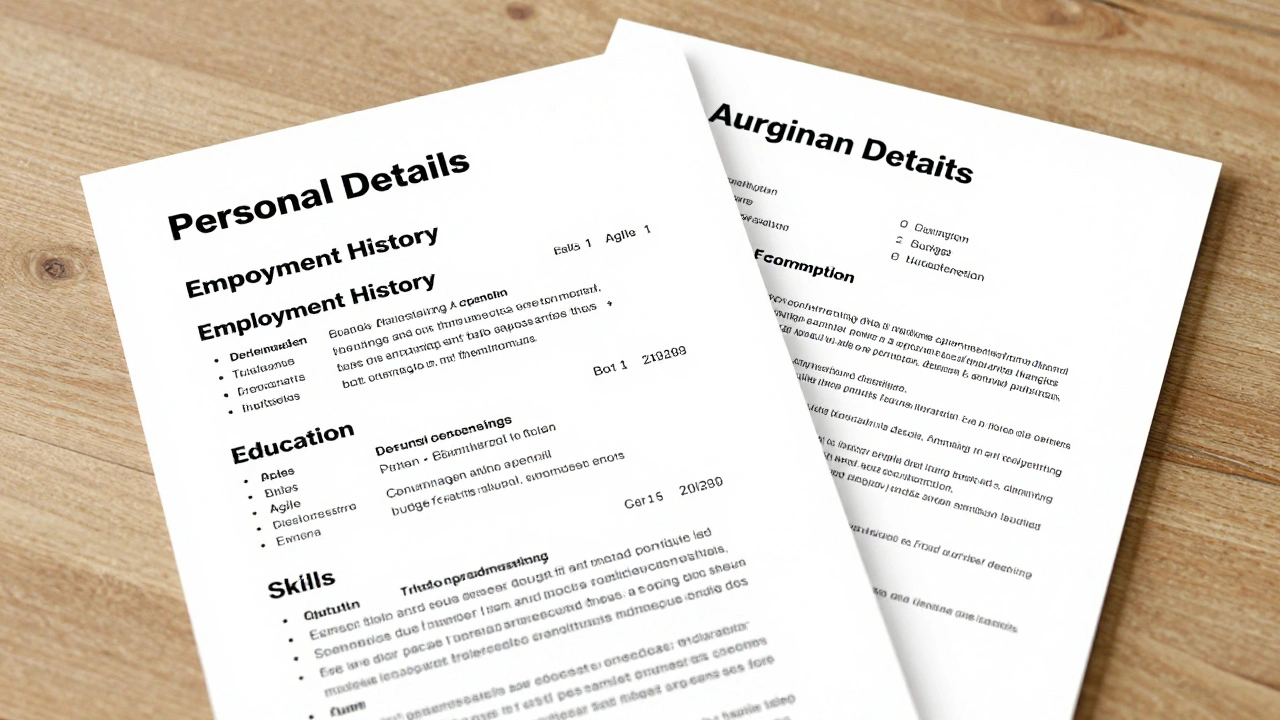
- Clear structure-no fancy templates, no graphics, no photos. Stick to clean headings: Personal Details, Personal Profile, Employment History, Education, Skills, and References.
- Reverse chronological order-your most recent job comes first, then the one before that, all the way back. No creative timelines.
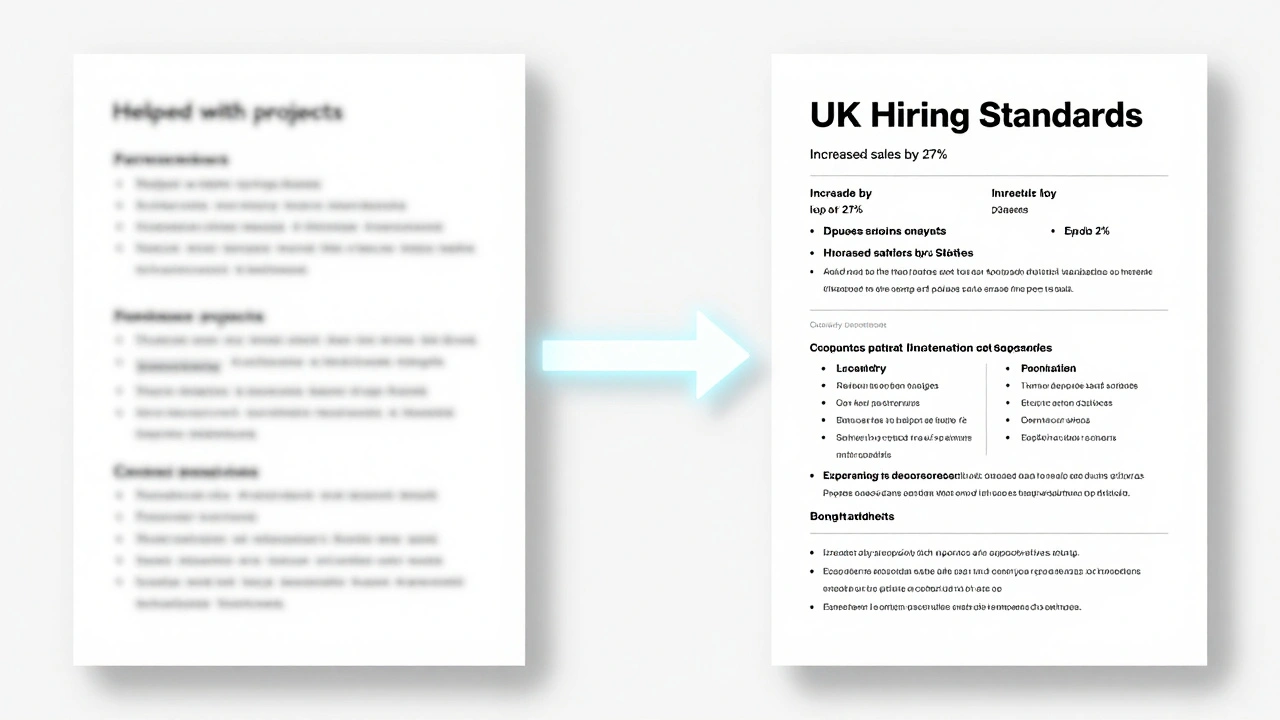
- Specific achievements-not just duties. Instead of "Managed a team," write "Led a team of 8, increasing sales by 27% in 6 months."
- No personal information-you don’t include your age, marital status, religion, or photo. UK law bans hiring decisions based on these factors, and including them can hurt your chances.
- References available on request-you don’t list referees on the CV. Just write "References available on request."
One recruiter in London told me they spend an average of 6 seconds on each CV before deciding whether to keep it. That’s not enough time to read between the lines. Your CV must be instantly scannable.
Why UK CVs are longer than US resumes
There’s a myth that longer means worse. In the UK, longer means thorough. Employers expect you to show progression, consistency, and depth. A 1-page CV looks incomplete. A 3-page CV looks professional.
For entry-level roles, 2 pages is ideal. For mid-career professionals, 2.5 to 3 pages is normal. Senior executives or academics might go up to 4 pages-especially if they’ve published papers, led projects, or held board positions.
Compare this to the US, where a 3-page resume often gets tossed. In the UK, it’s expected. The reason? UK hiring processes are slower. Companies often hire through agencies, use automated screening systems, and rely on detailed CVs to shortlist candidates. A shallow CV won’t make it past the first filter.

What to include in each section of a UK CV
Structure matters more than style. Here’s the standard UK CV format, section by section:
Personal Details
Just your full name, phone number, professional email, and location (city is enough). No home address needed. No date of birth. No nationality unless the job requires it (like visa sponsorship roles).
Personal Profile (or Personal Statement)
This is your elevator pitch-3 to 5 lines max. Don’t write "hardworking team player." That’s filler. Instead, say: "Experienced marketing manager with 8 years in B2B SaaS, specializing in lead generation and CRM optimization. Proven track record of increasing pipeline growth by over 40% across 3 companies. Seeking to bring data-driven strategy to a scaling tech firm."
Employment History
List jobs in reverse order. For each, include:
- Job title
- Company name and location
- Dates (month/year to month/year)
- 3-5 bullet points focusing on results, not tasks
Example:
- Senior Project Manager, TechNova Solutions, London - Jan 2021 - Present
- Delivered 12+ client projects on time and under budget, improving client retention by 35%
- Reduced operational costs by £180K annually through process automation
- Managed cross-functional team of 15 engineers and designers
Education
List degrees in reverse order. Include institution, qualification, grade (if 2:1 or above), and year. For example:
- MSc in Business Administration, University of Manchester - 2019 - Distinction
- BSc in Economics, University of Edinburgh - 2016 - First Class Honours
If you’re early in your career, put education before work experience. If you’ve been working for over 5 years, put work first.
Skills
Don’t just list "Microsoft Office." Be specific:
- Advanced Excel (PivotTables, VLOOKUP, Power Query)
- CRM: Salesforce, HubSpot
- Project Management: Jira, Trello, Asana
- Language: Fluent in Spanish (C1 level)
Skills are your safety net. If your work history is thin, this section can carry you.
References
Just write: "References available on request." No names. No emails. No phone numbers. Employers will ask later.
Common mistakes UK job seekers make
Even people who know the basics mess up. Here are the top 5 errors:
- Using a US-style one-page resume-It looks underdeveloped. UK employers assume you’re hiding something.
- Including a photo-It’s not illegal, but it raises red flags. You’re inviting bias.
- Writing vague bullet points-"Helped with projects" won’t cut it. Use numbers. Use verbs. Use outcomes.
- Using fancy fonts or colors-Stick to Arial, Calibri, or Times New Roman. Black text. White background. No gradients.
- Forgetting to tailor it-A generic CV gets ignored. Match keywords from the job description. If they want "Agile experience," say "Agile Scrum Master"-not just "team leader."
How to make your CV stand out in the UK
Here’s what actually works:
- Use keywords-UK applicant tracking systems (ATS) scan for job-specific terms. If the job says "budget forecasting," use that exact phrase.
- Quantify everything-"Improved efficiency" → "Reduced processing time by 42% in Q3 2024."
- Proofread like your job depends on it-A single typo can get you rejected. Ask a native speaker to check it.
- Save as PDF-Always. Never send a Word doc. Formatting breaks on different systems.
- Include a cover letter-It’s not optional. The CV gets you in the door. The cover letter gets you the interview.
When to use a CV vs. a resume in the UK
If you’re applying for a job in the UK-whether you’re local or from abroad-always use a UK-style CV. Even if you’re applying to a multinational company based in London. Even if their website says "resume." They mean CV.
There’s one exception: academic or research roles. In those cases, you might need a longer CV (5+ pages) that includes publications, grants, conferences, and teaching experience. But even then, it’s still called a CV.
Bottom line: If you’re in the UK job market, your resume is your CV. And your CV needs to be detailed, structured, and results-driven.
Final checklist: Your UK CV ready?
Before you hit send, run through this:
- Is it 2-3 pages long?
- Does it have clear section headings?
- Are all dates in month/year format?
- Do bullet points show results, not duties?
- Is there no photo, age, or personal details?
- Did you use keywords from the job description?
- Is it saved as a PDF with a professional filename (e.g., "JohnSmith_CV_Marketing.pdf")?
If you answered yes to all, you’re ready. Most applicants don’t make it this far. You just outclassed them.
Is a CV the same as a resume in the UK?
Yes, in the UK, "CV" is the standard term used for what Americans call a resume. While the word "resume" is sometimes understood, employers expect and require a UK-style CV, which is typically longer and more detailed than a US-style one-page resume.
How long should a UK CV be?
For most job seekers, a UK CV should be 2 to 3 pages. Entry-level candidates can aim for 2 pages, while those with 5+ years of experience should use 2.5 to 3 pages. Senior professionals or academics may go up to 4 pages if they have extensive publications, projects, or leadership roles.
Should I include a photo on my UK CV?
No. Including a photo is not illegal, but it’s strongly discouraged. UK employment law prohibits hiring decisions based on appearance, age, gender, or ethnicity. Adding a photo can trigger unconscious bias and may cause your application to be rejected.
Do I need to list my references on my UK CV?
No. Simply write "References available on request" at the bottom. Employers will ask for references only if you reach the interview stage. Listing names and contact details on your CV is outdated and unnecessary.
What file format should I use for my UK CV?
Always save your CV as a PDF. This ensures the formatting stays intact when opened on any device or operating system. Avoid Word (.docx) files-they often break when processed by applicant tracking systems. Name your file clearly: "FirstName_LastName_CV_JobTitle.pdf".
Can I use a creative design for my UK CV?
In most industries, no. UK employers value clarity over creativity. Avoid colors, graphics, icons, or unusual fonts. Stick to black text on white background using standard fonts like Arial or Calibri. Creative CVs might work in design or marketing roles-but even then, keep it clean and professional.
If you’re applying for jobs in the UK, your CV isn’t just paperwork-it’s your first impression. Get it right, and you’re already ahead of 70% of applicants. Get it wrong, and you’ll never know why you didn’t get called back.